

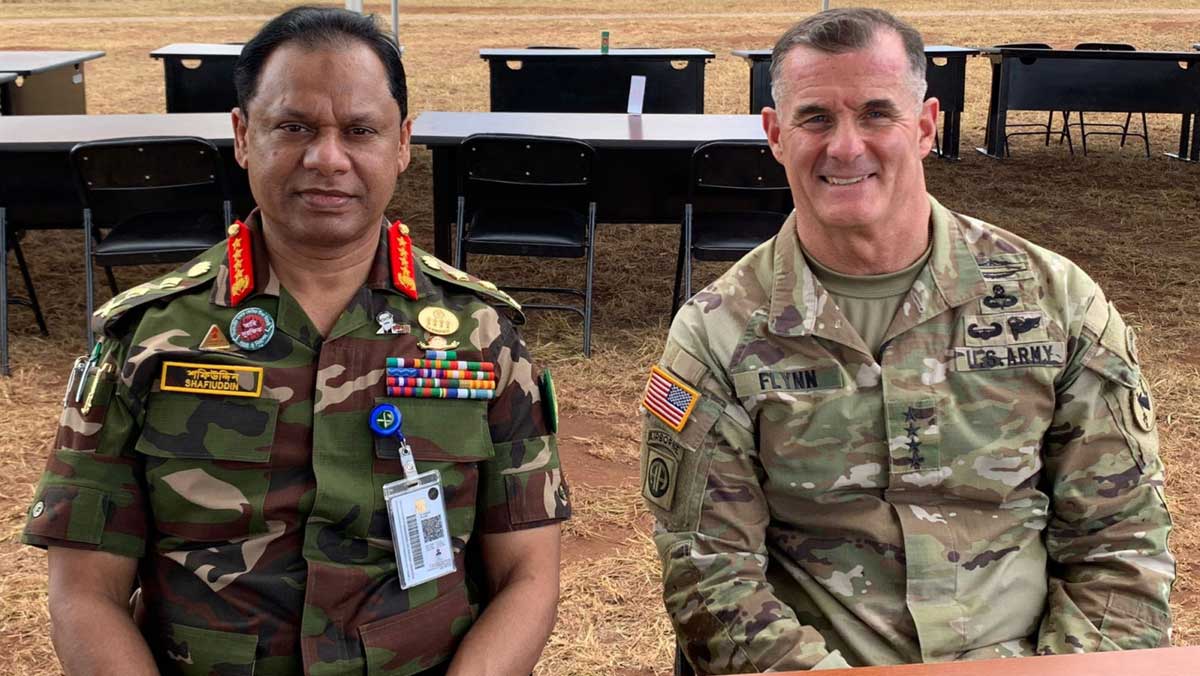
DHAKA, Bangladesh — The United States is intensifying a Bangladesh defense push aimed at steering Dhaka away from Chinese-linked military hardware as Bangladesh weighs talks with Pakistan on JF-17 fighter jets and advances a separate Eurofighter Typhoon track, Feb. 12, 2026. Washington says the effort is part of a wider strategy to counter Beijing’s growing influence in South Asia as Bangladesh heads into a pivotal political period and procurement decisions that could lock in suppliers for decades.
In an interview with Reuters, U.S. Ambassador Brent T. Christensen said Washington wants to “clearly communicate the risks” of deeper engagement with China while offering U.S. and allied systems as alternatives, according to Reuters’ Feb. 11 report. The comments came as Bangladesh weighed competing procurement pathways — including potential JF-17 purchases discussed in Pakistan and ongoing talks related to Eurofighter Typhoons.
Bangladesh defense choices intersect with U.S.-China competition
The latest Bangladesh defense messaging from Washington is landing amid heightened scrutiny of Dhaka’s external partnerships. Reuters reported that China recently signed a defense agreement with Bangladesh to build a drone factory near the Indian border and that Bangladesh has been in talks with Pakistan about JF-17 Thunder fighter jets, a multirole aircraft jointly developed with China.
U.S. officials have increasingly framed such decisions as more than a shopping list — pointing to lifecycle dependence, training pipelines, spare parts access, cyber and data-security considerations, and diplomatic exposure if systems deepen reliance on Chinese-origin supply chains.
Those arguments appear calibrated for an environment in which Bangladesh defense planners are seeking near-term capability upgrades while also trying to preserve strategic flexibility — a balancing act made harder by regional tensions and the modernization needs of an aging air fleet.
JF-17 talks add urgency to Bangladesh defense calculus
Bangladesh’s JF-17 discussions were highlighted in a separate Reuters report on Pakistan’s push for a defense pact with Bangladesh, including potential JF-17 sales, following talks between the two countries’ air force chiefs in Islamabad. The report described Pakistan’s efforts to expand arms exports and deepen cooperation with Dhaka as bilateral relations warmed after Bangladesh’s 2024 political upheaval. See Reuters’ Jan. 7 coverage.
Aviation industry reporting has also tracked the negotiations and framed them as part of a broader modernization drive. FlightGlobal reported that Bangladesh is discussing a possible JF-17 acquisition with Pakistan as it seeks to replace aging fighters and strengthen air-defense integration; see FlightGlobal’s reporting.
For Bangladesh defense officials, the JF-17 is often discussed in terms of availability, cost, and interoperability with existing inventories that already include Chinese-designed fighters. For Washington, the same aircraft is seen through the lens of Chinese co-development and the long-term implications of support and upgrades.
Eurofighter letter of intent signals a parallel Bangladesh defense track
At the same time, Bangladesh has been moving on a European option. Reuters reported that the Bangladesh Air Force signed a letter of intent with Italy’s Leonardo to procure Eurofighter Typhoon multirole combat aircraft — a preliminary step that, if finalized, would mark Bangladesh’s first major purchase of Western-built fighter jets. See Reuters’ Dec. 10 report.
Defense industry outlets have added detail on the Eurofighter process. Janes reported Bangladesh signed a letter of intent for Eurofighter Typhoons and noted the air force’s interest in the platform dates back years; see Janes’ Dec. 11 report. Aviation Week also described the LOI as a first step toward buying the Typhoon, providing additional context on how the program could develop; see Aviation Week’s coverage.
For Bangladesh defense strategists, the Eurofighter route offers a potential leap in capability and diversified sourcing — but it can also bring higher acquisition and sustainment costs, more complex training transitions, and longer timelines for delivery and infrastructure readiness.
Continuity: Bangladesh defense modernization didn’t start this year
The current fighter debate sits on top of nearly a decade of stop-start planning under Bangladesh’s “Forces Goal 2030” modernization umbrella and earlier tenders for new multirole aircraft. In 2017, Bangladesh’s Directorate General of Defence Purchases issued a tender for eight multirole fighters (with options), an early indicator of the need to replace older platforms; see Alert 5’s March 2017 report.
Analysts have periodically returned to the same question: whether Bangladesh would ultimately move toward a high-end Western fighter such as the Eurofighter or Rafale, or pursue a more affordable alternative aligned with existing supply chains. A Dhaka Tribune analysis in 2021 argued Bangladesh was headed toward a top-tier multirole fighter decision and placed Eurofighter and Rafale at the center of the discussion; see the Dhaka Tribune article.
That same year, aviation-focused reporting highlighted Eurofighter as a plausible contender and tied it to Forces Goal 2030 requirements and procurement planning. See Blog Before Flight’s March 2021 write-up for a snapshot of how the Eurofighter conversation evolved before the 2025 letter of intent.
What comes next for Bangladesh defense procurement
In the near term, Bangladesh defense decisions on fighters are likely to turn on three practical tests: financing and total lifecycle cost; delivery timelines and training conversion; and the political comfort level of tying major combat capability to either Chinese-linked supply chains or Western export controls.
Washington’s pitch suggests it expects the procurement decision to carry strategic weight beyond the air force — shaping how Bangladesh defense relationships develop across drones, air-defense networks, maritime surveillance, and broader security cooperation.
For Dhaka, the challenge is sequencing: whether to keep multiple options alive, pursue a mixed fleet, or commit to a single pathway that best fits budget realities and the operational need to replace aging aircraft while maintaining credible deterrence in a complex neighborhood.


