

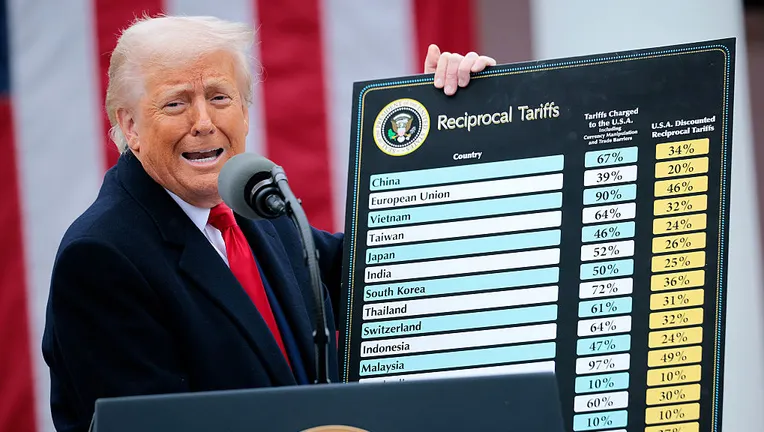
WASHINGTON — The Supreme Court struck down most of President Donald Trump’s sweeping Trump tariffs Friday, curbing his ability to impose global levies by executive order. In a 6-3 decision, the justices said the emergency-powers law Trump relied on does not let a president set import taxes during peacetime without clear congressional authorization, Feb. 20, 2026.
Trump responded within hours by ordering a temporary 10% global levy under a separate trade statute, setting up a new round of legal and economic uncertainty just as businesses and foreign governments were trying to price and negotiate around Trump tariffs. The initial details were outlined by The Associated Press.
The Supreme Court’s opinion in Learning Resources, Inc. v. Trump said the International Emergency Economic Powers Act — a 1977 law better known for sanctions and asset freezes — does not authorize tariffs. In the court’s view, the power to “regulate” imports during a declared national emergency is not the same as the power to tax, and tariff authority sits with Congress.
Trump had invoked IEEPA to justify two major buckets of Trump tariffs. One set, aimed at drug trafficking, imposed a 25% duty on most Canadian and Mexican imports and a 10% duty on most Chinese imports, according to the court’s syllabus. Another set, marketed as “reciprocal” Trump tariffs tied to persistent U.S. trade deficits, applied a duty of at least 10% on imports from all trading partners, with dozens of countries facing higher rates.
Trump called the decision “terrible” and said he was “ashamed” of some justices, arguing the tariffs were essential leverage. A SCOTUSblog case summary noted that the court’s majority also leaned on the “major questions” doctrine to say Congress must speak clearly before handing the executive branch such economically significant power.
What the Supreme Court ruling means for Trump tariffs
The practical impact is large but not total. The Supreme Court decision targeted Trump tariffs imposed under IEEPA — the reciprocal and fentanyl-related duties — while leaving other Trump tariffs intact if they rest on different laws.
In a statement responding to the decision, U.S. Trade Representative Jamieson Greer said the administration will maintain tariffs imposed under Section 232 national security authority and Section 301 unfair-trade authorities. The statement said existing Section 301 tariffs on China range from 7.5% to 100% and existing sectoral Section 232 tariffs range from 10% to 50%, and said those measures cover about 30% of U.S. imports.
The court also sidestepped one of the biggest near-term questions: refunds. The Supreme Court did not spell out whether importers are entitled to recover money already paid under the struck-down Trump tariffs, a gap the dissent warned could spark years of litigation.
Trump tariffs replaced by a temporary 10% global levy
Trump’s response was fast. He moved to replace the invalidated Trump tariffs with a 10% duty on imports from all trading partners for 150 days, using Section 122 of the Trade Act of 1974, according to a Reuters report on the new order. The new duty is set to start Tuesday and run for 150 days, and it relies on a rarely used authority that has limited modern courtroom testing.
The White House maintained exemptions that had already been carved out in the IEEPA program, including aerospace products; passenger cars and some light trucks; goods from Mexico and Canada that comply with the U.S.-Mexico-Canada Agreement; pharmaceuticals; and certain critical minerals and agricultural products, Reuters reported.
Section 122 allows tariffs of up to 15% for up to 150 days to address “large and serious” balance-of-payments problems, but Congress must authorize any extension. That built-in clock means the new Trump tariffs may expire before courts can fully test the policy, even as the administration lays groundwork for longer-lasting duties under other statutes.
Greer said the administration also plans to open new Section 301 investigations covering “most major trading partners” and issues ranging from industrial overcapacity and forced labor to pharmaceutical pricing and digital services taxes. If those investigations conclude that partners’ practices burden U.S. commerce, tariffs are among the tools available — and the White House has signaled it intends to keep Trump tariffs at the center of its negotiating strategy.
A long-running tariff playbook, with new legal limits
The Supreme Court rebuke lands in the middle of a longer U.S. debate over presidential latitude on trade — and in the middle of Trump’s long-stated focus on tariffs.
During Trump’s first term, the administration leaned heavily on Section 232 to impose tariffs on steel and aluminum on national security grounds, an approach the Commerce Department still describes in its Section 232 steel and aluminum overview. It also used Section 301 to escalate tariffs on China after an intellectual property investigation; in September 2018, USTR announced an additional tariff list covering about $200 billion in Chinese imports, initially at 10%.
Trump’s new 10% global levy also echoes an older precedent outside the Trump era. In 1971, President Richard Nixon announced a 10% import surcharge as part of a package aimed at addressing balance-of-payments pressures, as described in a Federal Reserve history essay. The politics and economics are different, but the mechanism is familiar: a broad import tax designed to create quick leverage.
What happens next
For companies and consumers, the immediate question is whether Trump tariffs will change prices quickly or simply prolong uncertainty in supply chains and pricing. A new, lower baseline could reduce some costs versus the higher “reciprocal” schedule, but the administration’s plan for additional probes suggests the headline rate could shift again.
For trading partners, the Supreme Court decision reduces one form of leverage but does not end the tariff threat. The administration is signaling that even if IEEPA is off the table, it will pursue Trump tariffs through slower, more procedural statutes — and continue negotiating deals with the threat of higher duties in the background.
And for courts and Congress, the ruling clarifies that emergency powers have limits when they collide with taxation authority. Whether lawmakers choose to tighten, expand or clarify tariff statutes may now decide how durable future Trump tariffs can be.


