

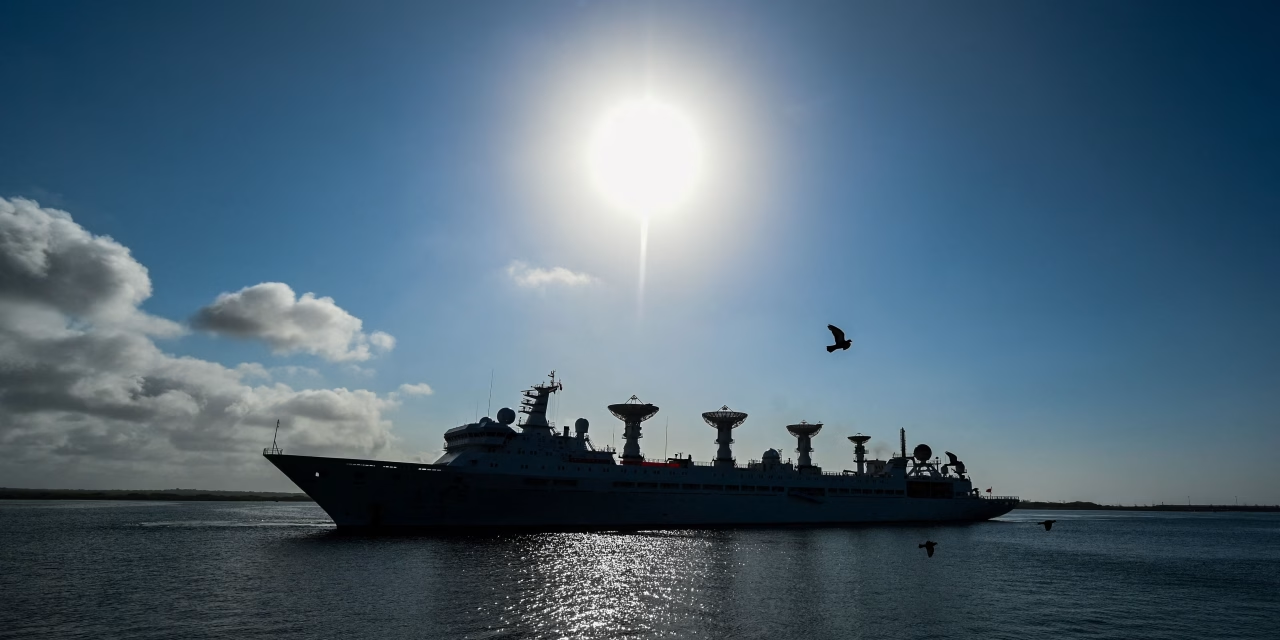
WASHINGTON — China is widening a campaign to map the ocean floor and monitor the undersea environment across the Pacific, Indian and Arctic oceans, a push U.S. officials and naval experts say could sharpen Beijing’s submarine edge in any future conflict with the United States. The effort matters because detailed bathymetric and oceanographic data can improve submarine routing, concealment and sonar performance while also helping place seabed sensors and, potentially, undersea weapons, March 24, 2026.
A Reuters investigation published Tuesday, based on ship-tracking data, Chinese government and university records, and scientific papers, found that research vessels tied to Chinese state institutions have spent years tracing tight survey lines near Taiwan, Guam, Japan, the Philippines, Hawaii, the Arctic and the approaches to the Malacca Strait. The public explanation for many of those voyages is climate research, fisheries work or seabed science. But the same data has obvious military value in waters where U.S. and allied submarines would need to move if an Indo-Pacific crisis escalated into open conflict.
China ocean floor mapping is pushing far beyond China’s near seas
The most striking part of the reporting is not a single ship but the scale and geography of the activity. Chinese survey work is now visible around the First Island Chain, around Guam and other U.S.-linked operating areas, and along Indian Ocean chokepoints that matter both to Chinese trade and to submarine access. At the March 2 U.S.-China Economic and Security Review Commission hearing, U.S. officials and outside specialists framed the undersea contest as central to broader U.S.-China rivalry, not a niche naval issue.
In Rear Adm. Mike Brookes’ written testimony, the commander of the Office of Naval Intelligence said China is building layered surveillance networks and gathering hydrographic data that can “optimize sonar performance” and support persistent submarine surveillance in key waterways. That is the core military significance of seabed mapping: commanders need more than a chart of the bottom. They need a working picture of depth, temperature, salinity, currents and acoustic conditions to know where a submarine can hide, where it is easiest to hear, and where fixed sensors are most effective.
Why China ocean floor mapping matters for submarine warfare
Submarine warfare rewards familiarity with the environment. A well-mapped seafloor can help a navy navigate more safely, exploit underwater terrain for cover and understand how sound behaves in different layers of water. In Michael Horowitz’s testimony to the same commission, he said China wants to use unmanned underwater systems for “persistent surveillance and seabed mapping” while tying those tools to a wider push for seabed sensors and autonomous systems. That fits with Beijing’s civil-military fusion model, where civilian research and military capability development reinforce each other.
Just as important, the campaign appears designed to solve a Chinese weakness as much as build a Chinese strength. Chinese officers and outside analysts have long worried that U.S. undersea surveillance makes it harder for the PLA Navy to leave port undetected and break through the First Island Chain. Better bathymetry, better ocean data and denser sensor networks would not erase that problem overnight, but they could reduce one of the traditional asymmetries the U.S. Navy has enjoyed underwater.
A campaign years in the making
This week’s story fits a pattern that has been building in plain sight. Reuters reported in 2023 that Washington was reviving its Cold War undersea surveillance network as Beijing pursued its own seabed sensor ambitions. In early 2024, CSIS warned that Chinese research operations in the Indian Ocean had clear military value for submarine operations, especially as Beijing tried to extend undersea reach beyond its home waters. And a July 2025 Taipei Times report described Chinese vessels repeatedly scanning east of Taiwan and around Guam, reinforcing the idea that Beijing had already begun mapping routes and approaches that would matter in a future fight.
None of that proves Beijing has chosen a conflict date or a final undersea doctrine. It does show, however, that China is investing steadily in the environmental intelligence, sensor placement and dual-use research infrastructure that would matter most if a confrontation with the United States moved below the surface. For Washington and its allies, the warning is not simply that China is building more submarines. It is that Beijing is working to know the underwater battlespace far better than it once did — and perhaps well enough to make parts of it much less forgiving for U.S. boats.


