

Valentino Fall 2026 turns Rome into a thesis statement
The return to Rome gave the collection a weight that went beyond location. Michele presented Valentino Fall 2026 at Palazzo Barberini, where the setting framed the clothes as a conversation between order and disruption. As Vogue’s runway review noted, the show closed with a full-length red dress cut with a dramatic V at the back, a look that read as both tribute and release.
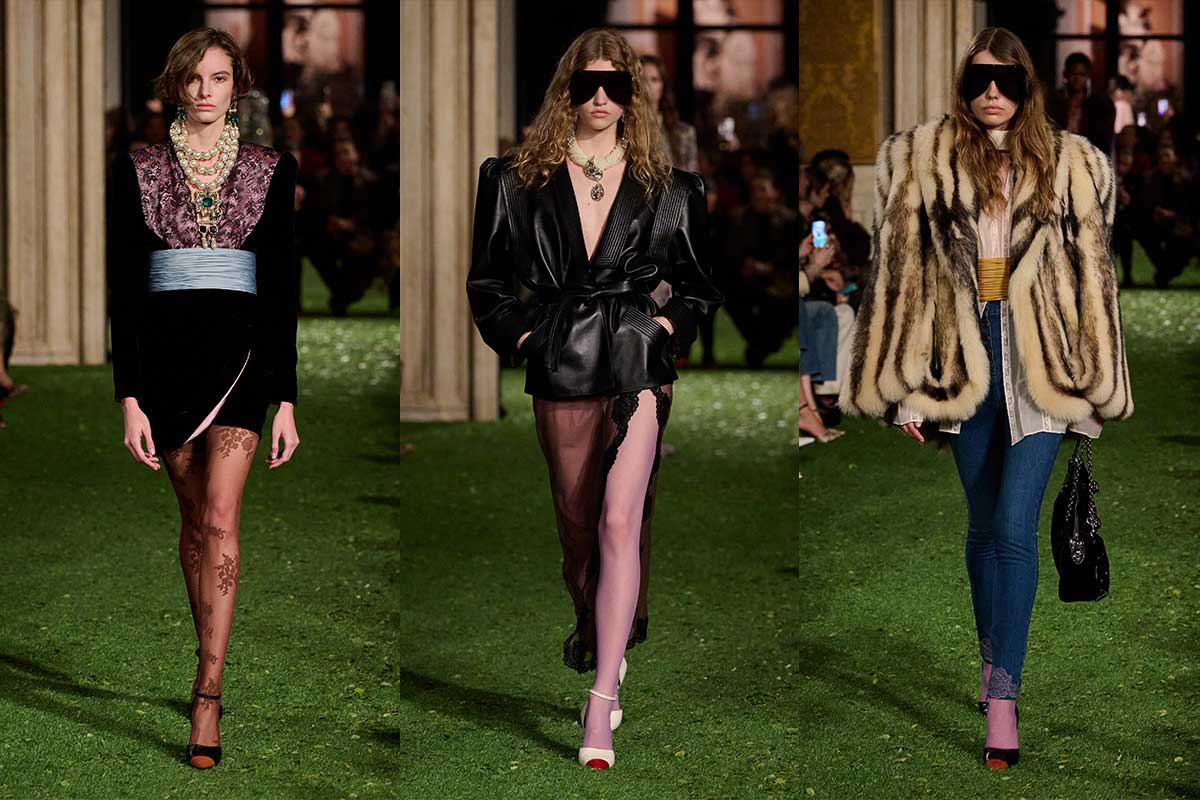
The finale mattered because red remains Valentino’s most recognizable emotional code. Michele did not flood the collection with it. Instead, he held it back, letting the color arrive as a concentrated punctuation mark after a lineup built from contrast: strict shoulders and soft draping, lace and leather, satin sashes and structured coats, transparency and opacity.
That tension was the point. Harper’s Bazaar’s report from Rome described Michele’s “Interferenze” as a study in opposites, with the designer drawing from 1980s energy while speaking to a more unsettled present. The result was not nostalgia for its own sake. It was a proposal for how Valentino can use glamour when glamour has to carry memory, grief and renewal at once.
A homecoming shaped by legacy
The show came two months after Garavani’s death, making the Roman staging feel especially deliberate. The house was founded in 1960 by Garavani and Giancarlo Giammetti, a point reinforced in Valentino’s own history, and its creative identity has long been tied to Rome even as its runway calendar often pointed to Paris.
Guests also underscored the continuity. South China Morning Post’s Style coverage reported a front row that included Gwyneth Paltrow, Colman Domingo, Lily Allen, Tyla and Jeff Satur, while noting that the show marked the maison’s first official return to the founder’s hometown since his death in January 2026.
Michele’s Valentino is increasingly built on the idea that a heritage house does not survive by preserving codes untouched. It survives by disturbing them carefully. That is why “Interferenze” felt like an apt title: The collection allowed the designer’s own ornate, archaeological eye to brush against Garavani’s ideals of beauty, ceremony and feminine authority.
Why the red finale worked
The power of the final red dress came from restraint. Valentino red can easily dominate a collection, but here it functioned as a closing argument. After jewel tones, black, mint, lilac, plush textures, oversized jewelry and Rockstud heels, the red finale clarified the story rather than simply repeating a brand signature.
L’Officiel Singapore’s review framed the show around memory, discipline and creative freedom meeting on the body. That description captures why the finale landed: It was not just a red dress. It was a disciplined symbol placed at the end of a restless collection.
Older context makes the Rome return feel earned
Valentino has used Rome as a stage before. In 2015, the house brought its “Mirabilia Romae” couture vision to the city, and Vogue’s account of that Roman moment emphasized the maison’s deep connection to the eternal city and its Piazza Mignanelli home. Fall 2026 belongs to that same lineage, but Michele’s version is less postcard romance than charged dialogue.
The color story also builds on recent Valentino history. Pierpaolo Piccioli’s Fall 2022 Pink PP collection proved that the house could turn one saturated shade into a cultural event without relying on red. Michele’s Fall 2026 finale reverses that strategy: Rather than immerse the runway in one color, he lets red return as a sharp emotional signal.
The leadership shift adds another layer. When AP reported Michele’s appointment in 2024, Valentino described the move as a new journey for the house’s heritage and couture codes. Two years later, that journey looks less like a clean break than a complex negotiation between Michele’s maximalism and Valentino’s long-held belief in beauty as power.
The verdict
Valentino Fall 2026 succeeded because it understood the assignment emotionally as well as aesthetically. The show honored Rome without turning the city into a backdrop, honored Garavani without freezing the house in reverence, and honored red without letting the color do all the work.
Michele’s “Interferenze” may not quiet debates about how much of his vision should enter Valentino’s codes. It probably intensifies them. But in Rome, that interference felt productive: a bold, polished and deeply symbolic homecoming that ended exactly where Valentino needed it to end — in red.


