

Chernobyl Shield Severely Damaged in Drone Attack, IAEA Says; Urgent Repairs Urged but Radiation Levels Unchanged KYIV, Ukraine — The structure that shields the world from radioactive material at the site of the Chernobyl nuclear disaster has been severely damaged by a drone strike in February to such an extent that it can no longer fully contain radiation, the U.N. nuclear watchdog said Monday, warning that urgent repairs are needed even as radiation levels remain stable.
Mon Dec. 7 2025 Chernobyl shield punched in February drone strike
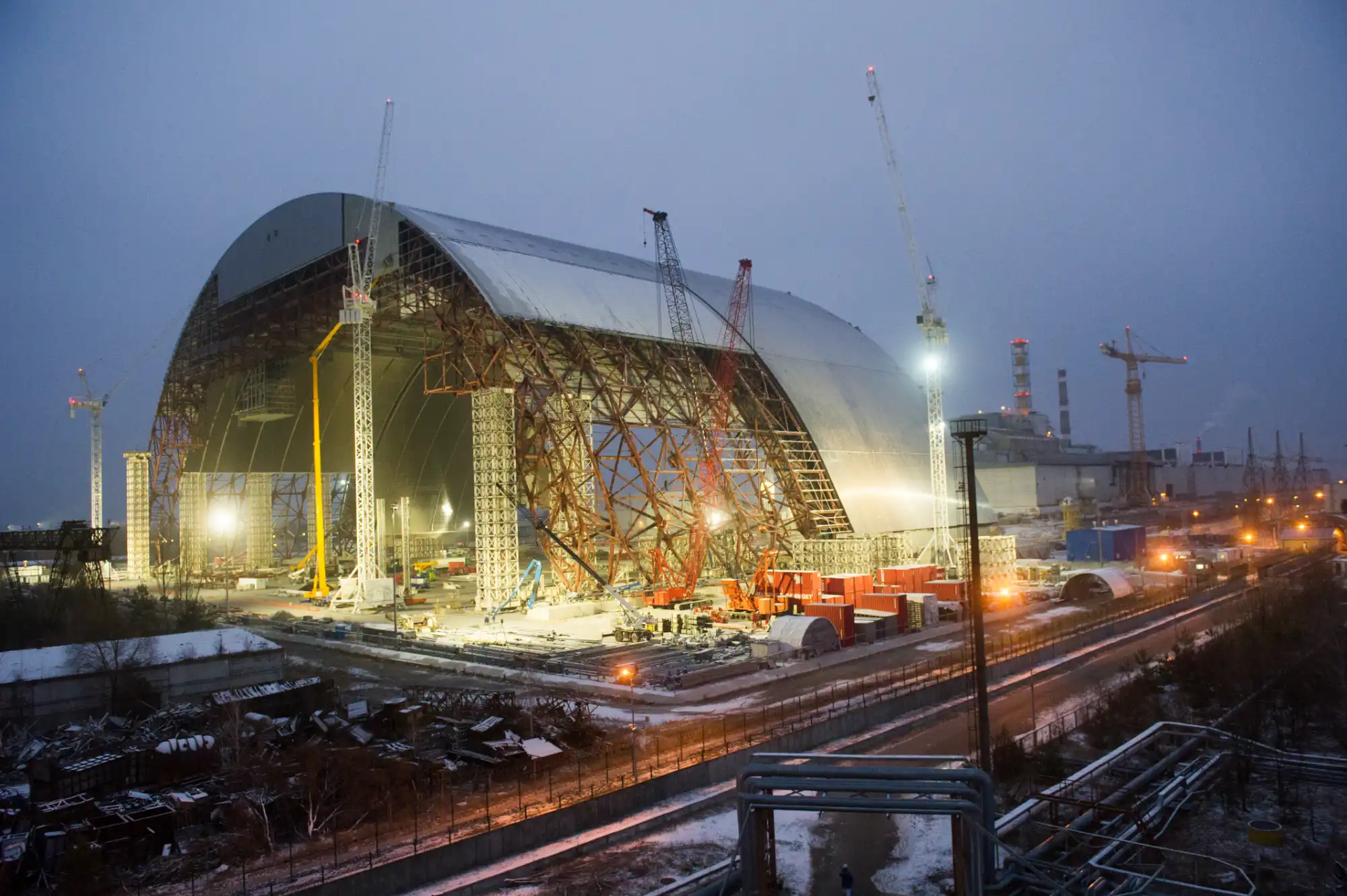
The New Safe Confinement — the giant steel arch that encases Chernobyl’s destroyed Reactor 4 — has “lost its primary safety functions” after a high-explosive drone punctured a hole in its roof and led to a fire inside layers of insulation above the reactor complex, inspectors from the International Atomic Energy Agency (IAEA) have concluded.
Both outer and inner cladding panels were penetrated in the Feb. 14 strike, which took out equipment near the gantry crane hall, but the core of the innermost containment barrier, as well as the original concrete sarcophagus structure, has yet to be breached.
The teams of IAEA inspectors who visited the site over the past few days determined that the arch must now be strengthened due to its inability for long-term confinement, meaning that it no longer can perform the central task of confinement, even though both the load-bearing structure and monitoring systems are functioning properly.
The agency tacked the Chernobyl assessment onto its larger timeline — added to online imagery of Ukraine — tracing nuclear-safety missions across the country, in a stark reminder of how that front line of the war now cuts through vital nuclear infrastructure.
Chernobyl is still safe for now despite a shrinking safety margin on radiation. The loss of the capability to fully confine the nuclear material does not necessarily risk any significant release of radiation, but certain parameters have changed, and it is a “tough situation”, Rafael Grossi, director general of the IAEA, told reporters.
Ukrainian officials also said no elevation in background radiation levels had been observed since the strike and blamed Russia for the attack; Moscow denies that it targeted the site. Engineers have done some emergency patching, but the I.A.E.A. has cautioned that more significant refinishing is needed “in the near term” to seal the damaged roof, restore fire protection, and prevent weather from corroding exposed structural elements.
The European Bank for Reconstruction and Development, which was among the original arch’s funders, has said it is poised to back a new repair program that could get underway in 2026 on secure conditions. The 36,000-ton steel arch and everything you’d like to know about the Chernobyl plant technical profile) It was built to withstand epic weather events and to protect against radioactive debris for approximately 100 years. It was not, however, designed to withstand the sort of direct military strikes involving explosive-filled drones from which it has now proved so tragically vulnerable.
Chernobyl in wartime: from shield to target.
The damage to Chernobyl’s shield adds a new chapter to the conflict, one that has repeatedly tested Europe’s nuclear safety system. When the arch was slid into position atop Reactor 4 in 2016, as Reuters reported on the project, it was described as a structure meant to block radiation for at least a century and to allow for the cleanup of excess waste.
However, Russian troops did capture the larger Chernobyl zone on the invasion’s first day in 2022 and turned it into a staging area for battlefield operations, which was covered in contemporaneous Reuters dispatches. Consequently, raising the spectre of that occupation as something “very, very dangerous,” IAEA chief Rafael Grossi called it, and subsequently, Russian soldiers’ digging trenches in contaminated soil near the plant was reported by Al Jazeera in 2022 to have caused a short-term spike in radiation levels.
Today’s alarm over the Chernobyl shelter coincides with increasing pressure on other nuclear sites in Ukraine. Europe’s largest nuclear power plant, the Zaporizhzhia facility, has been shelled multiple times, interrupted by drones and experienced complete losses of off-site power — all events described as “very alarming” by both the IAEA and U.N. Security Council. Experts at the World Nuclear Association say every additional strike on energy and waste facilities only reduces the safety margins built into Ukraine’s nuclear system.
What happens next for Chernobyl
In a report first detailed in the Guardian’s coverage of the IAEA findings, Grossi said there was no immediate public health risk but that the world “cannot afford complacency” at a location indelibly associated with nuclear disaster.
Ukrainian officials are now working with international partners to craft a repair plan that can be conducted during wartime conditions — one that may include temporary shielding, specialised robots and long shutdowns of work whenever air-raid sirens go off.
For the present, it is a shield with cracks: Chernobyl’s remains are a warning as much as they are a wall, a reminder that even decommissioned nuclear sites can be targets, and that their shield depends not only on engineering but on choices made far from the exclusion zone. How quickly the damaged arch can be repaired before a fresh strike tests it again will help determine for how long Chernobyl will remain safely entombed — and how close Europe comes to re-enacting its worst nuclear nightmare.


