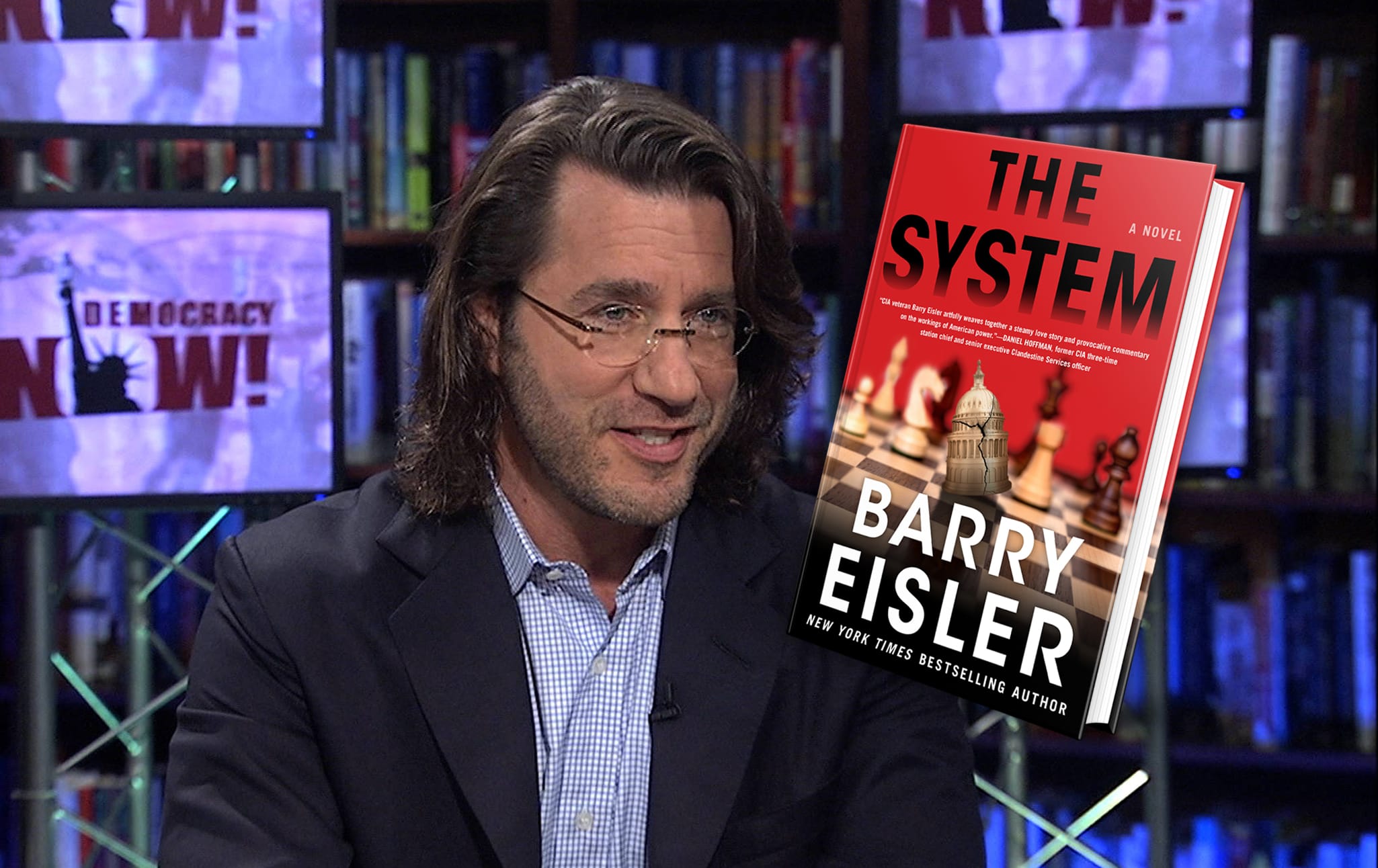
SAN FRANCISCO — Barry Eisler, a former CIA operative, is taking aim at Washington’s corridors of power in his 19th novel, The System, released June 6, 2025, according to a newsletter post announcing the launch. He uses a fast-moving story about an idealistic first-term lawmaker and a fugitive hacker to argue that propaganda and political theater can make escalation feel inevitable, Dec. 16, 2025.
Although Eisler’s book is fiction, it is built around recognizable institutions and incentives: the way ambition gets rewarded, the way euphemisms soften violence, and the way “winning” inside a system can quietly change what a person believes is acceptable. The book is billed as a “novel of the deep state,” but its central question is more human than conspiratorial: What happens to a politician’s ideals once real power starts setting the terms?
Barry Eisler’s ‘The System’ puts a rookie politician under pressure
At the center of the novel is Valeria Velez, a young candidate who flips a House seat in California’s 27th District and arrives in Washington promising to push back on what she and her team see as a war economy. In Eisler’s official synopsis, her first months in office collide with an existential threat: a fugitive hacker uncovers a secret Pentagon program that combines artificial intelligence with nuclear command-and-control, forcing Velez to choose between ideals and survival.
Eisler frames Velez’s rise as both a political test and a character study. The novel’s tension isn’t simply “good vs. bad,” but the pressure exerted by powerful blocs — the Pentagon, Wall Street and Silicon Valley — and the rationalizations people build as they accept compromise after compromise. In The System, getting access can mean surrendering the language you once used to criticize the machine.
Supporters have positioned the book as something beyond escapist fiction. Retired U.S. Army Col. Andrew Bacevich calls it “smart, stylish, and riveting,” while journalist Lee Fang describes it as “a searing, frighteningly prescient indictment” of Washington power games and the modern national security state.
Propaganda isn’t a subplot — it’s the operating system
Eisler has been direct about what he wants readers to see behind the plot. In an interview with Current Affairs, he said, “That is exactly what I’m trying to do,” describing the book’s core aim as showing “how power is really exercised in America.” He also argued that Americans are “heavily propagandized,” especially into believing that partisan conflict represents the deepest struggle over policy.
In The System, that argument becomes narrative fuel. Bureaucratic labels sanitize violence. Messaging turns budget fights into morality plays. And the loudest political battles can function as cover for quieter alignments — the ones that decide whether the U.S. escalates, retreats or drifts into the next crisis.
The novel’s sharpest point isn’t that propaganda exists, but that it can be comforting. It offers a script. It offers heroes and villains. It offers permission. And in Eisler’s telling, that permission is often the last step before policies that would otherwise be unthinkable start to feel “responsible.”
AI and nuclear command and control: fiction with real-world echoes
The book’s most urgent plot device — AI entwined with nuclear command-and-control — lands in the middle of a real policy debate about modernization, resilience and risk. A Congressional Research Service primer on nuclear command, control and communications notes that lawmakers have raised concerns about autonomous systems and the need to keep a “human in the loop” for actions critical to nuclear employment.
Eisler converts those abstract concerns into immediate stakes. If speed becomes the governing value — faster warnings, faster targeting, faster decisions — then the book asks who benefits and who pays when systems fail, misread signals or lock leaders into a narrowing set of options. The anxiety is familiar, even when the characters and scenarios are invented: technology can reduce uncertainty, but it can also compress deliberation.
A long-running theme: institutions that reward the wrong behavior
The System fits into a career-long pattern: Eisler interrogating what organizations reward, what they punish and what they quietly normalize. He has done it in espionage fiction, in political thrillers, and even in the publishing world. In 2011, The Guardian chronicled his decision to walk away from a reported $500,000 traditional publishing deal, a move that became a landmark moment in the rise of independent and hybrid publishing.
Later that year, an NPR interview carried by KERA News captured his blunt view of the marketplace: “Publishing for me is a business, not an ideology.” In The System, that pragmatism becomes a political dilemma. If politics is treated as “just business,” what gets traded first — and what gets traded last?
And long before artificial intelligence became a common headline in national security debates, Eisler was talking publicly about surveillance, prediction and the way governments shape what the public believes is normal. In a 2016 Democracy Now! interview, he described writing “reality-based” fiction about the security state and the rhetoric used to justify its expansion. The System extends that critique into Congress, focusing on how elected officials can end up defending the very dynamics they entered office to fight.
Why the book is resonating beyond thriller fans
Even by Eisler’s standards, The System signals its research openly, using endnotes and an explicit paper trail to show where the fiction is drawing from real-world reporting and analysis. That approach helps explain why the book’s blurbers and boosters include not just thriller writers but journalists and foreign-policy skeptics who spend their careers watching Washington’s incentives up close.
In a long conversation with entrepreneur and podcaster Guy Kawasaki, Eisler said Valeria Velez was “inspired by” Rep. Alexandria Ocasio-Cortez, D-N.Y., but differs quickly in background and trajectory, and he described the novel as an exploration of “the way power affects the ideals” of people who enter the system. The full transcript of Kawasaki’s “Remarkable People” interview reads like a behind-the-scenes guide to Eisler’s method: build fictional characters, then place them inside constraints that feel uncomfortably real.
Whether readers treat The System as a thriller, a civics lesson or a warning label, the book’s argument is hard to miss: power rarely announces itself in clear sentences. It arrives as a process, an incentive and a story people learn to tell themselves — until the story becomes the justification.