

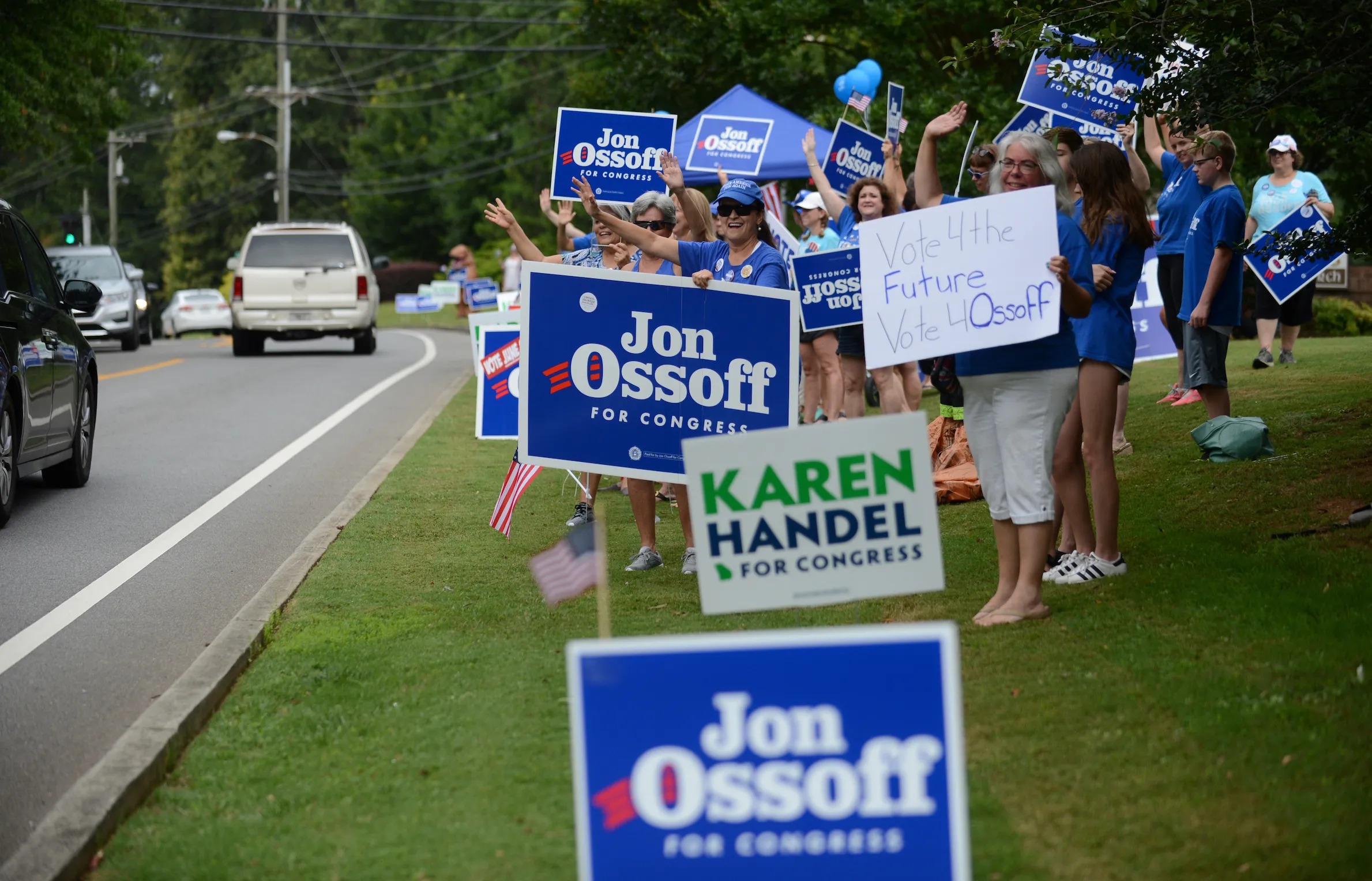
DALTON, Ga. — Republicans in northwest Georgia begin casting ballots Feb. 16 in a Georgia special election scheduled for March 10 to fill the vacant 14th Congressional District seat left open by former U.S. Rep. Marjorie Taylor Greene’s resignation. Instead of uniting behind President Donald Trump’s endorsed candidate, the race has become a MAGA-versus-MAGA scramble that is testing how much sway Trump still holds inside the movement he built, Feb. 14, 2026.
State officials have set the Georgia special election as an all-candidate contest — every contender appears on the same ballot regardless of party — with an April 7 runoff if no one wins a majority. Key deadlines, including the voter registration cutoff and the start of advance in-person voting, are spelled out in Secretary of State Brad Raffensperger’s call for the District 14 election.
Greene, a national MAGA figure since her 2020 election, resigned Jan. 5 after a public rupture with Trump and GOP leaders. The district remains one of the most Republican-leaning seats in the state, but the sheer size of the field has created an opening for Democrats to watch closely: split Republican votes could shape who advances, and whether Trump’s political brand still acts as a unifying force.
The dynamic has drawn national attention and highlighted how “MAGA” is being redefined in real time, as described in Reuters’ reporting on the MAGA-versus-MAGA fight.
Georgia special election becomes a MAGA-on-MAGA battleground
Trump endorsed Air National Guard Lt. Col. Clay Fuller, the former district attorney for the Lookout Mountain Judicial Circuit, early this month — a move that in earlier cycles often cleared the field. This time, it didn’t. More than a dozen Republicans are still running, including hard-right figures and self-styled insurgents who say they back Trump but question the circle advising him.
At a candidate forum in Kennesaw, voter John Burdette summed up a message heard repeatedly in interviews: “I’m a Trump supporter … but he doesn’t live in this district.” Another Republican voter, Charles Stoker, put it even more bluntly: “President Trump has been getting bad advice.” The remarks capture the tension at the heart of the Georgia special election: loyalty to Trump remains the baseline, but local voters and activists increasingly want to decide what “America First” looks like at home.
Former state Sen. Colton Moore is leaning into that posture, calling himself “Trump’s #1 Defender” and running under the slogan “GOD. GUNS. TRUMP.” He has also built an identity around fighting Georgia’s Republican establishment — a message that resonates with activists who view party leadership in Atlanta as too cautious.
Trump’s endorsement, and the limits of “complete and total”
Trump’s endorsement of Fuller arrived through a Truth Social post that praised the prosecutor’s record and touted “PEACE THROUGH STRENGTH.” CBS News Atlanta’s coverage of Trump’s backing reported that Trump said Fuller had his “Complete and Total Endorsement” and that Fuller responded with a promise not to let the district down.
Still, the endorsement has landed in a landscape Greene helped create: a district where candidates are competing not just on ideology but on combativeness, social-media messaging and willingness to attack perceived enemies. Fuller has tried to thread that needle. “I’m my own man,” he told Reuters, adding that he didn’t think voters wanted Greene’s “style again.”
Another contender, Meg Strickland, is one of the few self-described moderates in the race, urging Republicans to lower the temperature and return to small-government themes. “I don’t think that Trump is a true conservative,” Strickland told Reuters — a notable statement in a district Trump carried with 68% of the vote in 2024.
What the ballot math means in the Georgia special election
The mechanics matter. Because the contest is a “blanket” special election, the Georgia special election could produce a runoff that looks unusual for a deep-red seat: the top two finishers might be two Republicans, but a single Democrat could also advance if the GOP vote is carved up among multiple contenders.
Ballotpedia, which is tracking the contest and candidate filings, has counted 21 candidates: 16 Republicans, three Democrats, one Libertarian and one independent. The outlet’s overview of the field and runoff rules is laid out in Ballotpedia’s roundup of who is running.
Even among Republicans, polling has suggested a volatile race. A late-January Quantus Insights survey of registered Republicans, conducted before Trump’s endorsement, showed Moore and Fuller in the low teens, with more than a third of respondents undecided.
Democrats are realistic about the odds of winning the seat outright. But they see the Georgia special election as a chance to measure whether the GOP’s internal fight is leaving voters cold — and whether turnout drops enough to change the shape of the runoff. U.S. Army Brig. Gen. (ret.) Shawn Harris, a cattle farmer who has said he has about $1.2 million on hand, is aiming to court disaffected Republican voters with a message centered on lowering costs and expanding access to affordable health care.
Voters brace for a long 2026 calendar
The March 10 vote is only one step. The winner of the Georgia special election will serve out the remainder of Greene’s term through January 2027, but many candidates are also positioning for the regular election cycle that continues through the spring, summer and fall.
Atlanta News First has outlined the crowded timeline facing voters — including the likelihood of an April runoff and additional contests later in the year — in its explainer on what comes next for the race to replace Greene.
How this Georgia special election fits Georgia’s long pattern of testing Trumpism
Georgia has repeatedly served as a pressure gauge for Trump-era politics. In 2017, a high-profile special election in the Atlanta suburbs was framed nationally as a referendum on the new Trump presidency and whether Republican unity would hold, as noted in The Atlantic’s analysis of that year’s Georgia special election fight.
Four years later, the state again became a national focal point when Democrats won both U.S. Senate seats in January 2021, flipping control of the chamber and underscoring how turnout, factionalism and Trump’s role could remake the political map — a moment recapped in Time’s coverage of the Georgia Senate runoffs.
And in 2022, Trump’s influence met clear limits in Georgia’s Republican primaries when Gov. Brian Kemp defeated a Trump-backed challenger for the GOP nomination — an episode that Reuters detailed in its report on Kemp’s win over a Trump-endorsed rival.
Those contests didn’t predict every turn of Georgia politics, but they offer a through line: Trump remains a gravitational force, yet his endorsements and his style can cut in different directions — energizing a base while also splintering it. The Georgia special election in the 14th District is the latest, and perhaps clearest, example of that contradiction.
What to watch when results come in
Three indicators will shape the post-election narrative. First is whether Trump’s endorsed candidate finishes first March 10 — and by how much. Second is whether a Democrat makes the runoff, signaling that GOP vote-splitting was severe. Third is what kind of Republican advances: a candidate selling pure confrontation, or one arguing the district has had enough chaos after Greene.
Either way, the Georgia special election is offering Republicans and Democrats an early look at how the MAGA label is evolving now that it has spread beyond a single candidate and into a broader identity contest. For Trump, the question is not just who wins the seat, but whether his endorsement still ends arguments — or merely starts new ones.


