

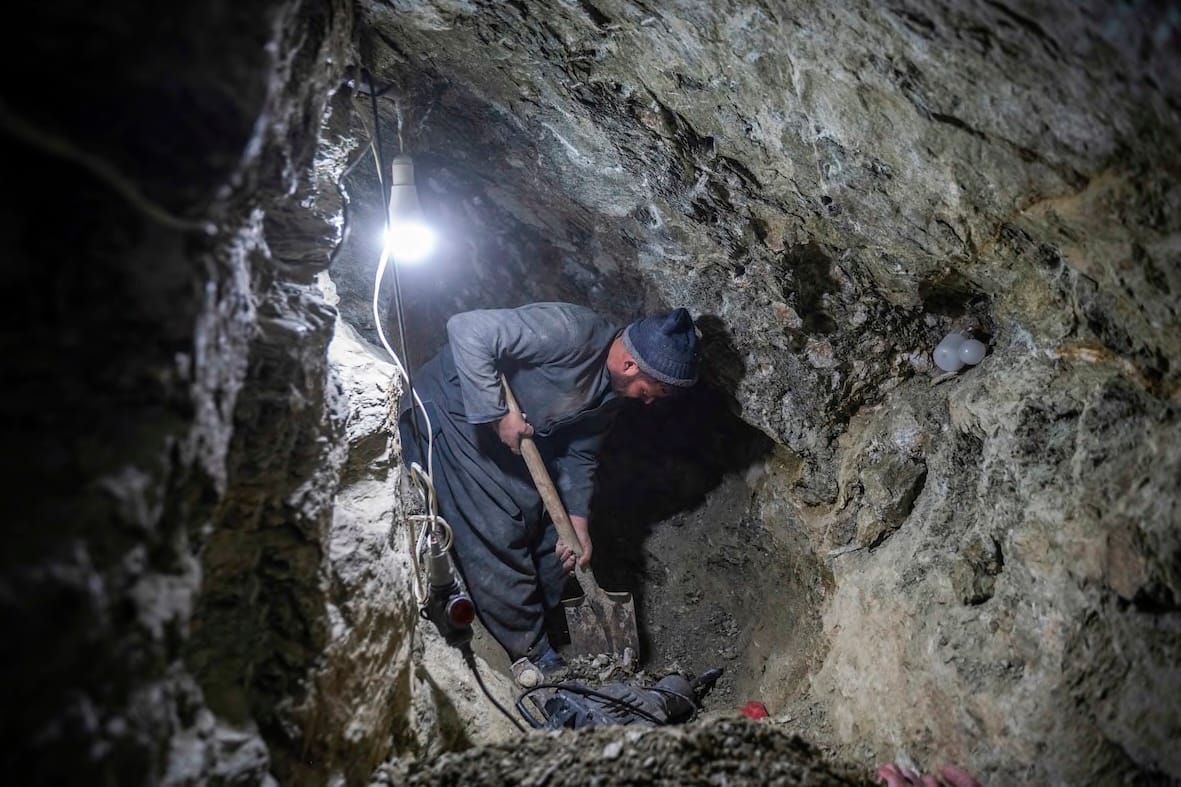
KUNAR PROVINCE, Afghanistan — Villagers in this mountainous eastern province are panning for gold along the Kunar River and on nearby slopes as they search for cash income. The practice has become a fallback because regular work is scarce and even small finds can help families cover food and household costs, April 18, 2026.
Recent AFP reporting published by Al Jazeera described hundreds of men digging dry stretches of riverbed near Kharwalu and chipping away at nearby hillsides in Ghaziabad before hauling sacks of stone to sieves and washing them with river water. Local officials told AFP the practice has continued in Kunar for more than a decade and now involves thousands of people using traditional methods. Officials also said authorities have curbed excavator use after local complaints about damage to the river and surrounding mountains.
The work is simple and punishing. Men dig, carry, sift, wash and repeat, hoping a week of labor will leave a few specks in the pan. One father of eight told AFP there are “not many job opportunities in the country,” while another worker said a lucky week can bring “about 1gm of gold,” or roughly $125. Those returns are modest, but in communities where cash income can disappear for weeks, they are enough to keep people coming back to the river.
Afghanistan gold panning grows as regular work disappears
The appeal of gold panning in Kunar is not only the promise of a payout. The barrier to entry is far lower than in most formal jobs or licensed mining projects, which helps explain why the river has become a labor market of last resort.
That pressure is visible well beyond Kunar. The World Bank said in December 2025 that Afghanistan’s GDP was projected to grow 4.3% in 2025 after 2.5% in 2024, yet rapid population growth was still expected to push GDP per capita down by 4%. A country can post headline growth and still leave households feeling poorer, especially in remote provinces where stable wage jobs remain rare.
A 2025 UNDP socio-economic review reached a similar conclusion, saying Afghanistan’s economy had returned to growth but that subsistence insecurity worsened in 2024, reversing some of the gains made in 2023. That helps explain why families in Kunar are not waiting for a formal recovery to reach them. They are trying to pull income from the river and the mountains now.
The national backdrop is harsher still. Reuters reported in January that 17.4 million people in Afghanistan were projected to face acute food insecurity in 2026, while millions of returnees from Iran and Pakistan were adding to pressure on jobs, rents and public services. In that environment, even a risky, exhausting week of panning can look more dependable than waiting for construction, transport or day labor to reopen.
Afghanistan gold panning fits a longer mining story
Kunar’s current rush for gold is not appearing in a vacuum. In 2021, Reuters outlined Afghanistan’s untapped mineral wealth, noting that the country holds deposits of copper, gold, iron ore, rare earths and other resources that have long been promoted as a possible engine for economic recovery.
That promise kept resurfacing. In 2023, The Associated Press reported that Taliban authorities said they had signed seven mining contracts worth $6.5 billion, arguing the deals would create jobs and improve the economy. For many villagers in Kunar, however, that larger investment story still feels distant. The money they can actually reach is the money they can sift from mud and stone with their own hands.
The dangers have also been part of the story for years. In 2019, Reuters reported that at least 30 miners were killed in a gold tunnel collapse in Badakhshan, a reminder that poverty-driven extraction can turn deadly when safety rules, modern equipment and oversight are missing. That history gives Kunar’s current gold panning boom a harder edge: it is a livelihood, but it is also a sign of how thin other options have become.
For now, villagers appear willing to accept the uncertainty. The pans often come up nearly empty, the stones are heavy, and the earnings can vanish with a bad week or a bad stretch of river. Yet the work persists because it offers something the wider economy often does not: immediate cash, however small, earned close to home.
That is why Afghanistan’s gold panners matter beyond the riverbank. Their labor highlights a central gap in the country’s recovery: mineral wealth may be abundant, but stable jobs are not. Until broader employment reaches places like Kunar, gold panning is likely to remain less an exception than a fallback.


