

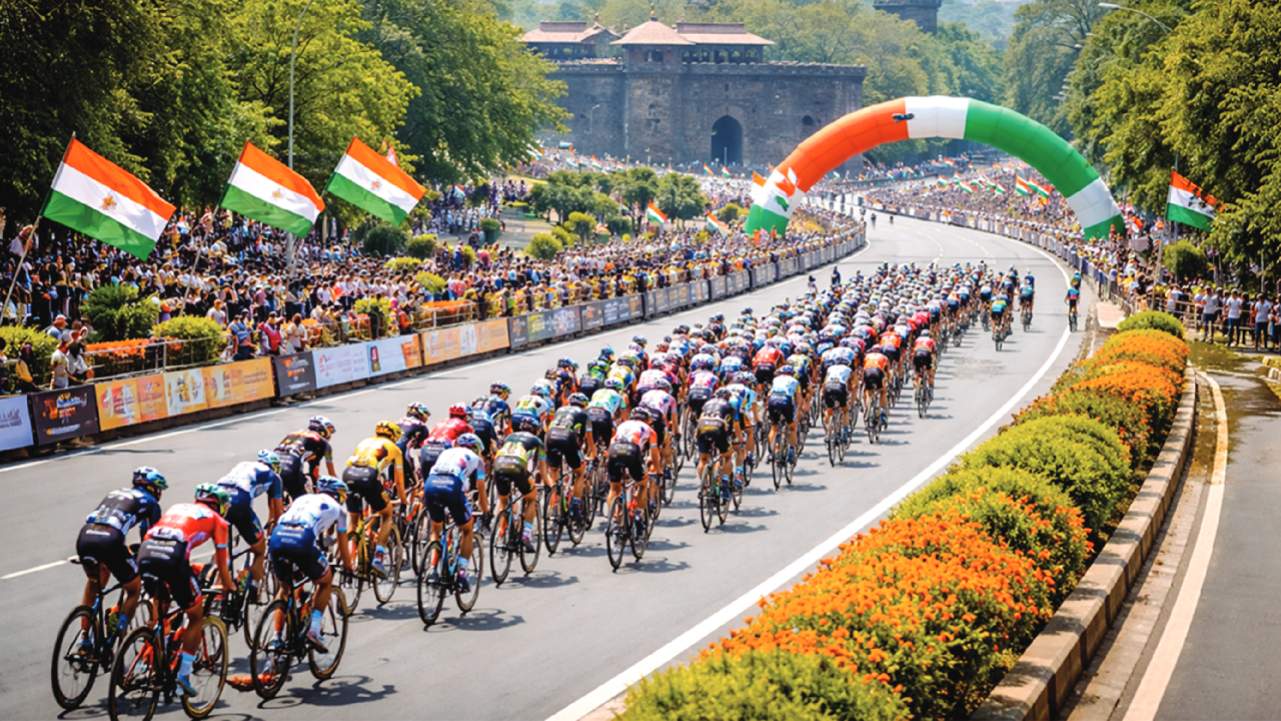
PUNE, India — The Pune Grand Tour, India’s first Union Cycliste Internationale (UCI) Class 2.2 men’s stage race, finished its inaugural run Jan. 23 after five days of racing across Pune district and drawing 29 teams and 171 riders from 35 countries. Organizers and cycling officials say the event’s UCI points and the public-works sprint behind it are meant to accelerate a long-term medal strategy as India positions itself to host the 2036 Olympics, Jan. 26, 2026.
The race is listed on the UCI’s official competition calendar as a 2.2 event, an entry-level international classification in road cycling’s stage-race ladder. It is also a practical test: can India deliver safe closures, consistent road surfaces and race-week logistics at a standard that visiting teams will trust?
Pune Grand Tour puts UCI points on home roads
For Indian riders, the Pune Grand Tour removes a barrier that has shaped careers for years: the cost of finding UCI competition abroad. “Older men always wish they were younger,” veteran rider Naveen John said in a Reuters report before the start, describing the race as the “biggest opportunity” he has seen for an Indian road cyclist.
John said the value goes beyond points. Completing a stage race against international fields provides a résumé line — a result that coaches and team directors can verify — when young riders seek contracts or development placements outside India.
A demanding first run, built for growth
Cyclingnews reported that the Pune Grand Tour opened with an about 8-kilometer prologue time trial in Pune and then moved through four road stages ranging roughly from 87 to 134 kilometers. The outlet said organizers repaved more than 500 kilometers of roads and enlisted more than 3,000 volunteers, reflecting how much coordination the first edition required.
Local planners, meanwhile, treated the race as a hard deadline for long-delayed maintenance. The Indian Express reported that the 437-kilometer course was prepared in a matter of months, including resurfacing and removing speed breakers along parts of the route to meet international specifications.
The Pune Grand Tour’s arrival also fits a longer arc. India previously hosted UCI-sanctioned one-day races — including the Tour of Mumbai in 2010 — and staged the multi-city Tour de India in 2013, which organizers said was added to the UCI calendar. The gap that followed left Indian riders with fewer international starts and limited exposure to professional tactics, making the Pune Grand Tour’s return to the calendar significant beyond a single season.
Now, cycling is being pitched as part of a broader high-performance build. A Business Standard report this month described plans under discussion for a multiyear sports infrastructure push — from training centers to sports science and talent identification — as India prepares for the 2030 Commonwealth Games and pursues a 2036 Olympic bid.
Whether the Pune Grand Tour becomes a medal-making engine will depend less on a single week of racing than on what follows: a reliable domestic calendar, stronger youth development, credible anti-doping controls and roads that are safer for daily riding as well as elite competition.


