

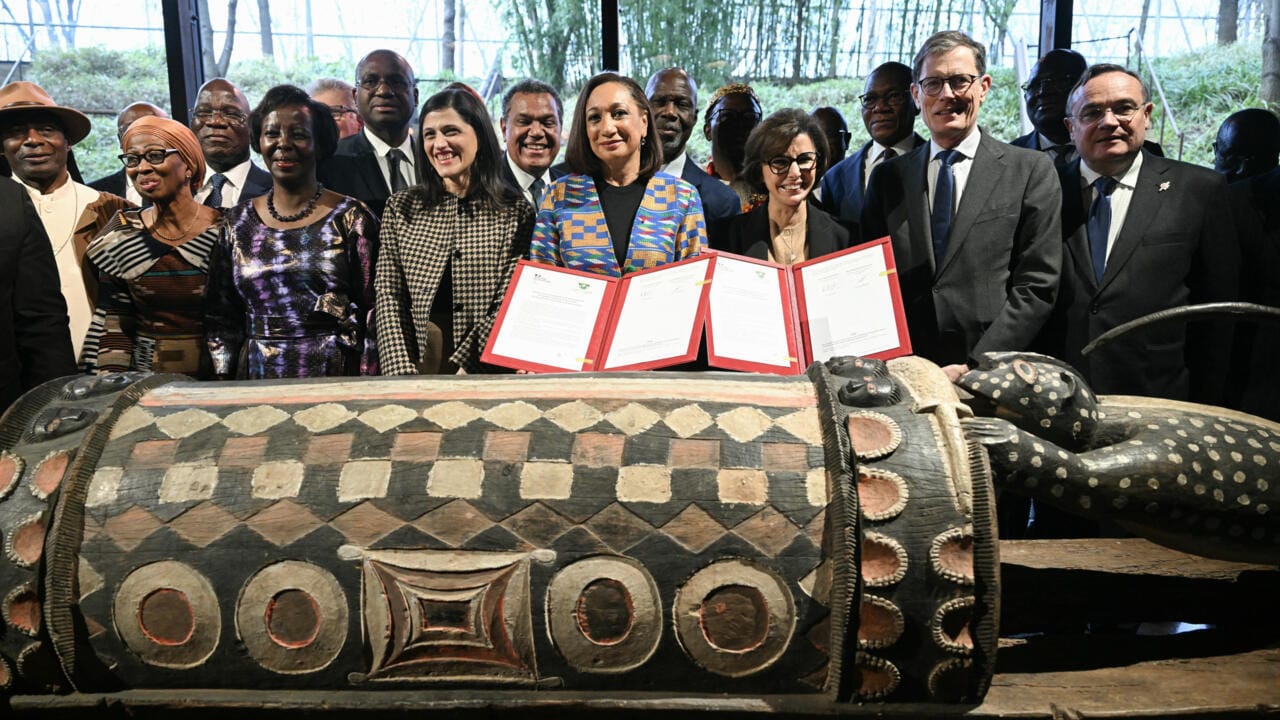
ABIDJAN, Côte d’Ivoire — France has returned the Djidji Ayokwe talking drum to Côte d’Ivoire, the first artifact Paris has formally restituted to the West African country and a sacred Atchan object taken by French colonial authorities in 1916. The handover closes a yearslong diplomatic and legal campaign around an instrument that came to symbolize both colonial-era dispossession and the broader push to return looted African heritage, March 13, 2026.
France completed the legal transfer in Paris on Feb. 20, according to a French Culture Ministry statement, after a July 2025 law removed the drum from France’s national collections. The Djidji Ayokwe arrived in Abidjan on March 13, where Reuters reported that traditional chiefs, dancers and government officials welcomed its return as a moment of justice and remembrance.
Far more than a musical instrument, the Djidji Ayokwe was a communication system and part of ritual life for the Atchan people of the Abidjan region. In a March 2026 UNESCO brief, the agency said the slit drum, carved from iroko wood and measuring about 3.30 meters long and nearly 430 kilograms, was used to send ritual messages and warn villagers during forced recruitment and military conscription.
The Associated Press reported that Atchan chiefs performed rites in Paris before the drum traveled home and that it is expected to spend about a month acclimatizing before it goes on display at the Musée des Civilisations de Côte d’Ivoire in Abidjan. That matters because the object is being restored not just to a museum, but to the cultural landscape from which it was removed more than a century ago.
Why the Djidji Ayokwe talking drum matters
Colonial authorities did not treat the drum as a neutral artifact. They saw it as a way for communities to transmit warnings, rally people and organize beyond colonial control. Its return therefore restores more than a work of craftsmanship. Symbolically, it returns a voice that colonial rule tried to silence.
The Djidji Ayokwe is also a precedent. Côte d’Ivoire has said it wants 148 objects returned from France, making the drum’s restitution a starting point rather than an endpoint. That turns this handover into both a cultural victory and a test case for what future restitutions could look like when provenance research, diplomacy and law finally align.
The long road home
This was not a sudden gesture. The path back can be traced through years of public diplomacy and museum work, including a 2022 visit by Côte d’Ivoire’s culture minister to the Musée du quai Branly-Jacques Chirac, a 2024 UNESCO update marking the launch of the restitution process after Paris and Abidjan signed a deposit agreement, and a July 2025 report on the French parliamentary vote that cleared the final legislative hurdle.
That timeline helps explain why the return is being treated as more than a museum transfer. Côte d’Ivoire formally requested the drum in 2019, President Emmanuel Macron backed the restitution at the Africa-France summit in October 2021, and French lawmakers eventually passed a specific law in July 2025 to make the transfer possible. What arrived in Abidjan this month was the result of diplomatic pressure, conservation work and years of negotiations rather than a single political announcement.
What happens next
UNESCO has pledged $100,000 to support staff training, research and interpretive materials around the drum’s display in Abidjan, and Ivorian officials have said the museum will use the return to deepen public understanding of the object’s place in the country’s history. The goal is not simply to show the drum again, but to reframe it as a living part of national memory rather than a colonial trophy.
For France, the restitution is a milestone in a slow, closely watched process of returning African cultural property. For Côte d’Ivoire, it is a rare reversal of a colonial seizure that remained embedded in a European public collection for generations. For the Atchan community, the meaning is simpler: the Djidji Ayokwe is back where it belongs.


