

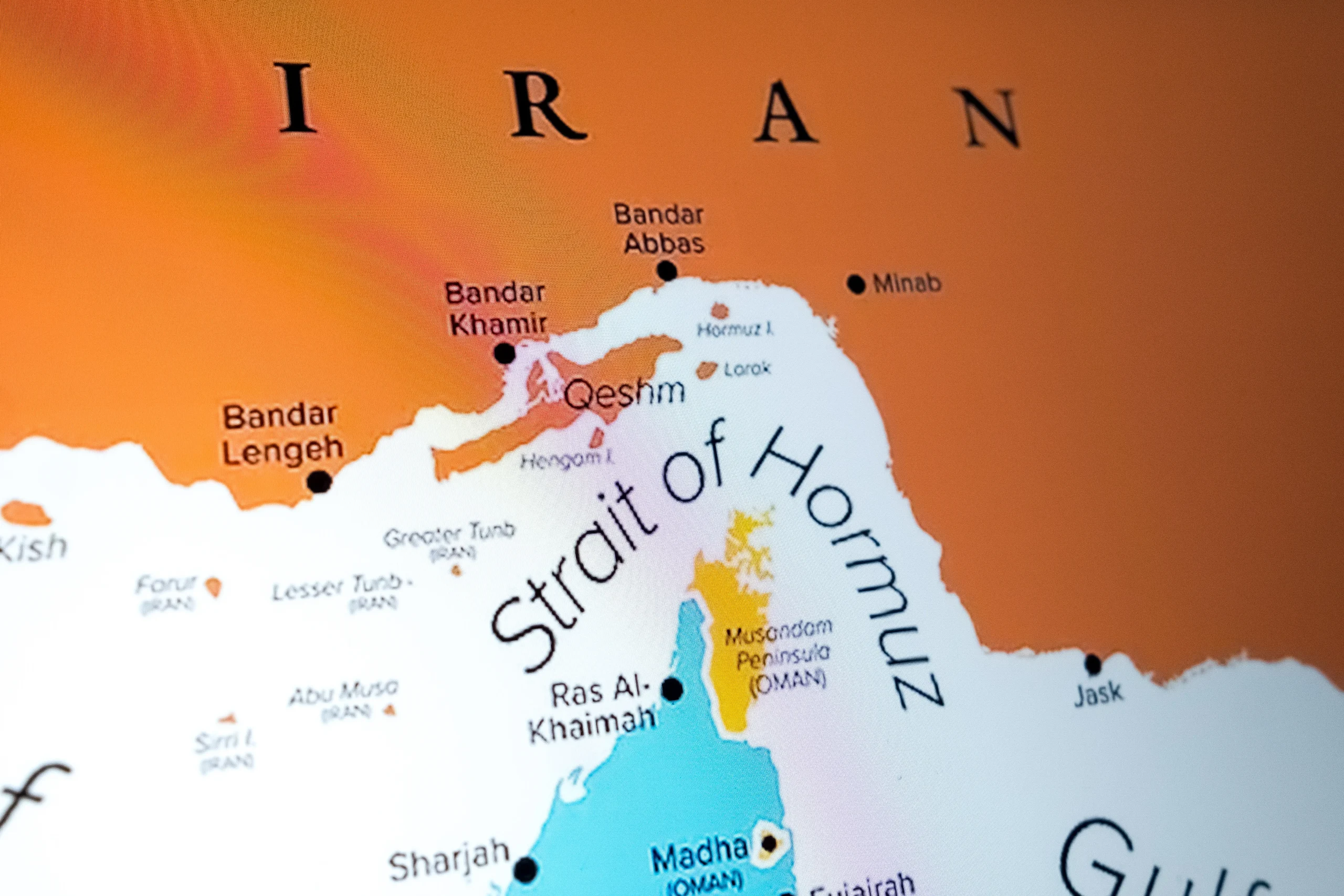
The latest escalation followed Iran’s warning that ships would face tighter controls as long as Iranian maritime traffic remains blocked. The Associated Press reported that Iranian parliamentary Speaker Mohammed Bagher Qalibaf linked the waterway’s reopening to Washington lifting its naval blockade, saying, “If the U.S. does not lift the blockade, traffic in the Strait of Hormuz will definitely be restricted.”
The maritime threat moved from warning to action Saturday when the United Kingdom Maritime Trade Operations agency received a report that a tanker had been fired upon by two gunboats linked to Iran’s Islamic Revolutionary Guard Corps about 20 nautical miles northeast of Oman. Reuters reported that the tanker and crew were safe, while a separate container ship in the area was hit by an unknown projectile that damaged containers but caused no immediate casualties.
Why the Strait of Hormuz matters to global energy
The Strait of Hormuz is a narrow but critical chokepoint between Iran and Oman, connecting the Persian Gulf with the Gulf of Oman and the Arabian Sea. The International Energy Agency says nearly 20 million barrels per day of oil moved through the Strait of Hormuz in 2025, including nearly 15 million barrels per day of crude oil, or about 34% of global crude oil trade.
Those flows matter most to Asia. China and India together received 44% of crude exports that passed through the waterway in 2025, while Japan and South Korea also remained heavily reliant on the route. Europe receives a smaller share of crude through the strait, but global pricing means any disruption is quickly felt far beyond the Gulf.
The United States has framed its blockade as a targeted measure against Iranian ports, not a closure of the international waterway. U.S. Central Command said the blockade began April 13 and applies to maritime traffic entering or exiting Iranian ports, while adding that U.S. forces would not impede vessels transiting the Strait of Hormuz to and from non-Iranian ports.
Iran, however, has cast the U.S. action as a direct threat to its trade and sovereignty. That gap between the U.S. description of a port-focused blockade and Iran’s response in the strait is driving the confrontation into its most dangerous phase.
Strait of Hormuz crisis sends fuel and shipping risks higher
Energy markets were already strained before the latest tanker incidents. The U.S. Energy Information Administration said in its April forecast that limited Strait of Hormuz oil flows pushed Gulf producers to shut in 7.5 million barrels per day of crude production in March, with shut-ins expected to rise to 9.1 million barrels per day in April. The agency forecast Brent crude would peak at $115 per barrel in the second quarter before easing if disruptions fade.
The EIA also projected U.S. retail gasoline prices would peak near a monthly average of $4.30 per gallon in April, while diesel would peak above $5.80 per gallon. Those figures underline how a naval standoff in one waterway can ripple through trucking, aviation, manufacturing and household budgets.
Liquefied natural gas is also exposed. Qatar, one of the world’s largest LNG exporters, depends on the route to reach Asian and European buyers. The EIA said reduced LNG flows through the Strait of Hormuz have tightened global supply and widened the gap between U.S. natural gas prices and import prices in Europe and Asia.
Older Strait of Hormuz flashpoints show continuity
The current crisis is not an isolated event. U.S.-Iran naval confrontations in the Gulf have a long history, including Operation Praying Mantis in 1988, when the U.S. Navy struck Iranian targets after USS Samuel B. Roberts hit a mine during the Iran-Iraq War’s tanker conflict.
Commercial shipping scares surged again in 2019, when two tankers were attacked near the strategic waterway and the United States blamed Iran, according to AP reporting from the time on tanker attacks near the Strait of Hormuz. Weeks later, tensions escalated further when Iran seized the British-flagged Stena Impero, a confrontation Reuters reported as part of a widening dispute over tanker detentions and Gulf shipping security.
Those earlier incidents help explain why governments, insurers and energy traders react sharply to even limited gunfire or warnings in the strait. Each episode reinforces the same vulnerability: a narrow maritime route can become a global economic pressure point when military forces, commercial ships and political ultimatums converge.
What could happen next in the Strait of Hormuz
The immediate risk is miscalculation. A warning shot, an intercepted radio call, a damaged container ship or a mistaken identification of a vessel could trigger a wider exchange between U.S. and Iranian forces. That danger is heightened because commercial tankers cannot easily reroute around the Strait of Hormuz without losing access to much of the Gulf’s export capacity.
Alternative routes exist but are limited. Saudi Arabia and the United Arab Emirates have pipeline options that bypass the strait, yet those routes cannot replace all crude, refined fuel and LNG flows moving from Gulf terminals. Even a partial shutdown can tighten inventories, increase freight and insurance costs, and force refiners to seek replacement barrels from farther away.
Diplomacy remains the clearest off-ramp. Any temporary arrangement would likely need to address two linked demands: Washington’s insistence that Iranian port traffic remain restricted until broader security terms are met, and Tehran’s insistence that Iranian vessels cannot be blocked while other ships continue moving through the strait.
Until that gap narrows, the Strait of Hormuz crisis will remain both a military flashpoint and an energy shock. The longer the blockade showdown lasts, the greater the chance that a regional confrontation becomes a deeper global supply crisis.


