

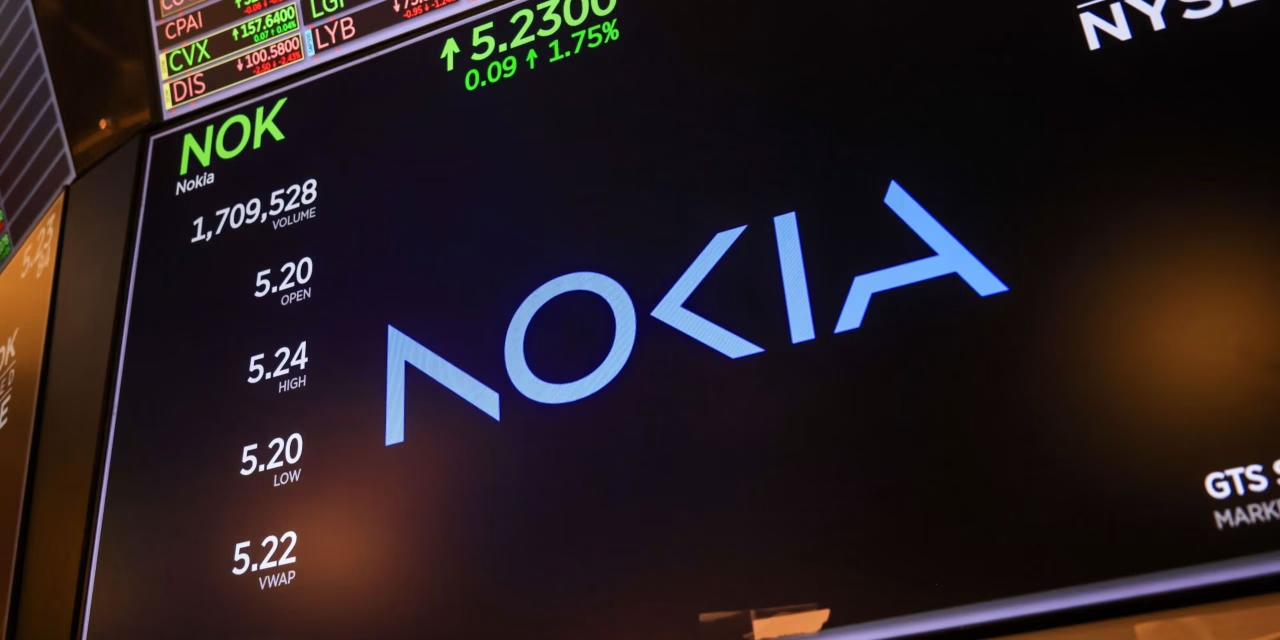
ESPOO, Finland — Nokia topped first-quarter 2026 profit estimates Thursday as AI and cloud demand lifted optical network sales, margins and order growth. The better-than-expected quarter reflected stronger hyperscaler spending, 1 billion euros in AI and cloud orders and continued momentum in IP and Optical Networks, April 23, 2026.
According to Nokia’s interim report for Q1 2026, reported net sales rose 2% to 4.497 billion euros, while comparable operating profit climbed 54% to 281 million euros and comparable operating margin improved to 6.2% from 4.2% a year earlier. In the full earnings release, the company also said free cash flow was 629 million euros and net cash and interest-bearing financial investments reached 3.788 billion euros.
What Nokia Q1 2026 results showed
Reuters reported that Nokia’s comparable operating profit beat the 250 million euro analyst consensus, while quarterly sales were broadly in line with expectations. The report also said the earnings beat pushed Nokia shares to their highest level since 2010 in early Helsinki trading.
Management’s presentation slides showed AI and cloud revenue rose 49% year over year and accounted for 8% of group sales in the quarter. Nokia also booked 1 billion euros of AI and cloud orders and raised its view of the addressable AI and cloud market to a 27% compound annual growth rate for 2025 through 2028, up from the 16% growth assumption it outlined in November.
“We are increasing our growth assumption for Optical and IP Networks and we are investing to capture accelerating demand from AI & Cloud customers,” CEO Justin Hotard said.
The quarter was especially strong in Network Infrastructure, where Optical Networks revenue rose 20% on a comparable basis and supported a higher full-year growth view. Nokia kept its full-year comparable operating profit outlook unchanged at 2.0 billion euros to 2.5 billion euros, but said it now expects Network Infrastructure net sales to grow 12% to 14% in 2026 and that the group is tracking somewhat above the midpoint of its profit range.
Why Nokia Q1 2026 results matter
The results suggest Nokia’s pivot away from relying mainly on cyclical telecom spending is gaining traction. Demand from hyperscalers building AI data centers is giving the company a faster-growing pool of customers for optical transport, IP networking and data-center connectivity, while helping offset weaker areas such as Fixed Networks.
That matters because the company is no longer selling only into traditional carrier upgrade cycles. It is increasingly positioned around the bandwidth, latency and power-efficiency requirements of AI infrastructure, a market that could prove structurally larger and less tied to the slower pace of 5G spending.
Nokia Q1 2026 results in longer-term context
Today’s beat did not appear out of nowhere. Nokia was still working through margin pressure a year ago, when a first-quarter 2025 miss was tied to a one-time charge in Mobile Networks and tariff-related uncertainty. It then completed its Infinera acquisition in February 2025 to deepen its optical footprint and expand its reach with hyperscalers, before it laid out an AI supercycle strategy in November 2025 centered on network infrastructure, AI-native connectivity and higher long-term profitability.
Seen in that sequence, the latest quarter looks less like a one-off upside surprise and more like early evidence that Nokia’s AI-and-optical thesis is starting to translate into cleaner execution, better margins and more credible growth. The next question for investors is whether the company can turn strong AI order momentum into several quarters of sustained revenue conversion.


