

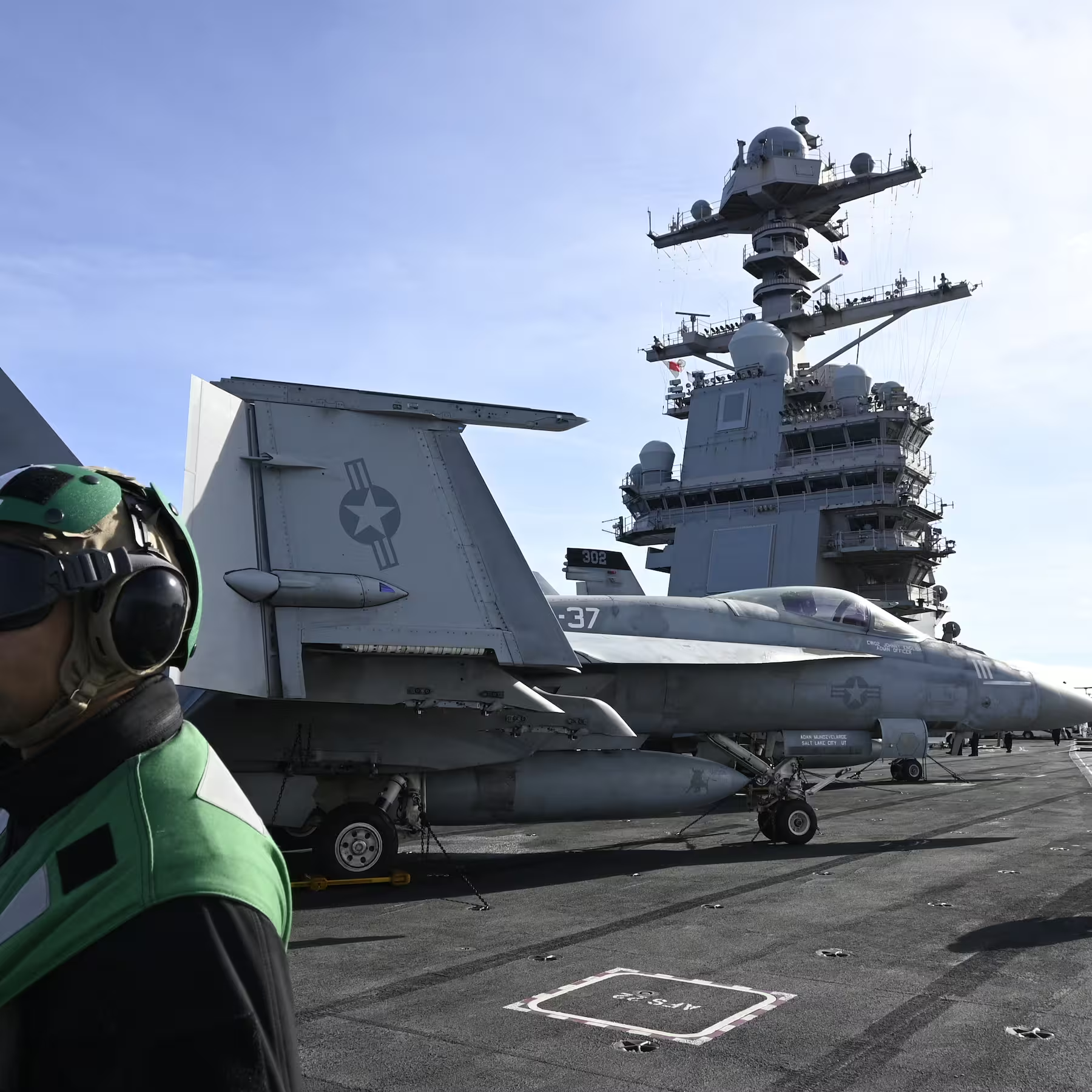
WASHINGTON – A U.S.-Venezuela military standoff escalated further as the USS Gerald R. Ford carrier strike group entered the area of responsibility of U.S. Fourth Fleet while Venezuela announced it would commence a “massive deployment” of forces across the country on November 12, 2025.
U.S.-Venezuela military standoff: What you need to know
The Ford is the first of four Navy destroyers that arrived in the U.S. Southern Command theater on November 11 to assist in counternarcotics missions; a Pentagon spokesperson stated, “additional forces will support and augment” operations to interdict trafficking.
Citing Reuters reporting, it is reported that the deployment follows an existing regional buildup that includes multiple warships, a nuclear submarine, and advanced aircraft—plus at least 19 strikes against suspected drug boats, which left about 76 people dead.
Caracas raised the alarm and ordered a “massive deployment” of its ground, air, naval, and riverine forces, as well as missiles, according to Venezuelan Defense Minister Vladimir Padrino López, involving 200,000 troops and militia.
American officials justify their position as counternarcotics; Venezuela sees it as coercion for regime change. At a CELAC conference, regional governments had called for respect for international law and opposition to the use of force or threats of force.
How far might the U.S.-Venezuela military standoff escalate? Five risk paths
Military signaling: The Ford deters, conducts surveillance, and increases aviation sorties. Professional interactions persist amid tense political messages and newly opened deconfliction channels.
The Ford is there to discourage and surveil. Sorties by naval aviation are on the rise, and professional interactions are increasing. This persists even as political messages chill and deconfliction channels open.
Expanded maritime interdiction.
The U.S. continues or escalates strikes on suspect vessels, causing civilian casualties and raising concerns about the laws of war from legal experts. Further deaths could lead to diplomatic fallout.
Border or air-defense miscalculation.
A radar lock, drone downing, or space dispute leads to a brief back-and-forth. With Venezuela on alert and with its missile forces scattered, an accident is more likely than in the 2018 incident.
Guerrilla and “anarchization” strategy.
The document planning favoured a long-term ‘irregular’ war — which included sabotage and urban disruption, rather than outright conventional conflict — according to Venezuelan sources.
Regional spillover and political rifts.
Diplomacy During CIA-CULAC Attacks: Colombia has restrained its intelligence sharing over the boat strikes, while CELAC leaders march for peace. Broader splits could disrupt interdiction networks and become a nightmare to manage crises.
U.S.-Venezuela military standoff: Capabilities and limitations
U.S. officials say the deployment is designed to disrupt transnational criminal networks. “These forces,” the Pentagon’s chief spokesman said, “improve detection and disruption.” “We are prepared to fight transnational challenges,” U.S. Navy Adm. Alvin Holsey, SOUTHCOM commander, stated.
For Caracas, the U.S.-Venezuela military standoff raises the costs of high mobilization and reveals gaps in maintenance. Calling up the militia and the Plan Independencia 200 projects may cover the gaps, but could overstretch readiness if it continues for too long.
U.S.-Venezuela military standoff de-escalation off-ramps
Hotlines and NOTAM coordination: Conduct real-time air and sea deconfliction to prevent incidents near the coast of Venezuela, as well as in key shipping lanes.
Third-party facilitation: Utilize Brazil, Mexico, CARICOM, and CELAC as guarantors for reciprocity (specifically, transparency in the review of patrol boxes and exercise programs).
Triage transparency: Author an anonymized after-action summary of maritime strikes. Publish the results, in fact, and staunchly deny that you’re escalating.
Graduated postural changes: Link sequential withdrawals or training pauses to objective decreases in hostile rhetoric and unsafe maneuvers.
Election and sanctions channel: Remove political disputes from maritime security discussions to prevent them from being linked, thereby incentivizing brinkmanship.
Bottom line
American-Venezuelan military brinkmanship is a volatile, yet not inevitable, affair. The Ford deployment adds pressure and risk, but it also provides an incentive for diplomacy. Short-term outcomes will depend on whether the tally of interdiction strikes increases and whether both parties agree to structured deconfliction, while regional actors maintain their stance against the use of force.


