

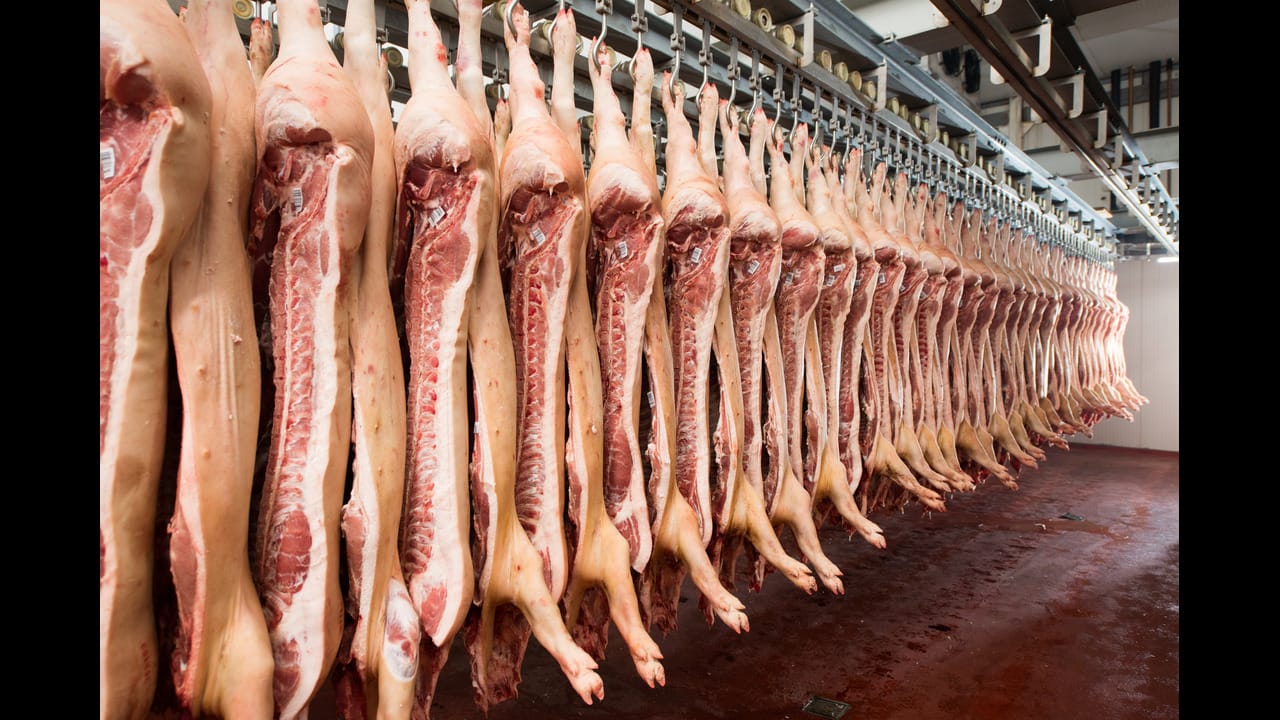
WASHINGTON — The U.S. Department of Agriculture says it will begin rulemaking to make 175-birds-per-minute poultry slaughter line speeds permanent and extend waivers that let certain pork plants run above 1,106 head per hour, March 17, 2025.
USDA framed the changes as a way to cut red tape and help plants meet demand, while unions and other advocates warned that faster production can heighten injury risks and strain inspection systems, particularly when staffing, training and reporting don’t keep pace with throughput.
In its announcement, USDA said FSIS will extend existing waivers, start rulemaking “immediately,” and stop requiring plants to submit what it called “redundant” worker-safety data. The agency said “extensive research” shows no direct link between processing speed and workplace injuries, according to USDA’s March 17, 2025, press release.
The policy push sets up a high-stakes fight over whether USDA should turn what has largely been a waiver-and-trial approach into a permanent national standard — and whether a speed-focused strategy can coexist with credible safeguards for workers and food safety. Reuters reported that chicken plants with waivers have been allowed to run up to 175 birds per minute compared with a prior 140-birds-per-minute limit, and that pork line-speed policy has also swung through multiple administrations and court challenges.
What USDA’s move means for meatpacking line speeds
The numbers at the center of the dispute refer to how fast animals move through key points in slaughter and processing:
Poultry (young chicken): Evisceration line speed is commonly discussed in birds per minute (bpm), with the upper end of the current waiver range at 175 bpm.
Swine: Slaughter line speed is often discussed in head per hour (hph), with 1,106 hph repeatedly referenced as the capped rate that plants return to absent special trial arrangements.
Supporters say standardizing faster speeds would reduce uncertainty for companies that have already reconfigured lines around waiver conditions. Opponents argue that turning waivers into a broader rule could widen exposure to repetitive-motion hazards, accelerate knife work, and make it harder to detect and correct contamination problems when lines are moving faster.
What the government-funded studies found — and what they didn’t
USDA has pointed to two third-party evaluation reports produced under the Poultry and Swine Processing Line Speed Evaluation Study (PULSE) effort.
Poultry: The Poultry Processing Line Speed Evaluation Study (PULSE) report found that workers across the evaluated plants faced high baseline ergonomic risk. Key findings included that 81% of evaluated workers were at increased risk for musculoskeletal disorders, and that the primary risk metric was associated with piece rate (a job-level measure of pace) more than with the broader evisceration line-speed category. The report also found that reported moderate-to-severe work-related pain was not more frequent at establishments with higher evisceration line speeds, and it flagged peracetic acid exposure concerns in a subset of sampled jobs.
Swine: The Swine Processing Line Speed Evaluation Study (PULSE) report similarly found elevated risk across plants and tied risk to workload measures. It reported that 46% of evaluated workers across all establishments were at high risk for musculoskeletal disorders, and that the effect of moving above 1,106 hph varied by establishment — including one plant where higher line speed was associated with a statistically significant increase in risk and another where it was associated with a statistically significant decrease, while four plants showed no statistically significant association.
Taken together, the reports provide data points for both sides: they document widespread risk and pain among workers while also suggesting that the relationship between “headline” line speed and ergonomic risk is mediated by staffing levels, job design, work practices and the piece rate workers actually experience.
The Salmonella rule withdrawal adds to the policy whiplash
In a separate but politically connected move, FSIS withdrew the proposed “Salmonella Framework for Raw Poultry Products,” ending a Biden-era proposal that would have treated certain Salmonella levels and serotypes in specified raw poultry products as adulteration and would have expanded microbial monitoring and reporting requirements. FSIS said it was withdrawing the proposal after reviewing comments and to further assess its approach, according to the April 25, 2025, Federal Register notice.
The timing matters for industry and regulators alike: accelerating or formalizing throughput policies while pulling back a major pathogen-control proposal invites questions about how USDA will define “maintaining food safety standards” in practice — and what enforcement mechanisms will be used to backstop that claim.
Continuity check: this fight over line speeds has been building for years
2018: Federal regulators addressed petitions and waiver policy debates over poultry line-speed limits and process control in a Federal Register notice on poultry line-speed waiver petitions.
2020: Worker-safety concerns around faster poultry speeds were already central to the public debate, including in a Union of Concerned Scientists analysis arguing higher speeds could increase injury risk and reduce the time available for safe work.
2021: A federal court order in the swine line-speed litigation vacated portions of the USDA rule in question as it related to eliminating line-speed limits under the New Swine Inspection System, as shown in the March 31, 2021, decision in Farm Sanctuary v. USDA (D. Minn.).
What to watch next
USDA’s decision to move from waivers to rulemaking puts the debate into a more formal, notice-and-comment process — one that will likely draw heavy participation from industry groups, unions, public-health experts and inspection personnel.
The central question won’t just be whether a higher maximum speed is “safe” in the abstract. It will be whether USDA and FSIS can define enforceable conditions — staffing, training, reporting, ergonomic controls, process-control metrics and inspection verification — that keep pace with faster throughput, while also addressing the food-safety gap left by withdrawing the Salmonella framework.


