ISLAMABAD, Pakistan — Pakistani officials say the Baloch Liberation Army (BLA) has escalated the Balochistan insurgency in Pakistan’s southwestern Balochistan province by deploying women suicide bombers and fielding weapons authorities describe as U.S.-origin, after a wave of attacks in January killed 58 people. Officials and analysts say the tactics are meant to widen recruitment and intensify pressure on the state, even as the origin of some seized weaponry remains difficult to independently confirm, Feb. 11, 2026.
The assessment, detailed in a Reuters report, comes as Pakistan tries to protect strategic infrastructure and mining projects in Balochistan, the country’s largest province by area and one of its poorest. Pakistan has banned the BLA, which the United States also designates as a terrorist organization.
Balochistan insurgency enters a new phase with women suicide bombers
In one image circulated by the BLA that Reuters said it could not independently verify, the group identified a woman and her husband in military-style clothing and framed their joint bombing as a romanticized “final mission,” writing: “They shared a marriage before they shared a final stand.”
Junior interior minister Talal Chaudhry said the use of women is designed to broaden the movement’s appeal. “It gives them popularity and reach, and it impresses on their community that the fight has entered their homes,” he told Reuters. A spokesperson for the BLA did not respond to a Reuters request for comment.
Authorities say at least six women took part in the January assaults, including three suicide bombers, and that more would-be attackers have been arrested in recent months. A December report by Pakistan’s Counter Terrorism Department described women recruits as coming from different socio-economic backgrounds, including some with university education, warning: “The shift represents a dangerous evolution in terrorist tactics,” and citing online radicalization and manipulation.
That warning is echoed in a separate case outside the province: police in Karachi detained a teenage girl authorities say was recruited online for what they described as a “major suicide attack,” and officials said she would be treated as “a victim rather than a suspect,” The Associated Press reported.
U.S.-origin gear, drones and battlefield communications
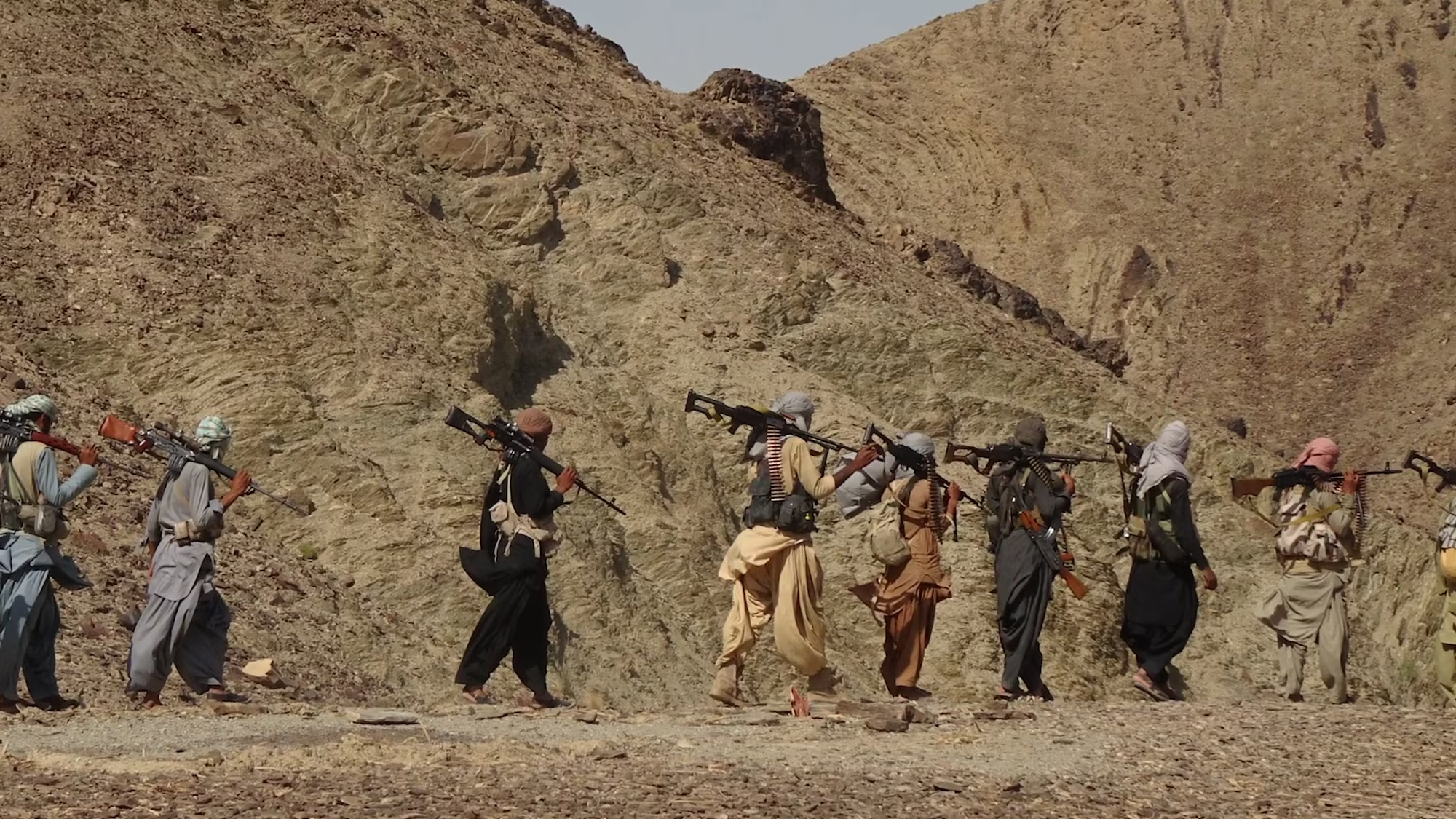
Pakistan’s military says separatist groups have boosted firepower with weapons left in neighboring Afghanistan after the 2021 U.S. withdrawal. In one official tally cited by Reuters, the armed forces reported recovering 272 U.S.-made rifles and 33 night-vision devices by June 2025, in addition to weapons seized after January’s violence.
Security forces also recovered items ranging from grenade launchers to M16- and M4-style rifles after the latest fighting, Reuters reported, while noting it could not verify whether all of the weapons used were made in the United States or sourced elsewhere.
Abdul Basit, a researcher at Nanyang Technological University in Singapore, said the combination of higher-end equipment and better intelligence gathering has changed the tempo of the Balochistan insurgency. “In South Asia today, the BLA is the most organised and lethal insurgent group,” Basit said, pointing to the group’s use of drones and satellite communications.
Balochistan insurgency: January attacks and the security response
During the January assault, militants attacked more than a dozen targets, including public facilities and markets, Pakistani officials said, before security forces launched sweeping operations across the province.
Pakistan’s military said it killed 216 fighters in a weeklong campaign that began Jan. 29 and recovered a “substantial cache” of foreign-origin weapons, ammunition and explosives, while also reporting civilian and security-force deaths. Balochistan Chief Minister Sarfraz Bugti said, “These attacks cannot weaken our resolve against terrorism,” Al Jazeera reported.
For residents and businesses, the surge has heightened uncertainty in a region that hosts major mining projects and strategic infrastructure, including the Chinese-backed development of Gwadar port. Officials say the intensified Balochistan insurgency is raising the stakes for planned investment — and for the protection of foreign workers and local communities.
Balochistan insurgency’s longer arc
The Balochistan insurgency has simmered for decades, with separatists demanding greater autonomy and a larger share of the province’s natural resources.
Women bombers are still rare in Pakistan, but they are not new to the Balochistan insurgency. A suspected female suicide bomber killed three Chinese teachers and a Pakistani driver in Karachi after an explosion near the Confucius Institute at the University of Karachi, April 26, 2022, Reuters reported at the time.
The BLA has also demonstrated an ability to stage complex, mass-casualty operations. In March 2025, the group said it had seized a passenger train in Balochistan, claiming hostages included security personnel and that hundreds of passengers were on board, The Guardian reported.
Pakistani officials say they are pressing social media platforms to remove militant propaganda and recruitment content, while analysts warn that each tactical shift in the Balochistan insurgency is likely to be met with new countermeasures — and a continued risk of attacks that spill beyond the province.