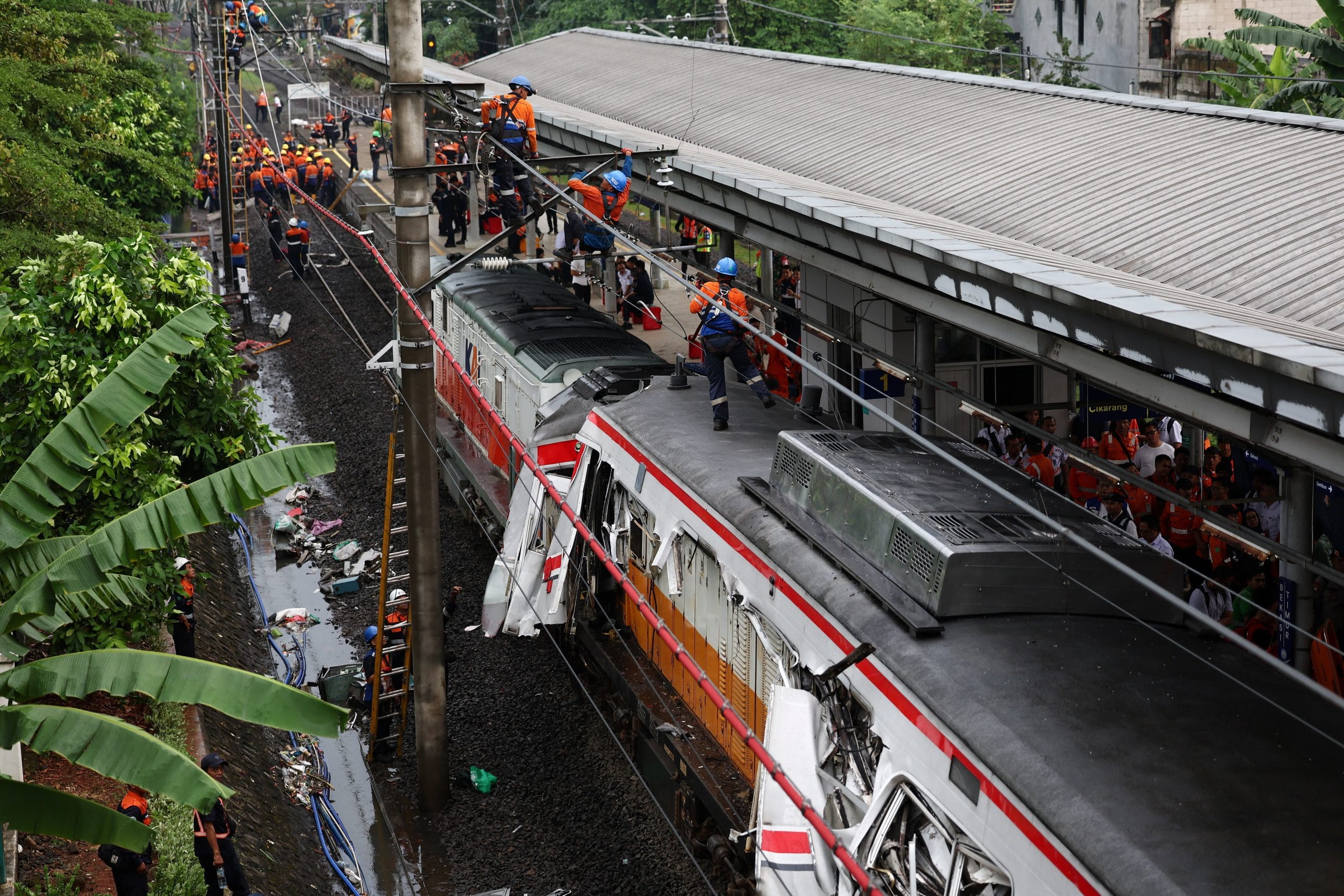
BEKASI, Indonesia — A long-distance train struck the rear of a stopped commuter train late Monday at Bekasi Timur Station, killing at least 14 people and injuring dozens, according to the Associated Press, April 28, 2026.
The collision, which officials said followed an earlier taxi-related incident at a nearby rail crossing, has prompted President Prabowo Subianto, lawmakers and transport authorities to demand answers about signaling, rail operations and crossing safety.
Bekasi train crash under investigation after rear-end collision
The crash involved the Argo Bromo Anggrek long-distance service and a KRL Commuter Line train that had been stopped at the station. The rear commuter car, designated for women, took the worst of the impact, and officials said all confirmed fatalities in the initial count were women.
Authorities were still reconciling casualty figures Tuesday. State railway officials and local reports put the toll at 14 dead and 84 injured, while Reuters reported a senior minister later said 15 people had died and 88 were injured.
Rescue crews worked through mangled metal to remove trapped passengers before officials said the main evacuation had ended. “There are no further casualties,” Mohammad Syafii, head of the National Search and Rescue Agency, told reporters, according to AP.
Officials examine taxi incident and railway response
A preliminary chronology from Indonesia’s Transportation Ministry said the chain of events began when a Bekasi-Cikarang commuter train hit an electric taxi at a level crossing near the station. Officials said railway staff then stopped another commuter train at Bekasi Timur Station before the Argo Bromo Anggrek service, traveling from Gambir to Surabaya Pasar Turi, was unable to stop fully and hit it from behind.
Investigators have not announced a final cause. Authorities are expected to examine whether the collision involved human error, signaling issues, technical failure, operational procedures or rail-crossing risks.
Prabowo visited injured passengers at dr. Chasbullah Abdulmadjid Regional Hospital in Bekasi and ordered an immediate investigation. “We will immediately carry out an investigation into what exactly happened,” he said in remarks broadcast by the Presidential Secretariat.
Safety pressure grows after deadly Bekasi collision
The Indonesian House of Representatives also called for a comprehensive probe, with Deputy Speaker Yuliati saying investigators should determine whether the crash was linked to human error, signaling problems or operational management failures.
The crash disrupted commuter services in the Jakarta metropolitan area, where rail lines carry large numbers of workers between the capital and surrounding cities. PT Kereta Api Indonesia set up emergency and information posts for families, while some commuter services were rerouted or cut short around the damaged section.
The Bekasi collision also fits into a longer record of serious railway accidents in Indonesia. In January 2024, a West Java train collision killed four people and injured 42. In December 2013, a commuter train hit a fuel truck on the outskirts of Jakarta, killing at least 10 people. In October 2010, a Central Java rail crash killed at least 36 people.
Those earlier accidents are likely to sharpen public scrutiny of the Bekasi investigation, especially over rail-crossing protections and the mixing of long-distance and commuter services in heavily used corridors.
Families await answers as rail safety probe begins
The National Transportation Safety Committee is expected to lead the technical inquiry, while police and transportation officials continue separate reviews. Officials said injured passengers were being treated at several hospitals and that the bodies of victims had been taken for identification.
For families, the immediate focus remains on identifying victims and recovering from the crash. For Indonesia’s rail system, the Bekasi train crash has become a test of whether investigators can produce clear findings and whether the government can turn those findings into safer daily travel for commuters.