
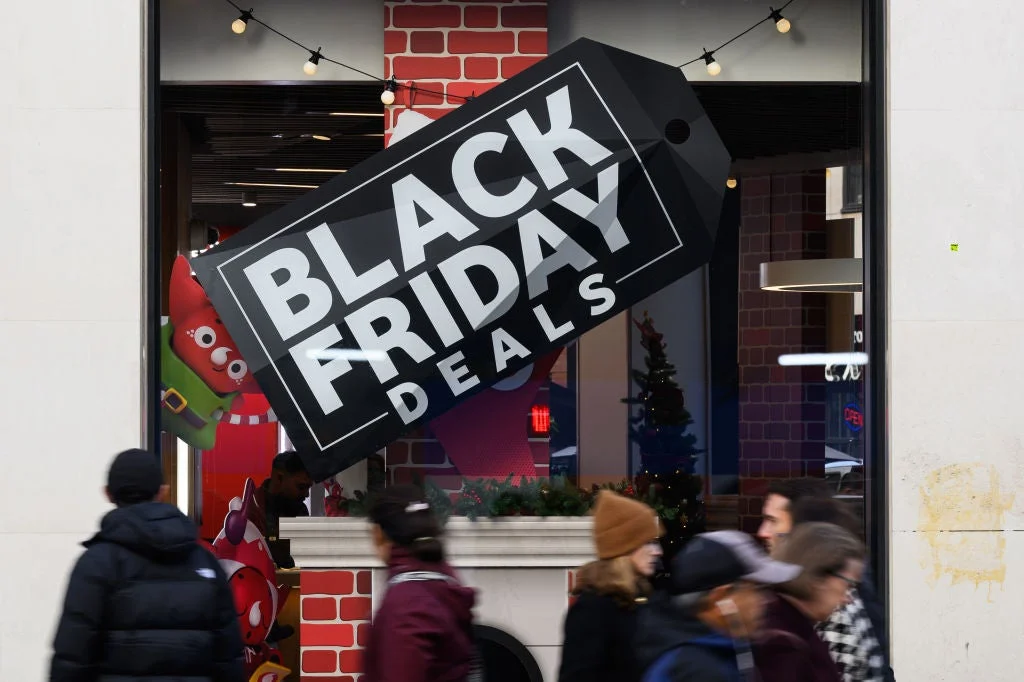
NEW YORK — Black Friday 2025 is likely to draw the largest crowd in stores and online since the pandemic, as U.S. shoppers pursue doorbusters and last-minute deals nationwide. Economists and retail trackers say the frenzy is being driven by weeks of early discounts, even as high prices, new tariffs, and sharper markdowns could prompt many people to stick to smaller spending this holiday season, on Friday, Nov. 28, 2025.
The National Retail Federation anticipates a record 186.9 million Americans will shop between Thanksgiving and Cyber Monday, above the 183.4 million who did so last year, and says November-December sales should exceed $1 trillion for the first time, though growth will slow from 2024’s pace, according to a projection cited by Reuters.
Record numbers will also be spent online. One analysis of Adobe data collected by Queue-it anticipates that U.S. e-commerce sales on Black Friday 2025 will rise roughly 8 percent to $11.7 billion, after reaching $10.8 billion in 2024, while the global online jackpot last year totaled almost $74.4 billion.
Surveys indicate that those larger amounts will come from more shoppers, not extravagantly exuberant indulgences. A new survey from Deloitte, the 2025 Deloitte Holiday Retail Survey, found Americans expect to spend anywhere from about $1,595 on average — tilted more toward essentials — while research firm Drive Research says 70% of those who plan to go all in for Black Friday are doing so because living costs have risen and they need to reel it in this year.
Bargain hunters are wondering more and more whether the Black Friday 2025 deals are as good as what they’ve seen in ads. A comprehensive pricing analysis from Red Stag Fulfillment uncovered figures showing that, even as the average advertised discount this year hovered between 28 and 38 percent on markdowns, “real” savings following pre-sale cost increases were only 5.5 percent, with many times landing cheaper later in the week.
Those findings echo earlier warnings. A 2022 investigation by DFD News, which used transaction and price-tracking data as a source for its reporting, noted that some major brands had jacked up their listed prices ahead of the holiday only to slap big discounts on them while advertising for Black Friday — especially in categories such as beauty — so they could tout their pricing deals to consumers once it was all over; such frenetic undercutting continued to influence how suspicious shoppers would scrutinize Black Friday numbers down through the years.
Retailers, strained by tariffs and higher costs, have responded with fewer, more targeted promotions. Walmart and other big-box chains are turning Black Friday 2025 into a series of events, including a three-wave sale with early access for loyalty members; Amazon has rolled out “Black Friday Week” discounts, as detailed on its retail calendar.
It’s more than a decade in the making, this stretched-out sale season. “You have the erosion of the philosophy behind having doorbusters at other times,” said Sami M. Kudaimi, who researches shopping and language at Kansas State University’s College of Business Administration, adding that such moves “took power away from” Black Friday itself. (A Washington Post report in 2014 even warned that promotions creeping into November were draining doorbusters of urgency.) And one story from that same weekend lamented fewer shoppers and lower spending when discounts are spread out over days rather than crammed into a single 24-hour spree.
By 2017, a Washington Post analysis flatly stated that “the era of holiday deals is dead and so is Black Friday,” citing research showing a diminishing share of Thanksgiving-week shoppers who planned to hit stores on the day itself as year-round promotions blunted the appeal of lining up before dawn.
Despite the pandemic-fueled spike in online shopping, recent seasons have seen a retail resurgence in IRL shopping. Axios called 2024 the “year of the store” and said that mall traffic rebounded significantly, with a record 183.4 million shoppers over the Thanksgiving-to-Cyber Monday span — a trend retailers hope to extend into Black Friday 2025.
Internationally, the pattern is similar. Official data shows British October retail sales slipping as shoppers waited for promotions, a slide that economists linked in part to the discount weekend, according to UK retail data. Australian chains, for instance, anticipate nearly $6.8 billion in sales from the Black Friday weekend this year — an indication of how a U.S. event has gone international.
Price fatigue and promotion creep were already apparent in 2022, when another Washington Post dispatch pronounced that Black Friday “isn’t what it used to be,” featuring thinner crowds, a longer shopping window, and households weary from inflation concentrating on basics at the expense of many an impulse buy.
For many families walking into Black Friday 2025, the plan is to come and spend wisely. “Everything just feels like it’s way more expensive,” said New York shopper Kate Sanner, who told Reuters she would concentrate on a short list of gifts and household items rather than run after every doorbuster deal.