

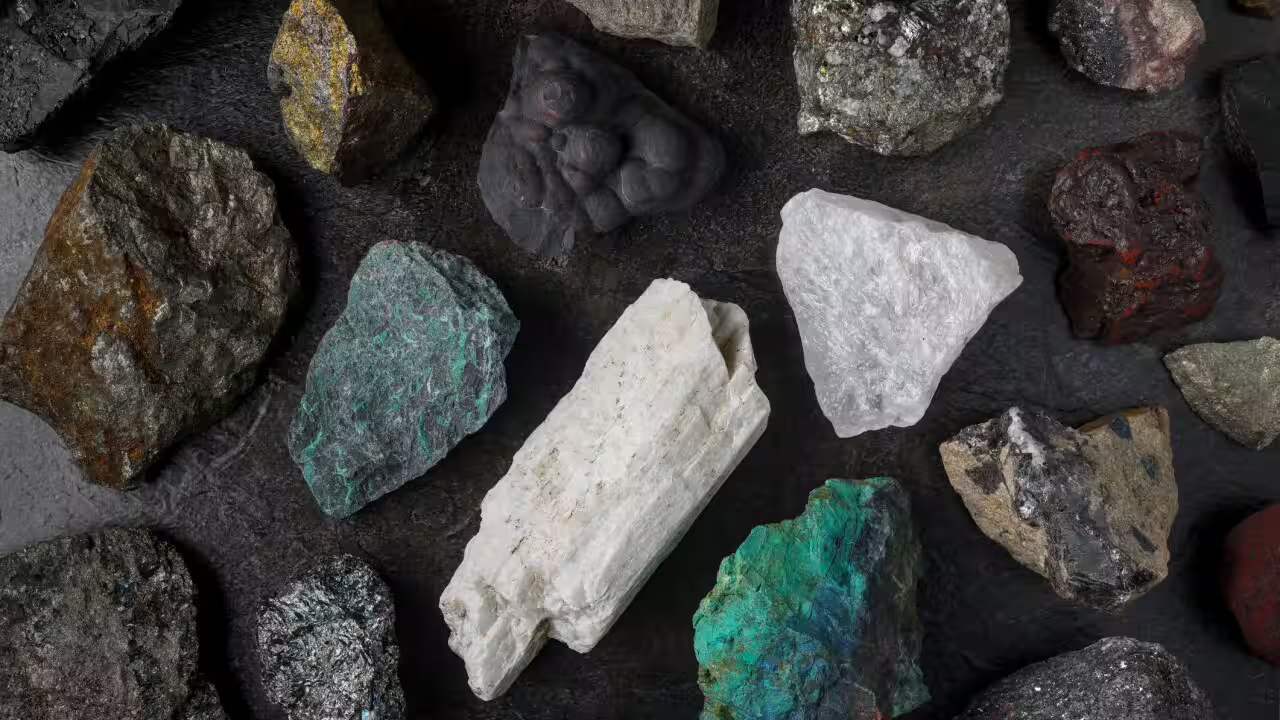
WASHINGTON — Finance ministers from the United States, the Group of Seven and several partner economies met to press for faster action to shore up critical minerals supply chains and curb reliance on Chinese rare earths, Jan. 12, 2026. The U.S. Treasury-led talks put a rare-earth price floor and other market-shaping tools on the table to help keep non-Chinese projects bankable even when prices swing.
The closed-door session, convened by U.S. Treasury Secretary Scott Bessent, brought together finance chiefs from the G7 — the United States, Japan, Britain, France, Germany, Italy and Canada — alongside officials from Australia, Mexico, South Korea and India. Participants did not issue a joint statement, but ministers described broad agreement on the need to move quickly, according to Reuters’ account of the meeting.
At stake are materials that sit deep in modern manufacturing: rare earths for magnets, motors and defense systems; and other critical minerals used in semiconductors, batteries and renewable energy equipment. The countries in the room, plus the European Union, represent a large share of global demand, while China remains dominant across key processing steps. That concentration, officials argue, leaves supply chains exposed to export controls, sudden price drops and geopolitical shocks.
critical minerals supply chains: why a rare-earth price floor is gaining traction
A price floor would function as a minimum, backstopped price for specified rare earths, designed to limit the damage if low-cost supply floods the market and undercuts new mines and processing plants outside China. Supporters say it could act like an insurance policy for investors: a predictable floor can unlock financing, expand long-term offtake contracts and encourage downstream manufacturers to diversify suppliers.
Germany’s Finance Minister Lars Klingbeil said the idea is still in early stages and would require further work across finance, foreign affairs and energy portfolios. Japanese officials described a menu of options that could accompany a price floor, including public finance, tax incentives and trade measures aimed at accelerating non-Chinese capacity.
Tools beyond pricing: standards, stockpiles and recycling
The push is not limited to price policy. G7 leaders have already endorsed building “standards-based markets” — tying investment and procurement to labor, environmental and transparency benchmarks — and explicitly listed price floors among possible tools in an official G7 roadmap on critical minerals.
Officials also pointed to strategic reserves and buyer coordination to reduce volatility. The Trump administration’s recent bilateral deal with Australia illustrates that approach, pairing financing and offtake intent with supply-chain coordination under the U.S.-Australia framework on critical minerals and rare earths. Recycling and “urban mining” — recovering rare earths and other critical minerals from end-of-life products — were also highlighted as faster-to-scale complements to new extraction.
critical minerals policy momentum has been building for years
The latest talks build on a multiyear shift toward “de-risking” supply chains rather than full economic decoupling. The Biden-era supply chain push that began with the “America’s Supply Chains” executive order set the groundwork for federal reviews of vulnerabilities, including critical minerals, under the Federal Register notice for the 2021 order.
In 2022, the U.S. and allies launched new coordination channels — including the Minerals Security Partnership — to steer public and private capital toward projects aligned with higher ESG standards, as described in a 2022 Reuters report on the partnership’s creation. The G7 later reinforced those aims at the 2023 summit in Japan, pledging to support local value creation and recycling in the Hiroshima leaders’ communiqué.
What is new now is urgency — and the willingness to test more interventionist tools. Bessent has been pushing partners to move faster since last summer’s G7 summit, and U.S. officials say the window to attract investment into new critical minerals projects will narrow if price volatility keeps scaring capital away, Reuters reported ahead of the Washington meeting.
Next steps are expected to include follow-up work by additional ministries and more detailed design questions: which rare earths would qualify, how the floor would be funded or guaranteed, and how to avoid unintended price spikes for manufacturers. For now, officials framed the effort as cooperation among partners — with critical minerals security moving from long-term strategy to near-term policy.


