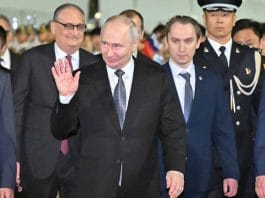

DHAKA, Bangladesh — India’s External Affairs Minister Subrahmanyam Jaishankar and Pakistan National Assembly Speaker Sardar Ayaz Sadiq exchanged a brief handshake while paying respects around the funeral rites of former Bangladeshi Prime Minister Khaleda Zia in Dhaka, Dec. 31, 2025.
Zia, who twice served as prime minister and dominated Bangladeshi politics for decades, died at 80 after a long illness, according to Reuters. Her funeral drew senior visitors from across South Asia, creating a rare, shared space where India-Pakistan officials were in the same room without a formal agenda.
In India-Pakistan terms, the handshake itself was microscopic: no joint readout, no announced meeting, and no public shift in policy. But the image has carried weight because it hints at something the region has lacked for months — routine contact that can keep a crisis from turning into a clash.
Why India-Pakistan “desi deconfliction” matters now
The urgency is not theoretical. After the May 2025 confrontation, both sides pulled back from sustained fighting, but the political space for dialogue narrowed, and each government cast the pause as validation of its own resolve. India’s defense minister later rejected claims that outside pressure drove the de-escalation, Reuters reported in July. That kind of public hardening makes it harder to rebuild quiet channels later.
“Desi deconfliction” is a plain idea dressed in local language: small, practical, region-owned steps that reduce miscalculation — especially when domestic politics, social media and fast-moving security incidents compress decision time. For India-Pakistan, it can mean restoring habits of contact even when trust is absent.
The Dhaka handshake: symbolism without commitments
Pakistan’s parliament secretariat said Jaishankar approached Sadiq and initiated the greeting, a detail highlighted by the Pakistani daily Dawn. Bangladesh, meanwhile, worked to tamp down overheated expectations, describing the exchange as routine courtesy rather than a diplomatic breakthrough, The Economic Times reported.
Those competing takes underscore the core challenge: India-Pakistan gestures are instantly politicized at home, even when they are accidental products of protocol. Still, the fact that the encounter happened at all — and was circulated publicly — suggests both sides are testing how much symbolism their audiences will tolerate.
Continuity: the region has tried this before
South Asia’s record shows that openings often begin with optics and then either mature into process or collapse under the next shock. The 1999 Lahore Declaration laid out commitments to dialogue and nuclear risk reduction, only to be overtaken by fresh conflict months later.
Two decades on, the Balakot episode reinforced how fast a terror attack and retaliation can push India-Pakistan to the edge; a Carnegie Endowment analysis after Balakot argued that recurring militant violence remained a central trigger for instability. And even in quieter periods, military-to-military guardrails have mattered: the two armies’ rare joint statement recommitting to a Line of Control ceasefire in February 2021 is documented in Reuters’ report.
What “desi deconfliction” could look like next
Make crisis communication boring again: regular, public confirmation that hotlines and director-general-level contacts are active — even when relations are frozen.
Protect technical channels from politics: separate border management, prisoner issues and humanitarian coordination from headline diplomacy.
Create small, verifiable wins: narrow steps that reduce friction and can survive the next India-Pakistan shock without being framed as “concessions.”
Whether Dhaka becomes a footnote or a foothold will depend on what follows the photo. A handshake cannot substitute for policy — but in India-Pakistan crises, the absence of even small, routine contact has repeatedly proven dangerous.