TAIPEI — Taiwan Deputy Foreign Minister Francois Wu quietly traveled to Israel this month for closed-door talks, three people familiar with the trip said. The unannounced visit comes as Taipei pursues deeper security cooperation and Israeli missile-defense know-how to help build its new “T-Dome” shield, Dec. 11, 2025.
People who described the trip, which has not been listed on Wu’s public schedule, spoke on condition of anonymity because of the sensitivity around Taiwan-Israel defense contacts. The visit, first reported by Reuters, has drawn no confirmation from either side; Taiwan’s Foreign Ministry instead said that “Taiwan and Israel share the values of freedom and democracy” and promised to keep promoting pragmatic cooperation in trade, technology and culture.
In a separate briefing last month, Foreign Minister Lin Chia-lung argued that deepening ties with Israel serves Taiwan’s national interest, citing Israel’s unusually strong backing for the self-ruled island compared with other Middle Eastern states, according to an Associated Press report. Lin said that “of course in terms of technology and defence there is mutual learning and some interactions” between the two sides, a rare public nod to the quiet Taiwan-Israel defense relationship.
Taiwan-Israel defense links quietly deepen
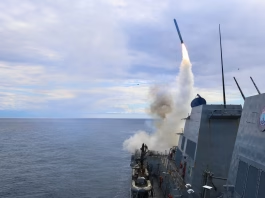
For Taipei, Taiwan-Israel defense cooperation stays unofficial because Israel, like most countries, recognizes Beijing diplomatically, but the strategic logic is clear. Taiwan is developing T-Dome, a multi-layered air and missile-defense system inspired in part by Israel’s Iron Dome and scheduled to be built between 2026 and 2030 to counter massed Chinese missile, drone and rocket attacks.
President Lai Ching-te unveiled the project in his Oct. 10 National Day address, vowing to push defense spending above 3 percent of gross domestic product next year and toward 5 percent by 2030, a trajectory detailed in an earlier AP story. Analysts writing in The Diplomat describe T-Dome as a layered “sensor-to-shooter” network linking U.S.-made Patriot batteries, indigenous Sky Bow missiles, radars and hardened shelters to keep Taiwan’s government and critical infrastructure operating under fire.
Wu’s secret trip appears to be part of that build-out, even if officials will not say whether T-Dome was on the agenda. Israeli missile-defense systems, battle-tested against rockets from Gaza and Iran, have become a template for countries racing to plug gaps in their air defenses, and Taiwan’s leaders increasingly present their island as another frontline democracy learning from Israel’s experience.
Long arc behind today’s Taiwan-Israel defense moment
While the Wu visit marks an unusually high-level and secretive exchange, it also fits a longer story of incremental ties. Taiwan and Israel have held regular economic and technology dialogues since at least 2011, when they concluded their ninth cooperation meeting in Tel Aviv, according to Focus Taiwan.
Personal affinity at the top has also mattered. In 2016, then president-elect Tsai Ing-wen, who visited Israel in 2013, was quoted as being “amazed” by Israel’s achievements and saw the country as a source of inspiration for Taiwan’s own development, the Times of Israel reported. Scholars say this admiration helped normalize the idea inside Taipei that Israel’s civil-defense posture and high-tech arms industry offer a model for a small democracy living under constant threat.
A 2018 Global Taiwan Institute study notes that Israel once licensed Taiwan to co-produce anti-ship missiles and fast missile boats, but that such transfers dwindled as Beijing’s leverage grew. In October this year, President Lai told a dinner in Taiwan hosted by the American Israel Public Affairs Committee that “Israel’s determination and capacity to defend its territory provides a valuable model for Taiwan,” framing T-Dome and today’s Taiwan-Israel defense overtures as a continuation of that long-running search for resilient partners.
Signals to Beijing, Washington and beyond
For Beijing, Wu’s discreet stop in Israel, layered atop T-Dome and a broader eight-year, $40 billion defense buildup, will likely be read as another sign that Taipei is tightening security links with U.S.-aligned partners. Chinese officials have already condemned the missile-shield plan as provocative, and experts warn that closer Taiwan-Israel defense cooperation could spur new pressure on Israel from Beijing, which has deep economic and technology ties with China.
For Washington and other supporters, however, Wu’s visit may be seen as proof that Taiwan is serious about sharing the burden of its own defense by investing in resilient air and missile shields and by diversifying partners. As T-Dome moves from concept to contracts, diplomats and analysts expect more such quiet trips — and more debate over how far Taiwan-Israel defense ties can grow without crossing China’s red lines.