The public mood is no longer ambiguous. A late-March Pew Research Center survey found that 61% of Americans disapprove of President Donald Trump’s handling of the conflict. A Quinnipiac University poll found that 54% of voters oppose the U.S. military action against Iran, while a new AP-NORC poll reported that 59% say the military action has gone too far and that roughly 6 in 10 oppose sending ground troops. The surveys differ in wording, but they point the same way: the war is losing the broad public margin a long campaign would need.
Iran war backlash is moving faster than Congress
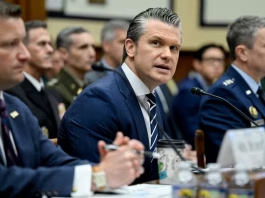
Congress, by contrast, has offered more resistance in rhetoric than in results. The House rejected a war-powers resolution March 5 after the Senate blocked a similar effort a day earlier, leaving Trump’s military campaign intact and pushing the real pressure point toward the War Powers Resolution’s end-of-April deadline. Since then, lawmakers in both parties have demanded more information about the scope and endgame, but criticism has not yet produced a new binding limit on the war. Supporters of the failed House measure said the vote would at least have forced the administration to define its objectives; Rep. Gregory Meeks called the conflict a “war of choice.”
The same pattern is visible on money. A possible supplemental funding request of more than $200 billion has already drawn resistance from Democrats and unease from some Republicans, especially with lawmakers still demanding more detail on the scope, cost and duration of the war. That leaves Capitol Hill in a familiar position: skeptical in tone, divided in practice and still unwilling to redraw the president’s room for maneuver.
That disconnect matters because the backlash is not limited to the anti-war left. Democrats and independents are driving most of the opposition, while Republicans remain broadly supportive but are less aligned on how far the conflict should go. The result is a political warning sign rather than a clean ideological split: many voters may accept pressure on Iran, but they are far less willing to back an open-ended conflict, a ground deployment or another blank-check war debate.
Iran war politics now hinge on cost, duration and control
For Congress, the next phase may be harder than the first. Voting down a war-powers resolution is easier than defending a long campaign once the bill arrives, casualties mount or fuel prices stay elevated. If the White House sends a supplemental request and still declines to seek a fresh authorization, lawmakers will have less room to argue that oversight can wait. The legal clock, the budget fight and the public mood are all converging at once.
That is why the current backlash is more than a polling problem. It is a test of whether Congress still intends to do more than complain after hostilities begin. So far, lawmakers have preserved the president’s flexibility while distancing themselves from the political risk. That balance gets harder to maintain the longer the war lasts.
Iran war debate did not start this month
The continuity is striking. After the killing of Iranian Gen. Qassem Soleimani, the House in January 2020 passed a war-powers resolution aimed at limiting further military action against Iran, reviving the same constitutional fight now back on Capitol Hill. Around the same time, Pew Research Center found that a majority of Americans believed Washington’s approach had increased the chances of a major conflict with Iran. Even earlier, a 2019 Reuters/Ipsos survey found that half of Americans already believed the United States was likely to go to war with Iran within the next few years.
That history does not make the current moment inevitable, but it does make it legible. The pattern has been consistent for years: presidents move quickly, Congress argues late and public opinion turns skeptical once the prospect of a wider war becomes real. The difference now is that the shooting is no longer hypothetical and the price tag is no longer abstract.
If that pattern holds, the decisive question will not be whether voters are opposed; the late-March polls already suggest they are. The question is whether Congress is prepared to translate that opposition into a real check on the war before the next deadline, the next appropriation fight or the next escalation forces the issue.