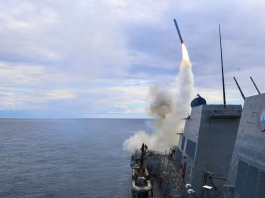
WASHINGTON — The U.S. military is preparing for the possibility of sustained, weeks-long operations against Iran and is moving a second aircraft carrier toward the Middle East as President Donald Trump increases pressure on Tehran while nuclear talks hang in the balance, U.S. officials said Friday. Officials said planners expect Iran to retaliate if Trump orders strikes, raising the risk of a cycle of attacks that could pull U.S. forces and partners deeper into a regional conflict, Feb. 13, 2026.
The preparations, described by U.S. officials speaking on condition of anonymity, come as Washington pursues diplomacy through intermediaries even while it reinforces the region with additional ships, aircraft and air defenses. Trump has repeatedly threatened military action if negotiations fail, while Iranian leaders and the Islamic Revolutionary Guard Corps have warned that any attack on Iranian territory would draw a response.
Iran contingency plans point to longer campaign, higher risks
Two U.S. officials said planning underway includes scenarios in which operations against Iran would extend well beyond a single night of strikes and could target Iranian state and security facilities in addition to nuclear-related infrastructure. The disclosure suggests the Pentagon is preparing for a wider, more demanding set of missions than the one-off attacks carried out last year, according to a Reuters report.
U.S. officials have not said an order to strike Iran is imminent, and the White House stressed that Trump has not removed diplomacy from the table. Asked about the contingency planning, White House spokesperson Anna Kelly said the president has “all options on the table” regarding Iran, according to Reuters.
Analysts say the risks for U.S. forces would rise quickly in any sustained campaign against Iran, which fields a large arsenal of missiles and drones and has a network of partners across the region. The United States maintains troops and facilities in multiple Middle Eastern countries, giving Iran a broad set of potential targets if it chooses to respond, the officials said.
Iran and the carrier buildup: USS Gerald R. Ford heads east
The Pentagon has ordered the aircraft carrier USS Gerald R. Ford to the Middle East, where it will join the carrier USS Abraham Lincoln and other naval forces already operating in the region. Trump said the additional carrier would provide “tremendous power” nearby, and he signaled that it is intended to sharpen the U.S. negotiating posture with Iran, according to a separate Reuters account of the deployment.
“In case we don’t make a deal, we’ll need it,” Trump told reporters of the carrier, adding that the United States would “have it ready,” according to both Reuters and The Associated Press.
Asked whether he wanted a change in power in Iran, Trump said it “would be the best thing that could happen,” but did not name anyone he would prefer to lead the country.
U.S. officials said the Ford would take at least a week to reach the Middle East, underscoring that the deployment is part of a broader posture shift rather than a public signal of an imminent strike.
AP reported that the Ford’s move will place two U.S. carrier strike groups in the region and follows recent friction at sea: U.S. forces shot down an Iranian drone that approached the Lincoln, and Iran attempted to stop a U.S.-flagged ship in the Strait of Hormuz.
Talks with Iran continue as military pressure mounts
Diplomats from the United States and Iran held indirect talks in Oman last week, and Iranian officials said the meeting was intended to gauge Washington’s seriousness and test whether a diplomatic process could continue. Iran’s foreign ministry spokesperson, Esmaeil Baghaei, said Tehran felt there was enough “understanding and consensus” to stay on the diplomatic track, according to a Reuters report from Dubai.
At the same time, Washington has sought to widen any agreement with Iran beyond nuclear limits to include Tehran’s ballistic missile program, regional armed groups and human rights concerns. Iran has said it is prepared to discuss curbs on its nuclear program in exchange for sanctions relief but has repeatedly rejected linking nuclear talks to its missiles.
In the latest sign that backchannel diplomacy is still moving, a source briefed on the matter told Reuters that U.S. envoys Steve Witkoff and Jared Kushner were expected to meet Iranian representatives Tuesday in Geneva with Omani mediators involved, underscoring how fast the standoff can swing between negotiations and military planning.
Iran’s nuclear file and inspections remain a flashpoint
Even as talks continue, the International Atomic Energy Agency has pressed Iran to account for nuclear material and allow access to key facilities damaged in last year’s strikes. U.N. nuclear watchdog chief Rafael Grossi has warned that the standoff over inspections “cannot go on forever,” according to a Reuters interview in Davos.
Grossi said the IAEA has been able to inspect declared sites that were not hit, but it has not gained access to major facilities at Natanz, Fordow and Isfahan. He said Iran must submit a report detailing what happened to bombed sites and nuclear material, including uranium enriched up to 60% purity, close to weapons-grade.
Iran standoff echoes years of escalation and failed diplomacy
The current pressure campaign sits atop years of cycles between negotiations, sanctions and military brinkmanship. Trump’s return to hardline tactics revives disputes that accelerated after he announced in 2018 that the United States would withdraw from the Iran nuclear deal, according to a Reuters report at the time.
Tensions spiked again in early 2020 when the United States killed Iranian Gen. Qassem Soleimani in a strike near Baghdad’s airport — an episode that triggered Iranian retaliation and renewed fears of open war, as described in AP’s report on the assassination.
More recently, Trump has pointed to last year’s U.S. strikes on Iranian nuclear facilities — Operation Midnight Hammer — as evidence of the military power he is willing to use if diplomacy fails. Reuters detailed how that June 2025 mission relied on deception and long-range B-2 bomber flights in its account of the operation.
For now, administration officials and diplomats say the goal remains a deal that curbs Iran’s nuclear work and reduces the risk of another regional war. But the dual-track strategy — negotiations backed by growing U.S. firepower — also means miscalculation could trigger the kind of prolonged conflict U.S. planners are now preparing for.