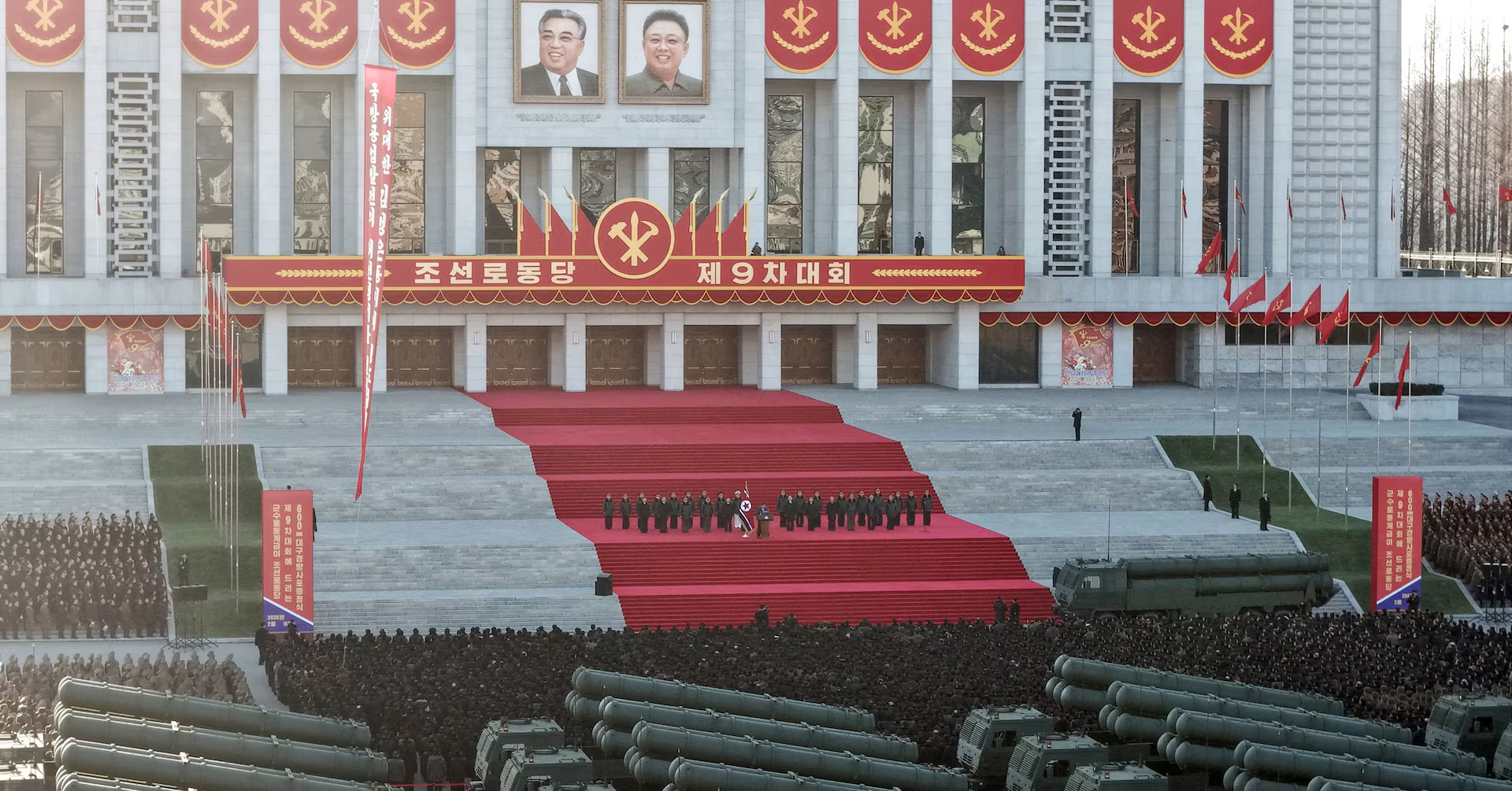
SEOUL, South Korea — North Korean leader Kim Jong Un used a rare ruling-party gathering in Pyongyang to outline new strategic goals meant to guide the country for the next five years, state media reported Sunday. The plan, presented to thousands of delegates at the North Korea congress, signals how Kim intends to pair economic promises with an expanding military posture as pressure from the United States and its allies persists, Feb. 22, 2026.
Details released so far have been broad, reflecting the limited information typically provided by North Korea’s state-run media and the lack of independent access to elite political events. Still, the North Korea congress — formally the Ninth Congress of the Workers’ Party of Korea, held about every five years — is the regime’s most important political meeting and a key moment for policy direction, personnel changes and propaganda messaging.
North Korea congress sketches the next five-year strategy
According to a Reuters report citing the Korean Central News Agency, Kim continued a lengthy review of the party’s performance over the past term during the third day of the party congress. KCNA said his report assessed the last five years and set out “strategic and tactical” directions and new tasks “across all sectors” to advance what it called socialist construction.
KCNA also described delegates as endorsing Kim’s report and framing it as a roadmap for a “new stage” of national development. Outside observers say North Korea’s leadership often uses party gatherings to set a broad national line — then later publishes more specific targets and appointments through follow-up party meetings and state planning announcements.
In an opening address earlier in the week, Kim said the previous five years were “a proud period,” and claimed the country had overcome stagnation and met major goals, while also urging a renewed focus on living standards and economic construction, according to a separate Reuters dispatch summarizing KCNA coverage.
Tensions with the West frame the North Korea congress
While Kim’s public remarks have emphasized the economy, the party congress is unfolding against a backdrop of deepening confrontation with Washington, Seoul and other partners, along with North Korea’s continued weapons development in defiance of U.N. sanctions.
Days before the congress opened, Kim signaled that fresh military and construction goals would be set and previewed what he called the next phase of self-reliant defense, KCNA said. In a report carried by Reuters, Kim touted advances in missile-related technology and described newly presented 600mm multiple rocket launchers as having “virtually no difference” from high-precision ballistic missiles in “precision and power,” adding that they incorporate “AI technology and compound guidance systems.”
The same reporting also underscored the brittle security environment on the Korean Peninsula. Kim’s sister, Kim Yo Jong, warned against what she described as infringements on North Korean sovereignty after South Korea expressed regret over drones being sent into the North, while Seoul weighed steps tied to a 2018 military agreement meant to reduce border friction.
What to watch next from the North Korea congress
Analysts will be looking for whether the North Korea congress produces clearer economic targets, a revised national development line, or a new military wish list that builds on the weapons programs Kim has promoted in recent years.
Two other issues are drawing attention. One is whether the regime uses the North Korea congress to reshuffle senior posts beneath Kim or elevate new figures tied to economic planning and the defense industry. The other is whether Kim takes steps to reinforce dynastic succession, amid speculation about his teenage daughter’s future role.
In the opening address reported by KCNA, Kim avoided directly addressing relations with the United States and South Korea, and did not refer to nuclear weapons, according to the same Associated Press overview that noted analysts are watching for possible leadership reshuffles and further signaling on military priorities.
Human Rights Watch, meanwhile, said the congress is taking place amid intensified domestic repression, including tighter information controls and broader punishment of perceived dissent, arguing that policy signals from Pyongyang should be read alongside human rights conditions inside the country. Read the group’s assessment here.
How the North Korea congress fits a decade of five-year plans
For North Korea, party congresses are also checkpoints for long-range economic planning. At the previous congress in 2021, Kim acknowledged major shortcomings in the prior economic plan and called for stronger military capabilities as the meeting wrapped up, according to a Reuters report from that year.
The cycle stretches back further. At the 2016 congress — the first in decades — Kim unveiled a five-year economic plan and paired it with messaging aimed at deterring external pressure, as described in a Reuters account from May 2016.
Researchers tracking North Korea’s stated objectives say the 2021-25 plan put heavy emphasis on self-reliance and listed sector-by-sector goals while leaving many implementation details opaque. The Open Nuclear Network’s analysis of the Eighth Congress described the five-year plan announced then as a central organizing framework for domestic policy — making the agenda announced at the current North Korea congress a key indicator of how Pyongyang wants to present its trajectory through the end of the decade.
For now, Kim’s latest report appears intended to project confidence and continuity: praise for the past term, a fresh five-year roadmap and the message that North Korea will pursue its chosen path despite outside pressure.