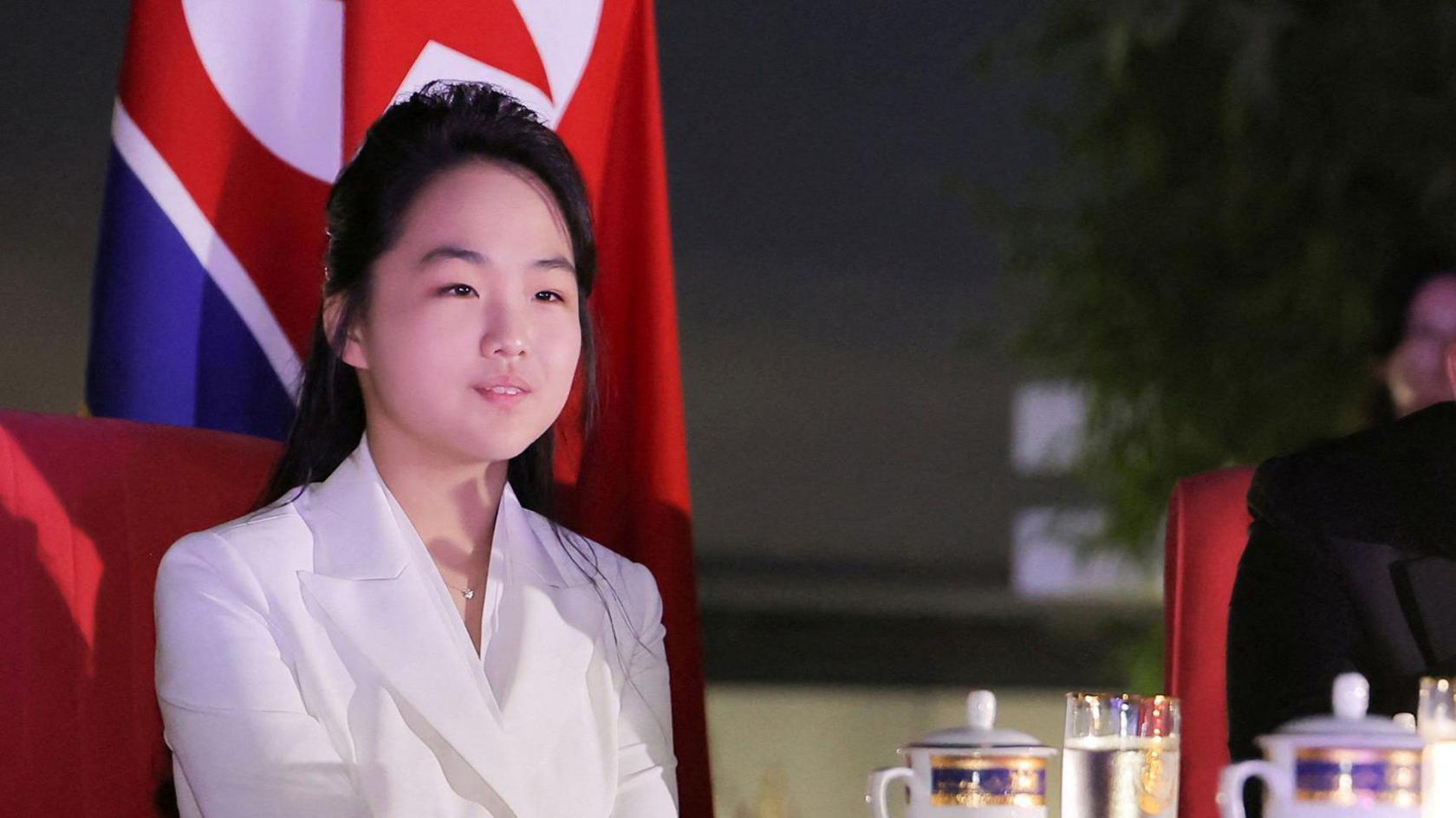
SEOUL, South Korea — Kim Jong Un has put his teenage daughter, Kim Ju Ae, in the brightest spotlight North Korea can offer: the optics of missiles, uniforms and loyalty rituals. The latest state-media imagery and South Korean intelligence assessments are sharpening succession speculation, but the regime has still not crossed the clear, formal thresholds that usually define a chosen heir in Pyongyang, March 1, 2026.
Over the past several weeks, Kim and Kim Ju Ae have been filmed and photographed at moments designed to telegraph continuity — a key party congress, a major parade and staged events that elevate the ruling family above the elite. Yet even as these signals accumulate, the absence of an official title, a formal party role or a declared succession narrative keeps the “heir” question open.
Kim Ju Ae and the new succession signals from the party congress
The freshest round of speculation followed South Korea’s National Intelligence Service briefing to lawmakers that Kim appears to be positioning his daughter as the de facto No. 2 figure — including suggestions she may be offering input on policy matters and that internal designation as successor could be underway. Reuters reported the assessment and lawmakers’ remarks, while noting Seoul was watching closely for any new title or status markers at top-level party gatherings (South Korea spy agency briefing on succession signals).
North Korea’s own presentation has been more visual than bureaucratic. During the Workers’ Party congress cycle, state media highlighted Ju Ae in carefully staged scenes that bind her image to the core pillars of regime legitimacy: the military, the nuclear narrative and the Kim family’s “bloodline” mythology. A photo set released after Kim handed out ceremonial sniper rifles to senior officials showed Ju Ae participating in a shooting-range demonstration — a conspicuous pairing of youth, weapons and leadership theater (KCNA imagery of rifles and range demonstration).
Associated Press coverage of the same episode underscored an important limitation: even with elevated visibility, Ju Ae does not appear to hold an official party post, and age-based rules would typically constrain formal membership and appointments (What AP reported from the congress imagery).
Parade optics: proximity, placement and wardrobe as messaging
Pyongyang’s parades are never just pageantry; they are the regime’s political language. In late February, state media footage showed Ju Ae at a major military parade, standing near her father and senior military figures — one of her most prominent appearances yet, according to Reuters (Reuters on Ju Ae’s parade appearance).
Placement matters in North Korean choreography. Being near Kim at a parade can imply trust and status, especially when the event’s purpose is to celebrate military strength and elite unity. But it can also be read as something less definitive: a symbolic “family state” tableau meant to reinforce Kim’s domestic narrative of permanence at a time when sanctions pressure, weapons development and foreign-policy risk remain constant.
Some analysts and media commentary have also seized on stylistic cues — including coordinated wardrobe — as part of a broader effort to craft a recognizable public persona for Ju Ae. Whether that translates into actual power is harder to measure from imagery alone.
Why the heir path still looks uncertain
Even if Kim is building Ju Ae’s profile, North Korea has not yet provided the unambiguous succession markers that have historically mattered inside the system: a party title, a seat on key bodies, a sustained propaganda campaign describing the heir’s revolutionary credentials, or explicit language elevating the successor as the future “center” of the state.
That gap is fueling two competing interpretations.
- The grooming thesis: Kim is deliberately normalizing Ju Ae’s presence to prepare elites and the public for a fourth-generation dynastic transition, while testing how far he can push imagery without locking the regime into a public commitment.
- The ambiguity thesis: The regime is using Ju Ae primarily as symbolism — projecting stability, softening Kim’s image and complicating foreign narratives — while keeping succession options open, including the possibility of another child or a different internal plan.
The Guardian summed up the push-pull between heightened visibility and entrenched uncertainty, including questions about how a male-dominated elite might react to a female successor and whether Ju Ae’s prominence could be misdirection (The Guardian analysis on the succession question).
NK News also warned against overstating the certainty of Seoul’s intelligence language, arguing that headlines declaring a settled succession can run ahead of what is publicly knowable about internal decision-making in Pyongyang (NK News on the risk of overreading the “successor” narrative).
Continuity over time: how the Kim Ju Ae story has evolved
The current debate did not start this winter. It has been building since Ju Ae’s first high-profile emergence in late 2022, when Reuters reported North Korean state media showed Kim with a previously undisclosed daughter at an intercontinental ballistic missile test — an image that immediately fused family, weapons and regime longevity (Reuters on the first public reveal in 2022).
By 2023, international coverage was already framing her as a potential “crown princess,” while emphasizing how little is known about Kim’s children and how difficult it is to read intent from propaganda alone (Al Jazeera’s early look at the succession speculation).
In mid-2024, Australian public broadcaster ABC reported lawmakers citing Seoul’s intelligence service as saying Pyongyang appeared to be teaching Ju Ae as an heir apparent — language that foreshadowed the sharper assessments now circulating after the 2026 congress cycle (ABC on South Korea’s 2024 intelligence assessment).
Together, those snapshots show a pattern: North Korea has steadily increased Ju Ae’s public exposure, often tying her presence to military or “national achievement” settings. What has not kept pace is the formal, institutional confirmation that typically closes the succession debate.
What to watch next
The next clues are likely to come in three places: (1) whether Kim Ju Ae is ever given an official title in state media beyond familial descriptors, (2) whether she appears in contexts that imply governance — inspections, guidance tours, or meetings where officials are visibly taking cues from her — and (3) whether propaganda begins building a standalone narrative around her legitimacy rather than merely her proximity to Kim.
For now, the regime is sending signals strong enough to keep the succession question alive — and vague enough to preserve maximum flexibility. In North Korea, that may be the point.