

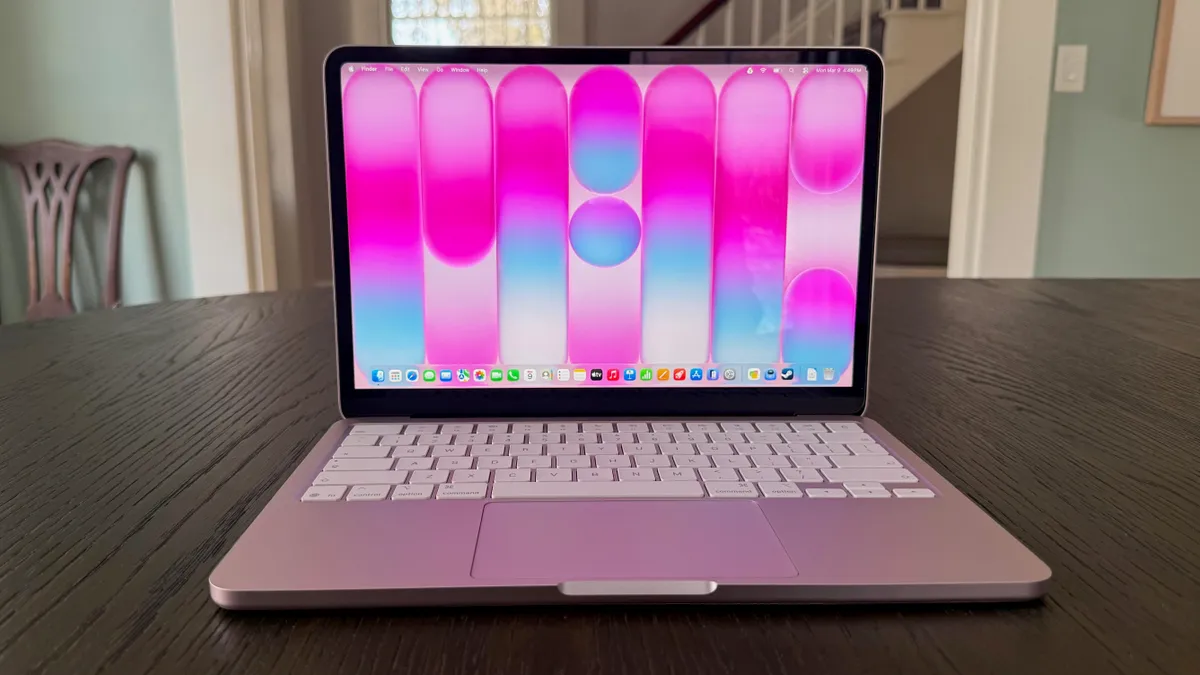
CUPERTINO, Calif. — Apple’s new MacBook Neo, the company’s $599 laptop and $499 education model, has quickly become its cheapest notebook and, according to iFixit, its most repairable MacBook in about 14 years, March 15, 2026.
The shift matters because it gives Apple a more credible answer to budget Windows laptops and Chromebooks, but the win comes with an asterisk: MacBook Neo is still capped at soldered 8GB unified memory, a limitation that could matter far more over time than its otherwise repair-friendlier redesign.
MacBook Neo repairability marks a real change for Apple
In Apple’s March 4 launch announcement, the company positioned the 13-inch MacBook Neo as a low-cost Mac for students and first-time buyers, starting at $599 and $499 for education. The MacBook Neo technical specifications show how aggressively Apple cut toward that price: an A18 Pro chip, 8GB unified memory on both configurations, 256GB or 512GB SSD storage, a 13-inch 2408-by-1506 display, two USB-C ports, a headphone jack and a 2.7-pound chassis.
The biggest surprise is not the spec sheet but what is inside the case. In its MacBook Neo teardown, iFixit said the laptop earns a 6 out of 10 repairability score, helped by a screwed-down battery, modular ports, easier access to several key components and the absence of original-parts pairing problems during testing. A separate Reuters report on the teardown said the redesign makes the Neo Apple’s most repairable laptop in more than a decade, even if it still trails the best repair-friendly Windows machines.
That improvement is meaningful in real-world use. In The Verge’s review, the Neo was praised as an unusually complete $599 laptop for everyday work, but its limits were just as clear: 8GB of RAM, slow base storage, no keyboard backlighting and a bare-bones port setup. Those are manageable compromises for schoolwork, web apps and office tasks, but they narrow the machine’s headroom from day one.
Why MacBook Neo’s 8GB memory is still the biggest drawback
Repairability and upgradeability are not the same thing, and that distinction is where the Neo stops being an easy long-term recommendation. The laptop may be simpler to open, service and keep in use, but its memory is still part of the main package, which means buyers cannot add RAM later. If a student, family or small business buys the Neo as a four- to six-year machine, that fixed ceiling may age worse than a battery, a port or even the keyboard.
That matters even more because Apple is marketing the Neo as ready for AI features and everyday Apple Intelligence use. For basic browsing, note-taking, streaming and light productivity, 8GB is likely enough for many buyers today. For heavier multitasking, local creative work or whatever entry-level AI workflows look like a few years from now, it is the one compromise owners cannot fix, swap or grow out of.
MacBook Neo looks better in historical context
The Neo’s repair-friendly design stands out because Apple’s notebook story moved in the opposite direction for years. In iFixit’s 2012 Retina MacBook Pro teardown, the site called that machine virtually non-upgradeable, highlighted its glued battery and gave it a 1 out of 10 repair score.
Apple’s public stance softened later. The company announced Self Service Repair in 2021, then expanded self-repair support to MacBooks in 2022, but those programs did not automatically make Mac hardware easy to live with. MacBook Neo feels more significant because it is the first low-cost Mac in years where the hardware itself visibly reflects that shift.
MacBook Neo verdict: cheaper, more fixable, still not especially future-proof
MacBook Neo deserves credit for two things Apple has rarely delivered together in one laptop: a truly low starting price and a design that no longer treats routine repairs like a punishment. That alone makes it one of the most interesting Macs Apple has launched in years.
But the praise only goes so far. If you need an inexpensive Mac for classes, family use or basic office work, the Neo looks like a smart buy. If you want a laptop with more long-term breathing room, the soldered 8GB memory remains the strongest reason to spend more and move up the lineup.


