MILAN — The Maria Grazia Chiuri Fendi Debut kicked off Fendi’s Fall/Winter 2026-27 runway show Wednesday during Milan Fashion Week, wrapping the Roman house’s centenary-era reset in plush, fur-forward outerwear as Uma Thurman, Dakota Fanning and Iris Law led a celebrity-heavy front row, Feb. 25, 2026.
Chiuri, returning to the brand where she began her career in accessories, framed the moment as a collective effort — “Less I, more us” was painted across the showspace floor — and set out to make a case for coats, craft and texture as Fendi’s new common language.
Maria Grazia Chiuri Fendi Debut: fur heritage, rebuilt for 2026
The Maria Grazia Chiuri Fendi Debut opened in a run of black: oversized blazers and long overcoats over trousers, slip dresses and sheer lace, with plush collars and hood linings doing much of the talking. Bombers, patchwork coats and fur-edged parkas landed the outerwear thesis, while laser-cut leather echoed lacework and beadwork kept evening looks light.
Outside the venue, K-pop fans lined up across the street from a small group of anti-fur protesters, underscoring how quickly the conversation turns when the Maria Grazia Chiuri Fendi Debut leans into Fendi’s signature material. In an Associated Press report from the show, Silvia Venturini Fendi — who had been running womenswear during the brand’s centenary year — called watching Chiuri’s first runway “very moving.”
Chiuri also signaled guardrails. As The Guardian reported, the collection used archival fur and introduced the idea of an atelier dedicated to repurposing vintage pieces — a bid to treat fur as something to be preserved and reworked rather than endlessly produced.
Runway details: black, navy and a few jolts
From there, the palette stayed mostly black and navy, interrupted by denim, animal prints and the occasional red or khaki flash. Harper’s Bazaar described the debut as “beautifully constructed” and intentionally low on spectacle — the kind of wardrobe-building edit that prioritizes wearability over viral moments — in its review of Chiuri’s first Fendi collection.
For industry watchers, the Maria Grazia Chiuri Fendi Debut also read as a pivot toward unity: a co-ed approach, similar tailoring for men and women, and accessories meant to live in the real world, not just on a runway. “I wanted to pay homage to the heritage of the brand,” Chiuri said backstage, according to Vogue’s first reactions roundup. “The five sisters were a big school for me, and for all designers.”
Front row and street scene: Uma Thurman, Dakota Fanning and Iris Law
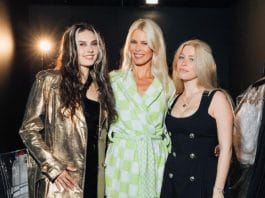
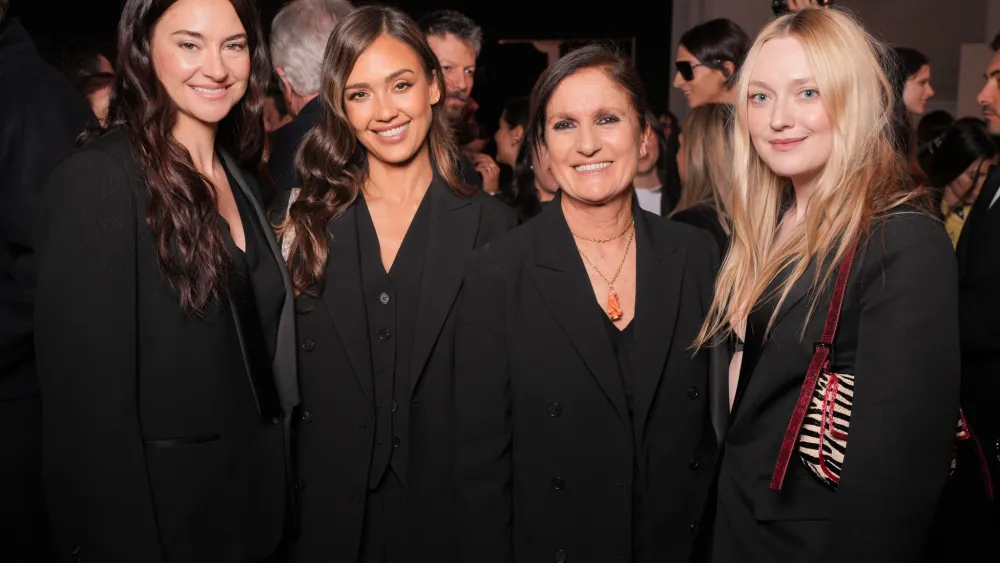
The show’s optics were pure Milan: movie stars, house icons and fan culture in the same frame. ELLE’s Milan Fashion Week dispatch counted Thurman, Fanning, Shailene Woodley, Law and Monica Bellucci among those seated at the show in its highlights recap, with the front row’s polished tailoring mirroring the collection’s opening looks.
That high-wattage audience also sharpened the stakes: Fendi has long traded on the tension between artisanal luxury and provocation, and the Maria Grazia Chiuri Fendi Debut leaned into that history while trying to keep the silhouette modern and useful — a great black blazer, a great coat, a bag that can take a beating.
A homecoming built on legacy — and the Baguette
Chiuri’s return plays especially well at a house with a deep bench of origin stories. Camera Nazionale della Moda Italiana has traced how the five Fendi sisters turned their parents’ fur-and-leather shop into an international name and brought Karl Lagerfeld in during the 1960s, in its history of Fendi and Italian fashion.
That Lagerfeld era also rewired what “fur” could mean in fashion. In a 2016 Harper’s Bazaar interview, Lagerfeld described decades of experimentation at the house — including techniques like knitting, pleating and intarsia — in a look back at his long Fendi collaboration.
And Chiuri has her own Fendi history: she helped drive the accessories engine in the 1990s before her later work at Valentino and Dior. A 2017 i-D interview noted her early time on Fendi’s design team and the way her career has repeatedly returned to the idea of women’s wardrobes as community, in a profile published during her first year at Dior.
At Fendi, that philosophy was translated into bags and outerwear. The Maria Grazia Chiuri Fendi Debut put the Baguette back in the spotlight with bold textures and animal motifs, betting that a familiar icon — refreshed — can bridge the brand’s heritage with a next-generation customer.
What comes next for Chiuri’s Fendi
If the Maria Grazia Chiuri Fendi Debut is the blueprint, Fendi’s near future looks coat-led, craft-first and deliberately restrained: fewer loud logos, more tactile surfaces, and a sharper focus on pieces meant to “bear witness to a life lived” — with fur treated as archive, craftsmanship and controversy all at once.