
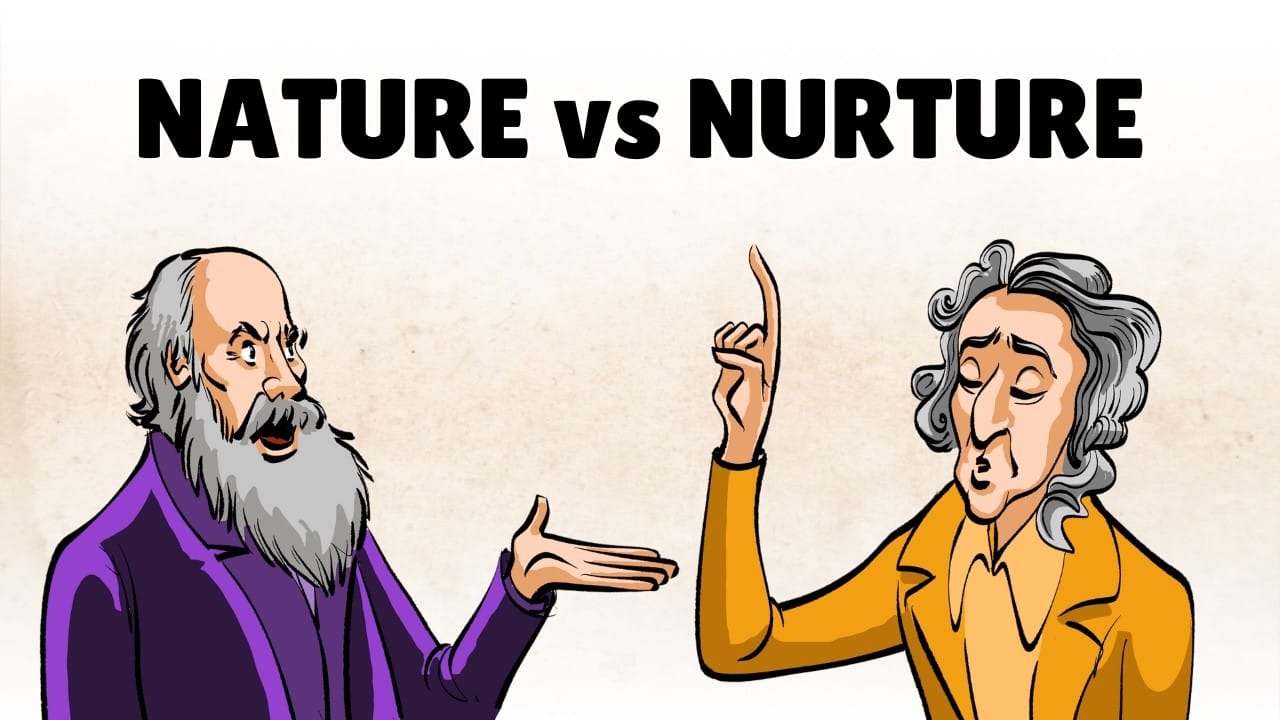
The conclusion is not that DNA writes a person’s character in advance. Instead, decades of twin research and newer genetic studies suggest that genes often shape tendencies, while environment, relationships and individual experiences influence how those tendencies develop.
Nature vs nurture is no longer a simple either-or fight
The modern science of personality has moved beyond the old question of whether people are shaped by nature or nurture. A more accurate answer is that both are operating at the same time, often in ways that are difficult to separate.
Researchers often study personality through the Big Five framework: neuroticism, extraversion, agreeableness, conscientiousness and openness. A 2024 Nature Human Behaviour study described those five traits as a widely accepted model for understanding human personality and found genetic links across large samples, including hundreds of thousands of participants.
That does not mean a person is locked into a fixed identity from birth. It means personality traits are influenced by many genetic variants, each usually having a small effect, alongside life circumstances that can strengthen, soften or redirect those tendencies.
What twin studies actually reveal about personality traits
Twin studies compare identical twins, who share nearly all their DNA, with fraternal twins, who share about half of the genetic variation that differs among people. If identical twins are more similar on a trait than fraternal twins, researchers can estimate how much genetic differences contribute to variation in that trait across a population.
A landmark 2015 meta-analysis of 50 years of twin studies examined 17,804 traits from 2,748 publications and more than 14.5 million partly dependent twin pairs. Across all traits, the reported heritability estimate was 49%, a finding that helped explain why the debate has endured for so long: the evidence did not hand victory to either genes or environment.
For personality, that middle ground matters. A high heritability estimate does not mean a trait is unchangeable. It means that, in the population studied, genetic differences helped explain some of the differences between people. The same person can still change across time, relationships, work, stress, education and culture.
Older studies show the debate has been evolving for decades
The new genetic work fits into a much longer scientific story. In 1987, Robert Plomin and Denise Daniels argued in a widely cited paper on siblings in the same family that children can grow up under the same roof and still experience different environments. Their point helped shift attention from “family environment” as a single shared force to “nonshared environment,” the experiences that make siblings different from one another.
A year later, researchers studying personality similarity in twins reared apart and together found that shared family environment played a small role for most of the personality measures they examined. That finding challenged the assumption that the same household produces the same personality outcome.
The Minnesota Study of Twins Reared Apart added another major piece of evidence. In a 1990 Science article, researchers reported that on multiple measures of personality, temperament, interests and social attitudes, identical twins reared apart were about as similar as identical twins reared together, according to the study’s PubMed abstract.
The surprising truth: genes matter, but destiny does not
The most important takeaway from twin research is not that personality is predetermined. It is that people are shaped by a mix of inherited tendencies and lived experiences, and those forces often interact.
Someone may inherit a tendency toward emotional sensitivity, high sociability or strong persistence. But whether that tendency becomes a strength, a struggle or something in between can depend on context: family support, peer groups, culture, education, trauma, opportunity and personal choices.
This is why heritability can be misunderstood. A trait can be partly heritable and still responsive to change. A person high in neuroticism, for example, may be more prone to worry, but therapy, stable relationships, exercise, sleep and coping skills can still affect how that tendency appears in daily life.
Why nature vs nurture still matters
The debate remains important because it shapes how people think about responsibility, education, mental health and parenting. If personality were treated as entirely genetic, people might underestimate the power of support and intervention. If it were treated as entirely environmental, people might ignore biological differences that affect how people respond to the same situation.
The strongest evidence points to a more balanced view. Personality traits are not blank slates, and they are not genetic scripts. They are patterns built from biology, experience and time.
That may be the real surprise behind the twin studies: nature and nurture are not rivals. They are partners in the long, uneven process of becoming a person.