

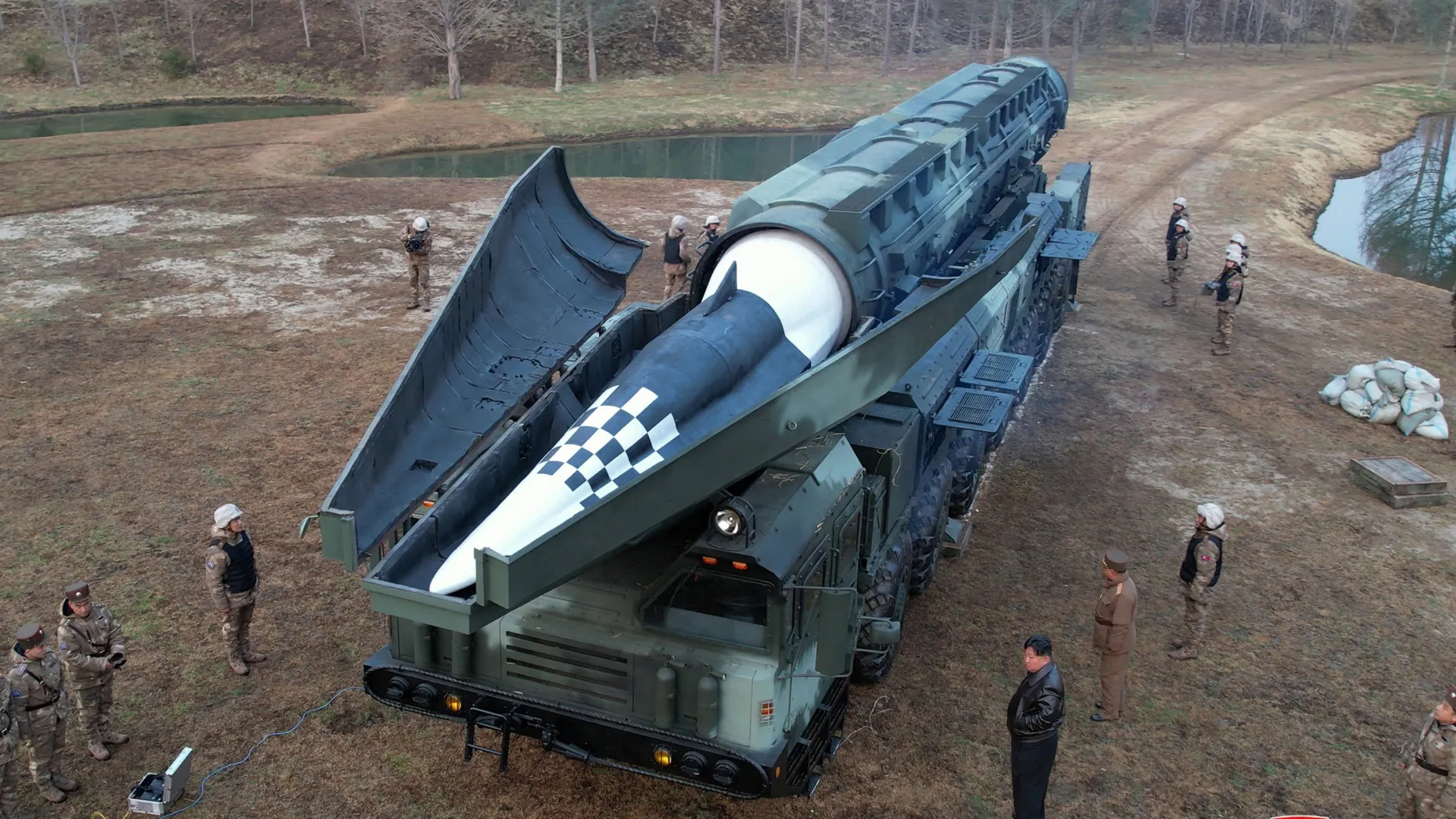
SEOUL, South Korea — North Korea said Sunday that Kim Jong Un oversaw a ground test of a newly upgraded high-thrust solid-fuel missile engine at an undisclosed site in North Korea, a move that could sharpen Pyongyang’s ability to build faster-launching long-range weapons with less warning time. The test, described by state media as part of a new five-year defense plan to improve “strategic strike means,” reinforces Kim’s push to make his missile force more mobile, survivable and harder to pre-empt, March 29.
According to the state-media account mirrored by KCNA Watch, the engine used composite carbon-fiber material and produced a reported maximum thrust of 2,500 kilonewtons. Reuters reported that Kim called the test significant for modernizing North Korea’s strategic forces, while the official account did not disclose the date or location of the firing.
Why the North Korea missile engine test matters
Solid-fuel missiles matter because they can be moved, hidden and launched more quickly than liquid-fuel systems, which typically need to be fueled before liftoff. If North Korea’s reported numbers are accurate, the latest engine test suggests Pyongyang is trying to squeeze more thrust from a lighter motor case, giving designers more room to trade weight for range, payload or both.
That could help North Korea improve the missiles it already has or support follow-on systems that can threaten the U.S. mainland from road-mobile launchers. But the picture is not complete. AP noted that outside experts remain cautious because North Korea did not release some technical details, including the total combustion time, making it hard to judge how mature the engine really is.
The timing also matters. Reuters said Kim used a February ruling party congress to roll out a new five-year military plan, again putting nuclear and missile development at the center of national strategy. Sunday’s engine test fits neatly into that blueprint.
What the latest test could change
Higher thrust by itself does not prove North Korea has solved every challenge involved in a reliable long-range missile. Re-entry vehicle performance, guidance, staging and survivability under wartime conditions still matter. But better propulsion is one of the core building blocks. More powerful solid-fuel motors can support heavier payloads, longer ranges or smaller missiles with similar reach.
For regional militaries, that matters because mobility and shorter launch preparation times complicate detection and interception. A missile that spends less time exposed before launch is simply a harder target set for the United States, South Korea and Japan.
North Korea missile engine test continues a longer pattern
This is not an isolated event. In a Reuters report from November 2024, North Korea said it had flight-tested the solid-fuel Hwasong-19 intercontinental ballistic missile, a launch that showed how far the country had already moved beyond liquid-fuel dependence at the top end of its arsenal. Go back further, and Reuters reported in December 2022 that Kim had overseen a high-thrust solid-fuel motor test at Sohae, a moment experts read as an early marker in the drive to build quicker-launching strategic missiles.
Seen in that sequence, the latest firing looks less like a one-off stunt than the next engineering step in a yearslong effort: first proving a high-thrust motor, then fielding a solid-fuel ICBM, and now trying to improve the engine that could power more capable long-range systems. That does not automatically mean North Korea is ready to deploy a fully mature next-generation missile tomorrow. It does mean Kim’s long-range program appears to be moving forward in steady, technically focused increments.
The broader message is political as well as military. By publicizing engine work rather than only headline-grabbing launches, Pyongyang is signaling that it is still investing in the less visible industrial side of missile development. That kind of work rarely draws the same attention as a launch, but it is often what determines how quickly a weapons program can improve over time.


