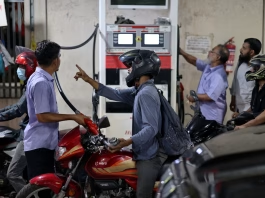

LONDON — Oil prices climbed more than 1% Wednesday after President Donald Trump ordered what he called a “total and complete” blockade of sanctioned oil tankers entering or leaving Venezuela, injecting fresh geopolitical risk into already jittery trading. Stocks were far steadier, with investors balancing the headline shock against a packed week of central-bank decisions and key economic data, Dec. 17, 2025.
Oil prices jump after Venezuela tanker blockade order
Brent crude futures were up 79 cents, or 1.3%, at $59.71 a barrel, while U.S. West Texas Intermediate gained 77 cents, or 1.4%, to $56.04 in early trading, according to a Reuters report on the oil market move.
The rebound followed a sharp slump a day earlier that left crude hovering near five-year lows, after optimism around Russia-Ukraine peace talks revived expectations that more supply could reach the market if sanctions were eased. Traders also pointed to technical buying after prices dipped below the psychological $60-a-barrel level.
While Venezuela is not a dominant supplier in global terms, the announcement added uncertainty around shipping and enforcement at a time when demand concerns remain elevated. A U.S. oil trader told Reuters the action could affect roughly 0.4 million to 0.5 million barrels per day, a disruption that could add about $1 to $2 a barrel if sustained.
Stocks drift as investors look past the shock headline
In contrast to the energy market’s quick repricing, global equities were mostly rangebound after mixed U.S. labor data did little to shift rate expectations — and as investors positioned for multiple policy announcements in Europe and Japan, according to a Reuters global markets wrap.
That report noted a stronger-than-expected rebound in U.S. job growth for November alongside a rise in the unemployment rate to 4.6%, the highest in more than four years, with analysts cautioning that recent data collection had been disrupted by a lengthy U.S. government shutdown. “Associated data collection issues will leave many sceptical about reading too deeply into these latest jobs figures,” said Nick Rees, head of macro research at Monex Europe.
Across Asia, benchmarks were mixed and U.S. equity futures were little changed as traders waited for Thursday’s U.S. inflation report and a trio of central-bank decisions that could steer currencies, bond yields and risk appetite into year-end.
Central banks take the spotlight
With markets debating whether inflation is cooling fast enough to justify easier policy — and how much growth can slow before rate cuts accelerate — the week’s calendar is unusually dense:
The Bank of England’s schedule for its next MPC announcement, with traders watching for a close vote and updated guidance.
The European Central Bank’s Governing Council meeting calendar, which lists the Frankfurt decision and news conference.
The Bank of Japan’s release calendar, showing the two-day policy meeting that ends Friday.
In markets, expectations are split: investors have been leaning toward a Bank of England cut, a steadier European Central Bank, and a potential move higher from the Bank of Japan — a combination that can reshape interest-rate differentials and, by extension, foreign-exchange positioning.
Venezuela’s oil story: years of sanctions, workarounds and market whiplash
Today’s shock announcement lands on top of years of stop-and-start restrictions that have repeatedly reshaped how Venezuelan crude reaches global buyers. An Al Jazeera explainer from 2019 detailed how U.S. sanctions against Venezuela’s state oil company were designed to pressure the Maduro government while tightening access to key markets.
In late 2022, Washington shifted again, granting limited relief that allowed Chevron to resume some activity in Venezuela — a move covered in Time’s report on the Chevron license and sanctions easing.
By 2024, the U.S. course changed once more as political disputes over election commitments flared, and Washington moved to restore broader restrictions, according to Al Jazeera’s coverage of the reimposition of oil sanctions.
For now, traders are weighing whether Wednesday’s jump in crude becomes a sustained rally or a brief risk-premium spike. Much may hinge on how the blockade order is implemented, how buyers and shippers respond, and whether broader demand and supply forces — including expectations tied to Russia and major central banks — ultimately overpower the Venezuela-driven shock.