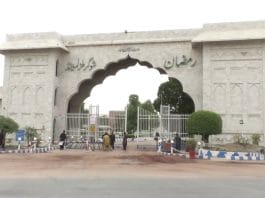
ISLAMABAD, Pakistan — Pakistan declared an “open war” with Afghanistan’s Taliban government Friday after air and ground strikes hit Kabul and other cities, widening Pakistan-Afghanistan clashes beyond the border. Islamabad said the strikes were retaliation for Afghan drone and ground attacks on Pakistani posts and renewed accusations that militants based in Afghanistan are fueling violence inside Pakistan, while the Taliban said it was ready for talks, Feb. 27, 2026.
Pakistan’s Defense Minister Khawaja Muhammad Asif said the two neighbors had moved into an “all-out confrontation,” writing on social media: “Our cup of patience has overflowed. Now it is open war between us and you (Afghanistan).” Pakistan-Afghanistan clashes have simmered for months, but the current flare-up is the sharpest escalation since the Taliban returned to power in 2021. A Taliban spokesman, Zabihullah Mujahid, said leaders in Kabul wanted to “resolve this matter through dialogue” even as both sides traded claims of heavy losses that could not be independently verified.
Pakistan-Afghanistan clashes spread from the border to Kabul
Afghan officials said Pakistan struck targets in Kabul and Kandahar — the southern city where senior Taliban figures are based — as well as multiple eastern provinces bordering Pakistan. In Kabul, residents described loud blasts and a long series of secondary explosions after a weapons depot was hit; Reuters witnesses and verified video reported smoke rising over western neighborhoods and ambulance sirens cutting through the night.
Pakistan’s military and security officials said the air-to-ground strikes targeted Taliban military offices, posts and ammunition depots after Afghan forces launched drone attacks late Thursday along the frontier. Taliban officials said civilians were also hit but gave no detailed toll. Pakistan confirmed 12 of its soldiers were killed; Afghan officials said 13 Taliban fighters died. Both sides also issued much higher casualty claims — Pakistan said 274 Taliban officials and militants were killed, while the Taliban said 55 Pakistani soldiers died — figures that could not be independently verified.
The Pakistan-Afghanistan clashes also flared at major crossings along the 2,600-kilometer (1,615-mile) frontier, often referred to as the Durand Line. Pakistan’s information ministry said Pakistani troops were responding to “unprovoked fire” at multiple locations, while Taliban officials framed their attacks as retaliation for earlier Pakistani strikes on Afghan territory.
Why Islamabad says Pakistan-Afghanistan clashes are tied to the TTP
At the core of the crisis is Pakistan’s claim that the Tehreek-e-Taliban Pakistan, or TTP, operates from Afghan territory and uses it as a rear base to plan attacks inside Pakistan — an allegation Taliban leaders deny. Pakistani officials say militant violence has climbed sharply since the Taliban returned to power in 2021, and that Kabul has not done enough to curb cross-border networks.
The Taliban, meanwhile, has said Pakistan is blaming Afghanistan for its own internal security failures and warned that further strikes on major Afghan cities would draw retaliation. In the latest Pakistan-Afghanistan clashes, Taliban officials said “specialized laser units” were operating at night as drones and artillery fire crossed the border.
Talks offer meets widening regional pressure
Even as the military escalation accelerated, Mujahid said Taliban leaders remained open to negotiations, a position detailed in a Reuters account of the strikes and the Taliban’s offer of talks. Qatar, which helped broker last year’s ceasefire, has again been in contact with both sides, Afghan officials said.
International pressure mounted quickly. Russia — the only country to officially recognize the Taliban government — urged an immediate halt to cross-border attacks and a return to diplomacy, according to a Reuters report on Moscow’s call to negotiate.
The United States also said it supported Pakistan’s “right to defend itself” against attacks from the Taliban, and a U.S. diplomat said she spoke with Pakistan’s foreign secretary, according to Reuters reporting on Washington’s response.
Humanitarian agencies have warned that sustained fighting could deepen a crisis in Afghanistan, where aid needs remain severe. The U.N. says nearly half of Afghanistan’s population requires humanitarian assistance — a figure expected to rise if the Pakistan-Afghanistan clashes continue.
A familiar cycle, with higher stakes
For many Pakistanis and Afghans, the latest escalation has echoes. A Reuters report on the October 2025 Doha talks described how Qatar and Turkey helped secure an immediate ceasefire after a week of fierce fighting and Pakistani airstrikes — a truce that reduced violence but never resolved the underlying dispute over militant sanctuaries and border control.
Earlier flashpoints also showed how quickly the Pakistan-Afghanistan clashes can jump from skirmishes to airstrikes. In April 2022, Pakistan said cross-border attacks from Afghanistan had increased after strikes that Afghan officials blamed on Pakistan; Reuters reported that Taliban officials warned of “bad consequences” if such attacks were repeated.
In March 2024, analysts warned Pakistan’s cross-border operations could harden positions on both sides and worsen the plight of civilians and refugees; an Atlantic Council roundup of expert views said Islamabad’s frustration with the TTP issue was pushing it toward a more coercive strategy against Taliban leaders.
That backdrop is now colliding with a fragile regional environment. According to an Associated Press explainer, tensions have also been inflamed by Pakistan’s deportation campaign affecting more than two million Afghans, and by wider concerns that militant groups remain active along the Durand Line. Whether fresh mediation can stop the Pakistan-Afghanistan clashes from becoming a prolonged conflict may depend on whether Islamabad and Kabul can agree on credible steps to curb cross-border militant violence — and avoid strikes that deepen civilian harm.