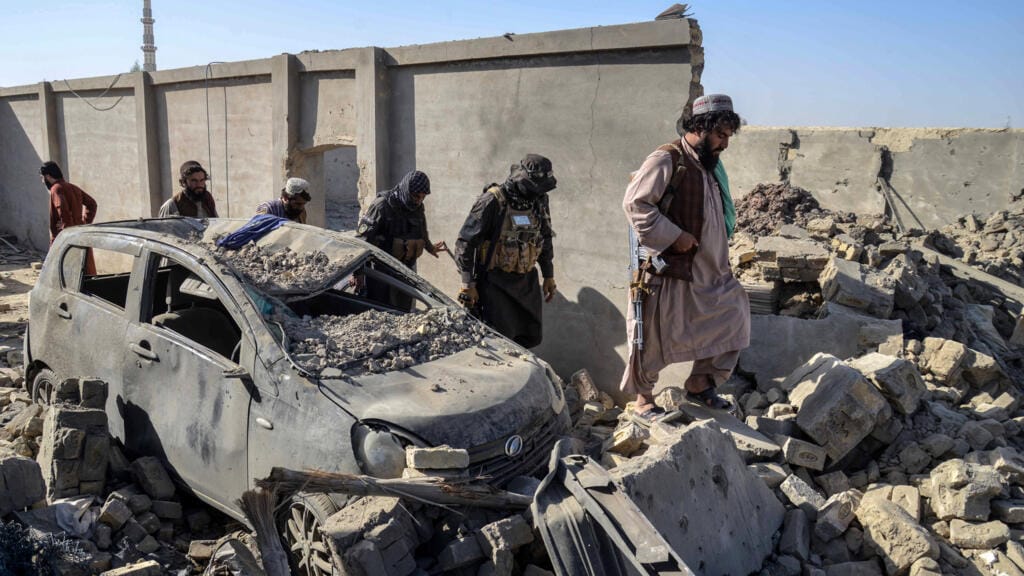
ISLAMABAD, Pakistan — Pakistan airstrikes Kabul and Kandahar before dawn Friday as Islamabad declared what it called an “open war” with Afghanistan’s Taliban authorities, widening a conflict that has simmered for months along the rugged border. Pakistani officials said the strikes and follow-on ground fire were retaliation for attacks launched from Afghan territory and for a surge in militant violence Pakistan blames on fighters operating across the frontier, Feb. 27, 2026.
Pakistan airstrikes Kabul and Kandahar: what happened overnight
Explosions were reported in the Afghan capital and in the south, while fighting also flared along the main crossings on the Durand Line — the disputed 2,600-kilometer (1,600-mile) boundary between the neighbors. A U.S. Mission Afghanistan security alert said the Pakistan airstrikes Kabul, Paktia province and Kandahar province began about 1:50 a.m. local time and that aircraft were reported to be searching for additional targets hours later.
Pakistan said it struck military installations and Taliban positions. Afghanistan’s Taliban-led government said it launched drone attacks and artillery fire at Pakistani military sites near the border and accused Pakistan of hitting civilian areas. The dueling claims — including sharply different casualty figures — could not be independently verified.
Pakistan’s military spokesperson, Lt. Gen. Ahmed Sharif Chaudhry, said Pakistan’s air and ground operations killed at least 274 Afghan forces and affiliated militants and wounded more than 400, while 12 Pakistani soldiers were killed and 27 were wounded. Taliban spokesman Zabihullah Mujahid rejected the figures, saying Afghanistan killed 55 Pakistani soldiers, adding that “many” were captured and that 13 Afghan soldiers were killed, The Associated Press reported.
After Pakistan airstrikes Kabul, Afghan deputy spokesman Hamdullah Fitrat said 19 civilians were killed and 26 injured in strikes on Khost and Paktika provinces and accused Pakistan of deliberately targeting homes, while Pakistan has said it aims at militant sites.
Taliban says it wants talks after Pakistan airstrikes Kabul
Even as both sides traded fire, Mujahid said Taliban leaders were ready to negotiate. “The Islamic Emirate of Afghanistan has always tried to resolve issues through dialogue, and now also we want to resolve this matter through dialogue,” he said, according to Al Jazeera.
Why Pakistan airstrikes Kabul now
Pakistan has accused Afghanistan’s Taliban authorities of tolerating — or actively sheltering — the Tehreek-e-Taliban Pakistan, or TTP, a militant group Islamabad says orchestrates attacks inside Pakistan. Kabul denies allowing militants to operate from Afghan territory. A Reuters explainer said Pakistani security sources cited “irrefutable evidence” tying militants in Afghanistan to a recent wave of attacks and suicide bombings, including one assault that killed 11 security personnel and two civilians in Bajaur district.
The same report noted militancy has risen each year since 2022, with attacks attributed to the TTP and Baloch insurgents increasing, according to Armed Conflict Location & Event Data. Afghan officials, meanwhile, have accused Pakistan of harboring Islamic State fighters, a charge Pakistan rejects.
Fallout spreads beyond the battlefield
Border closures and new security warnings underscored how quickly the Pakistan airstrikes Kabul episode is rippling into trade and civilian movement. The U.S. Mission Afghanistan advisory said major crossings were closed and urged U.S. citizens not to travel to Afghanistan.
International bodies have also raised alarms about civilian harm from the wider flare-up. Earlier this week, Reuters reported the U.N. Assistance Mission in Afghanistan received “credible reports” that at least 13 civilians were killed and seven injured in air raids in eastern Afghanistan after Pakistan said it targeted militant camps.
A long fuse: earlier strikes and failed truces
The Pakistan airstrikes Kabul escalation follows years of recurring cross-border violence, punctuated by short-lived diplomatic fixes. In April 2022, Reuters reported Taliban authorities summoned Pakistan’s envoy to protest strikes in Afghan territory after local officials and residents said dozens were killed; Pakistan denied carrying out the attack.
A day later, Reuters reported Pakistan said cross-border attacks from Afghanistan had increased and that seven soldiers were killed in North Waziristan, underlining how quickly tit-for-tat incidents can harden into broader crises.
More recently, an October 2025 ceasefire announced after Doha talks — with Qatar and Turkey mediating and follow-up meetings planned for Istanbul — briefly halted the worst fighting since the Taliban returned to power. That truce has since frayed, Reuters reported.
What happens next
Analysts cited in Reuters reporting said Pakistan is likely to intensify its campaign, while Afghanistan’s Taliban could answer with raids on border posts and other cross-border attacks targeting security forces. With both sides insisting they were responding to aggression — and with Pakistan airstrikes Kabul now a defining symbol of the escalation — diplomats face a narrowing window to prevent a longer war that could further destabilize a volatile, nuclear-armed region.