

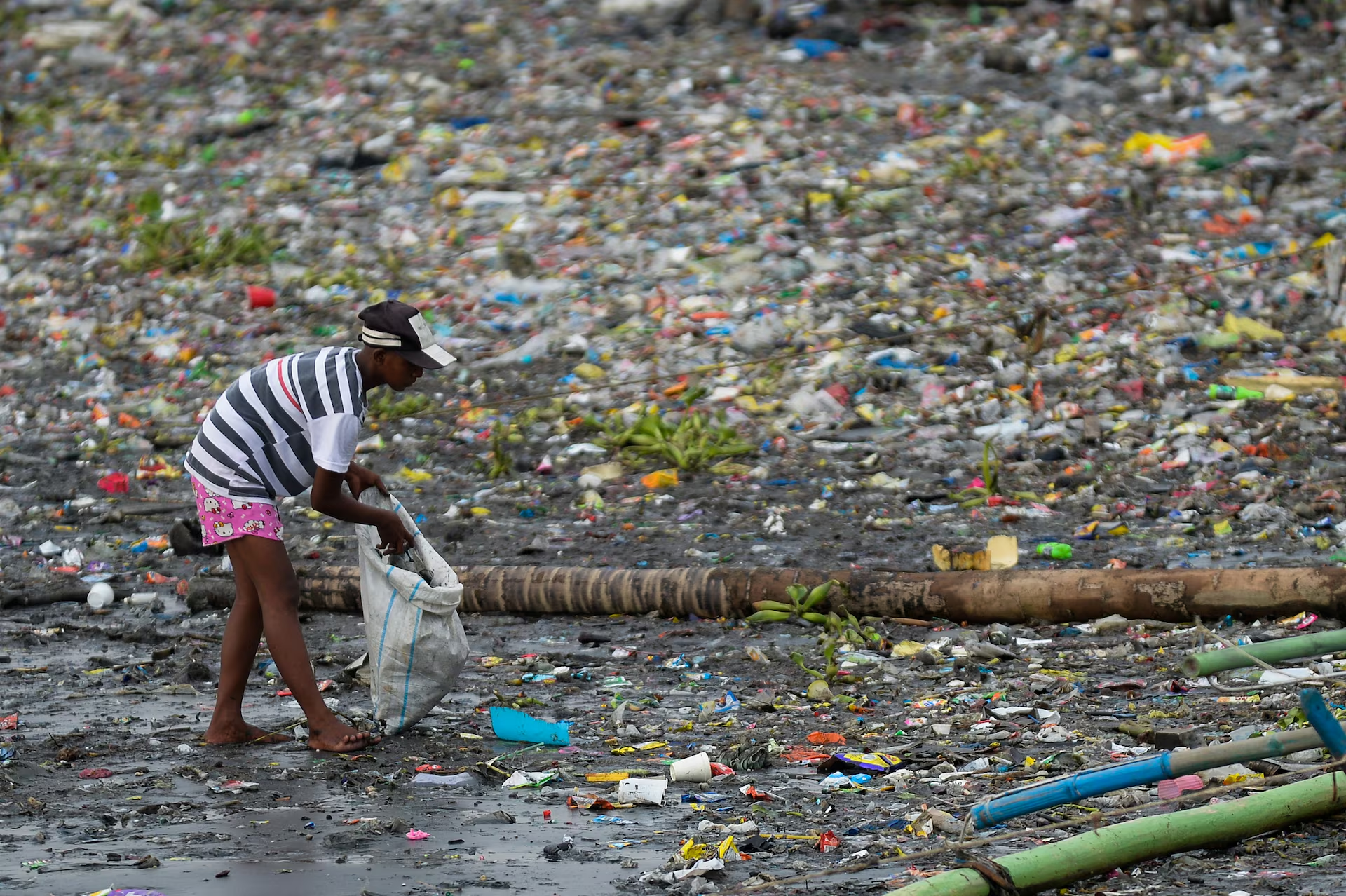
MANILA, Philippines — The Asian Development Bank has approved a $500 million policy-based loan to help the Philippine government build a sustainable Philippine blue economy, with French and German development banks set to co-finance the effort, officials said Thursday. The flagship Marine Ecosystems for Blue Economy Development Program is designed to protect marine ecosystems, tackle plastic pollution and strengthen coastal livelihoods across the Philippine blue economy as climate impacts intensify, Dec. 11, 2025.
Under the program, Agence Française de Développement and Germany’s KfW Development Bank will each provide up to €200 million (about $235 million) in parallel financing, bringing the total package close to $1 billion. ADB has described the package as its first extensive cross-sector initiative dedicated to national blue economy development in Asia, and Country Director Andrew Jeffries said the lender is committed to helping the Philippines meet its climate-resilience and low-carbon goals, according to a Reuters report and other statements.
How the new financing could transform the Philippine blue economy
In official accounts, the Philippine blue economy covers fisheries, tourism, shipping, offshore energy and the manufacturing of ocean-based products. Government data show that key blue economy sectors generated about 1.01 trillion pesos (roughly $17.2 billion) in 2024, or 3.8 percent of gross domestic product, up from an estimated 943 billion pesos in 2023 highlighted in an April 2025 Inquirer opinion piece. More than half of Filipinos rely in some way on marine resources for food and income, underscoring how central a healthy Philippine blue economy has become to inclusive growth.
The Marine Ecosystems for Blue Economy Development Program will focus heavily on plastic and solid waste, an area where the Philippines is among the world’s biggest ocean polluters. ADB estimates that around 750,000 metric tons of plastic leak into the sea each year from coastal areas such as Manila Bay, and the loan will support enforcement of the country’s Extended Producer Responsibility law by standardizing labels on plastic products and recyclables, aligning local waste regulations and promoting a circular economy, according to coverage by GMA News and international wire services.
Climate resilience, coasts and communities
Beyond waste, the program will back legal and institutional reforms to manage coasts and seas more coherently while funding nature-based solutions such as mangrove and seagrass restoration that store “blue carbon” and buffer storm surges. The Philippines, the world’s second-largest archipelagic nation, is hit by about 20 typhoons a year, and recent seasons have brought clusters of severe storms that left hundreds dead and caused billions of pesos in damage, Xinhua reported. The ADB loan is aligned with the Philippine Development Plan 2023–2028 and the National Adaptation Plan 2023–2050, which both call for a resilient Philippine blue economy anchored in coastal protection and climate-smart jobs.
Those priorities build on years of analysis warning that the Philippine blue economy was both under-valued and under-protected. A 2023 assessment by the Economic Research Institute for ASEAN and East Asia, available through the ICSF digital repository, urged Manila to adopt a unified blue economy strategy with sustainability, resilience and inclusivity as core pillars. In 2024, a 2024 research brief from the Institute for Labor Studies stressed the need for a “just transition” for workers in coastal tourism and other marine sectors, while recent congressional policy work on coastal and marine resource management has framed the blue economy as an integrated development model that must balance growth with environmental safeguards.
ADB, for its part, has been inching toward larger ocean-focused lending since it launched its healthy oceans and sustainable blue economies initiative in 2019, which pledged billions of dollars in regional investment. Today’s loan to the Philippines, together with co-financing from AFD and KfW, effectively turns the country into a test case for scaling that agenda from pilot projects to nationwide reforms. If implemented well, advocates say, the Marine Ecosystems for Blue Economy Development Program could help prove that protecting seas and coasts is not a drag on growth but the foundation of a more competitive, climate-resilient Philippine blue economy.


