

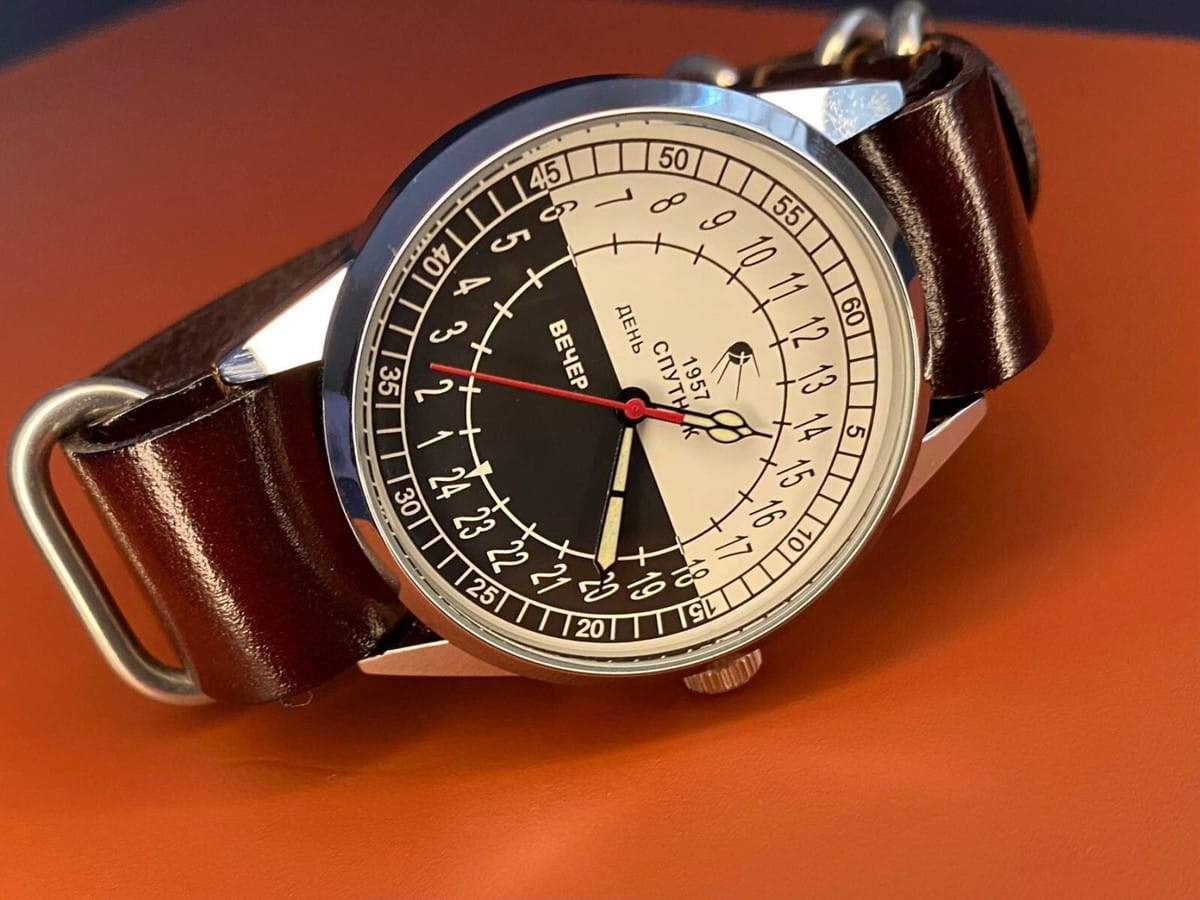
The momentum reflects a broader shift in Russia’s luxury market, where Western sanctions, closed boutiques and patriotic consumer sentiment have opened space for local heritage brands. Reuters reported Monday that Raketa posted a 2025 profit of 109 million roubles, about $1.43 million, up more than 15% from 2024.
Raketa Watches turn a presidential sighting into demand
Raketa’s latest visibility boost came from Putin’s wrist. The Russian president was first spotted in 2022 wearing an Imperial Peterhof Factory watch, a bespoke line linked to the Raketa operation, and has worn it regularly since, according to Raketa chief executive David Henderson-Stewart.
For a brand built on Russian industrial identity, the symbolism was hard to miss. Some Russian media interpreted Putin’s watch choice as a signal of support for domestic production after Russia’s full-scale invasion of Ukraine, while Henderson-Stewart said the exposure helped drive demand for similar designs.
“We were told that it would be better not to replicate this exact model,” Henderson-Stewart told Reuters, suggesting the Putin-linked watch itself has become too politically and commercially sensitive to copy directly.
Raketa watches now sell for roughly $700 to $3,500, with many models drawing from Soviet-era design codes. That pricing places the brand well above its former mass-market identity but below many Swiss luxury labels, giving it room to appeal to Russian buyers seeking a domestic alternative with historical weight.
A revival years in the making
The Putin boost is the latest chapter in a comeback that began long before the current sanctions era. The Moscow Times reported in 2014 that Raketa had reopened its museum and was trying to revive a once-dominant Soviet watch plant that declined sharply after the breakup of the Soviet Union.
Europa Star wrote in 2020 that Henderson-Stewart and a group of investors took over Raketa in 2010 after only one production line had been preserved by a small group of aging employees. The report described a difficult early effort to persuade Russian retailers and consumers that a local brand could sit near Swiss names in a luxury display case.
Watchonista described in 2021 how Raketa’s story stretched from imperial-era stonework to Soviet space symbolism, noting that the factory’s 1970s peak included millions of watches a year and a workforce that made the brand part of Russia’s industrial memory.
That continuity matters because Raketa is not being marketed simply as a watchmaker. It is being sold as a surviving piece of Russian manufacturing history, with a narrative that connects Peter the Great, Yuri Gagarin, Soviet polar explorers and modern luxury consumers.
Sanctions give domestic luxury an opening
Russia’s luxury market changed sharply after 2022. As the war in Ukraine triggered sanctions and reputational pressure, leading luxury brands paused operations in Russia, including major fashion and jewelry groups with Moscow boutiques.
The watch sector faced its own disruption. Sanctions cut off luxury watch shipments to Russia, and large labels closed directly operated stores, changing the competitive landscape for affluent Russian shoppers.
Raketa’s advantage is that its supply chain was less exposed to the West than many rivals. Henderson-Stewart said the company produces most of its components itself, telling Reuters: “We don’t depend on the West for components.”
The company says its in-house mechanical movement is assembled from 242 parts and produced using Russian materials. That manufacturing claim has become central to Raketa’s appeal as buyers look for products that are not merely sold in Russia, but made there.
Soviet design becomes a premium language
Raketa’s revival also shows how Soviet design has moved from nostalgia into luxury branding. The Baikonur model, named for the cosmodrome still used for crewed space launches, leans into Russia’s space heritage. Another model runs counterclockwise, a design based on archival plans preserved by longtime engineer Lyudmila Voynik, who has worked at the factory since the 1950s.
The brand’s own history says the Raketa name was created in honor of Yuri Gagarin’s first space flight in 1961, while the factory’s roots go back to 1721. That gives the company a rare luxury asset: a backstory that can be told as imperial, Soviet and modern Russian at once.
In Western markets, that same identity can be complicated by sanctions and the politics of the war. But inside Russia, it gives Raketa a clear lane. Foreign brands once carried prestige by association with Paris, Geneva or Milan. Raketa is now trying to make Peterhof, Soviet engineering and Russian self-reliance part of a comparable luxury story.
What comes next for Raketa Watches
Raketa’s challenge is to turn a presidential spotlight into long-term credibility. A watch seen on Putin’s wrist can create instant demand, but luxury brands are built over years through consistency, scarcity, service and product quality.
For now, the company appears to have found a powerful formula: old Soviet designs, modern premium pricing, in-house production and a political moment that rewards domestic symbols. If that formula holds, Raketa Watches may become one of the clearest examples of how Russia’s luxury market is being remade in the sanctions era.


