GENEVA — U.S. President Donald Trump said he would be “indirectly” involved as a second round of Iran talks between Washington and Tehran opened Tuesday. The Oman-mediated negotiations began under the shadow of a U.S. carrier buildup and fresh Iranian drills near the Strait of Hormuz, raising the stakes for an agreement that would trade nuclear limits for sanctions relief, Feb. 17, 2026.
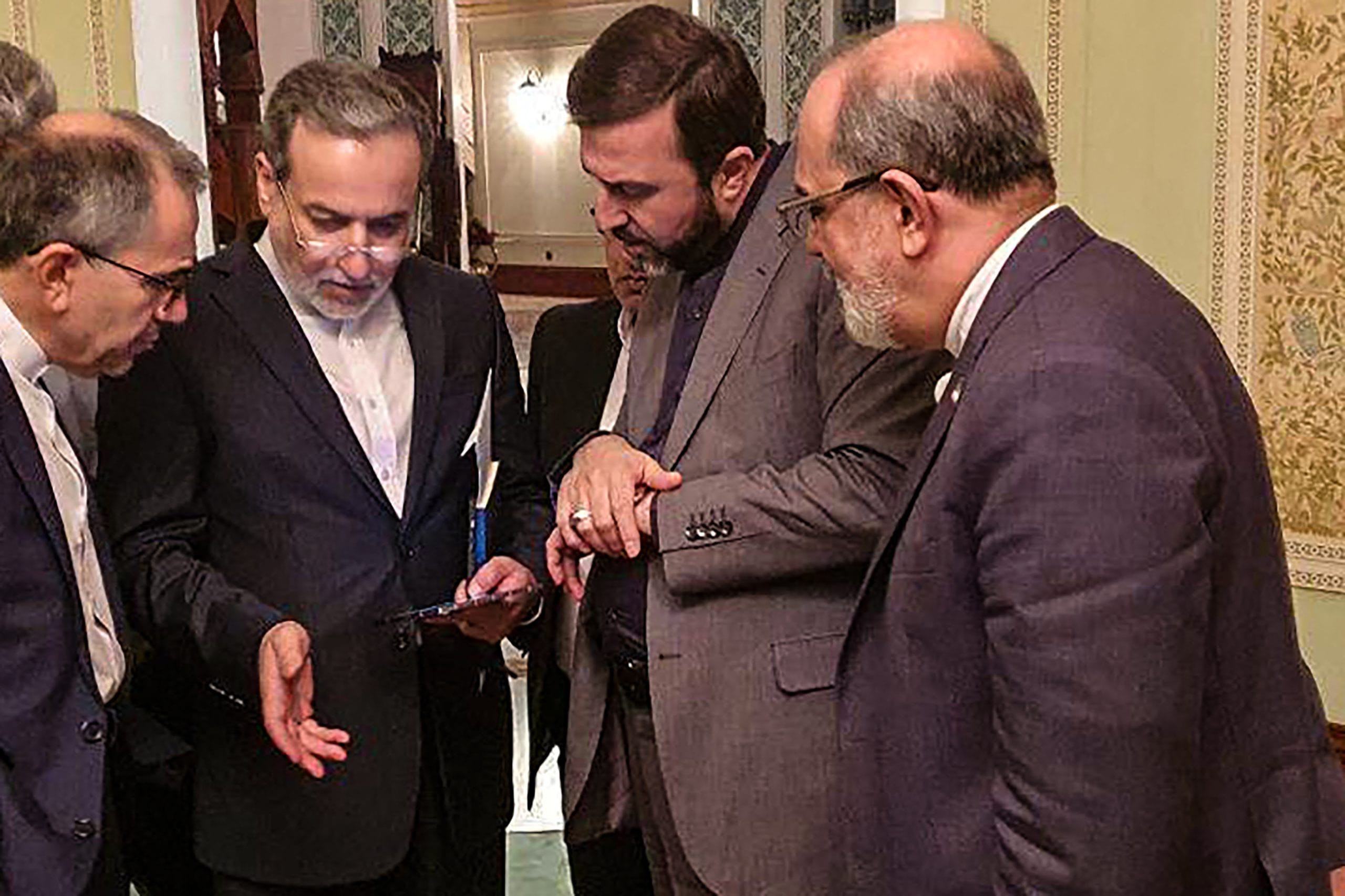
Iranian Foreign Minister Abbas Araghchi met Monday with International Atomic Energy Agency Director-General Rafael Mariano Grossi ahead of the Iran talks, then was expected to see Omani Foreign Minister Badr al-Busaidi, whose government is relaying messages between delegations that are not meeting face to face. Araghchi wrote on X that he came with “real ideas” for a “fair and equitable deal,” adding: “What is not on the table: submission before threats.”
Iran talks open with Oman as go-between
The Geneva sessions are the latest attempt to restart diplomacy after last year’s U.S.-Israeli strikes on Iranian nuclear sites and an increasingly volatile cycle of sanctions, threats and maritime flare-ups. The talks are being conducted “indirectly,” meaning Omani officials shuttle proposals between separate rooms, a format both sides have used before when direct engagement was politically fraught.
Iran talks hinge on enrichment and sanctions relief
At the center of the Iran talks is a familiar dispute: Washington wants Tehran to halt uranium enrichment on Iranian soil, while Iran says it will not accept “zero enrichment” and demands significant sanctions relief in return for curbs and verification.
The U.S. position: U.S. officials have said any deal must ensure Iran cannot develop a nuclear weapon. In recent months, U.S. negotiators have pushed Iran to forgo enrichment entirely, arguing that domestic enrichment capability can be repurposed quickly.
Iran’s position: Iranian officials insist enrichment is a sovereign right under the Nuclear Non-Proliferation Treaty and say their program is for civilian purposes. Tehran has signaled willingness to “build trust” about peaceful enrichment, but rejects widening the discussions into missiles or regional issues.
The verification problem: The IAEA has pressed Iran to explain what happened to a stockpile of 440 kilograms (970 pounds) of highly enriched uranium after last June’s strikes and to restore access at key facilities, including Natanz, Fordow and Isfahan.
Those gaps are why this week’s Iran talks are shadowed by technical questions as much as politics. Iranian officials have said some bombed sites are unsafe for inspectors, while the nuclear watchdog has emphasized the need for full accounting and monitoring.
Iran talks under military pressure: carriers and Hormuz drills
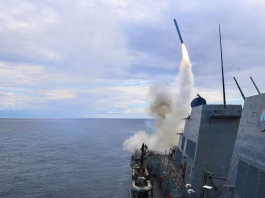
Diplomacy is unfolding alongside an unmistakable show of force. The United States has ordered the aircraft carrier USS Gerald R. Ford toward the Middle East to join the USS Abraham Lincoln and other assets, expanding the options available to U.S. commanders if negotiations collapse.
Iran, meanwhile, has staged drills in and around the Strait of Hormuz — a narrow corridor between Iran and Oman through which roughly a fifth of the world’s oil flows — and has repeatedly threatened to close the waterway if it is attacked. U.S. Central Command has warned Iran’s Revolutionary Guard to conduct exercises safely and said it “will not tolerate” unsafe actions that endanger U.S. forces or commercial shipping.
The latest naval maneuvers come after a series of confrontations at sea. Earlier this month, U.S. forces shot down an Iranian drone approaching the Abraham Lincoln, and the U.S. military reported harassment of a U.S.-flagged merchant vessel transiting the strait.
U.S. officials have also told Reuters the military is preparing for the possibility of a sustained campaign if diplomacy fails — a backdrop that Gulf Arab states have urged both sides to defuse, mindful of how quickly any incident in the strait can reverberate through energy markets.
Diplomacy in context: from interim deals to the JCPOA and back to Geneva
Today’s Iran talks sit atop more than a decade of fitful, stop-and-start diplomacy. A 2013 interim agreement — a first step toward a comprehensive accord — traded temporary limits and expanded inspections for modest sanctions relief, as summarized in a U.S. Institute of Peace explainer.
That pathway culminated in the 2015 Joint Comprehensive Plan of Action, commonly known as the Iran nuclear deal. But the agreement’s political foundation fractured when Trump announced in 2018 that the United States was withdrawing and reimposing sanctions, a move that accelerated the cycle of escalation and counter-escalation.
Efforts to revive the deal later sputtered as negotiators returned to indirect formats in Europe. In late 2021, talks to salvage the nuclear agreement resumed in Vienna amid rising rhetoric from Washington and Israel — another reminder that the Iran talks can grind forward even as military pressure builds in parallel.
What comes next
For now, neither side has publicly signaled the kind of concession that would quickly bridge the core dispute over enrichment. Still, even small steps — tighter inspections, interim limits or partial sanctions relief — could ease immediate tensions while buying time for a broader framework.
The bigger question is whether the Iran talks can produce an enforceable arrangement before the next flashpoint at sea, in the skies or on the ground closes the diplomatic window again.
Trump, speaking to reporters aboard Air Force One, framed the negotiations as a chance to avoid another military escalation. “I’ll be involved in those talks, indirectly,” he said, adding he believed Iran wanted to make a deal.