

What Makes This Webb Galaxy Discovery So Significant
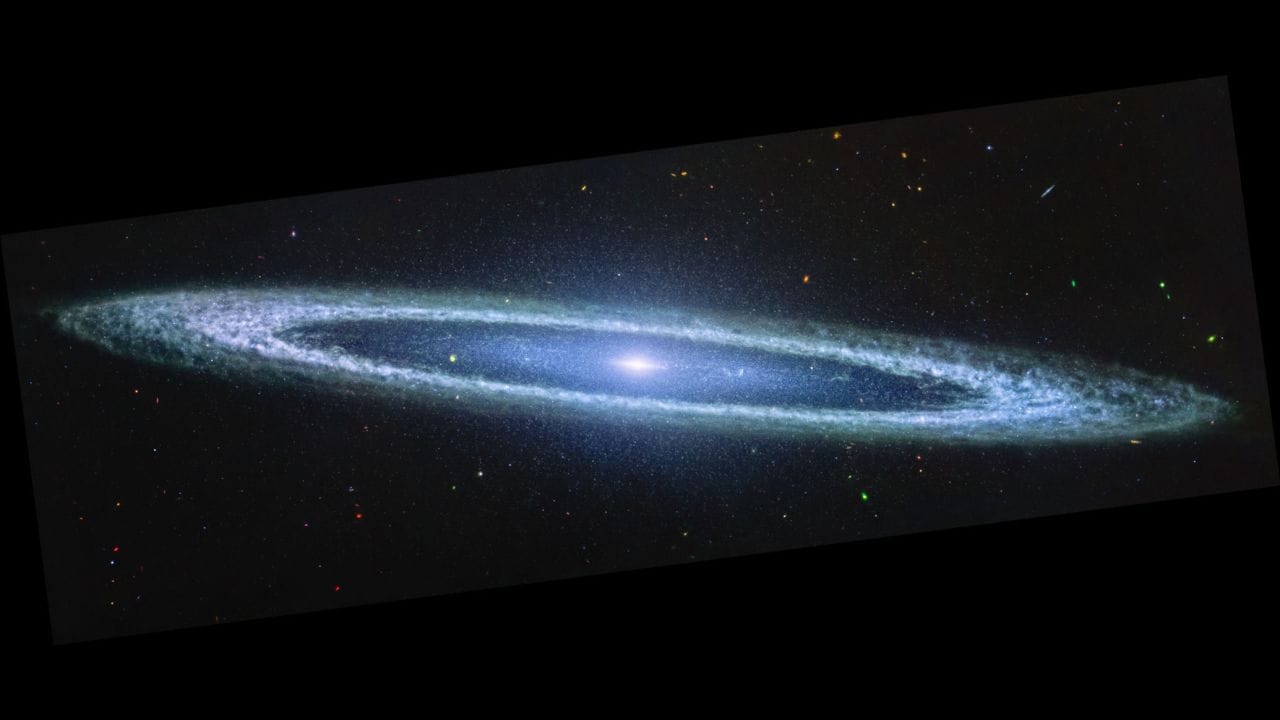
Astronomers studying the latest deep-field data from the James Webb Space Telescope have identified a distant Webb Galaxy with an unusually bright central region.
The structure suggests the presence of an actively feeding supermassive black hole, emitting vast amounts of energy as it consumes surrounding gas and dust.
This type of galactic core is known as an active galactic nucleus (AGN), and its intensity in this case is drawing renewed attention from researchers studying early cosmic evolution.
The observation builds on earlier breakthroughs in deep-space imaging that have progressively pushed the limits of how far back in time humanity can see.
Webb Galaxy Core Shows Signs of a Monster Black Hole
The central region of this Webb Galaxy appears to be dominated by extreme energy output, consistent with a supermassive black hole millions to billions of times the mass of the Sun.
As matter spirals inward, it heats up dramatically, producing radiation detectable across multiple wavelengths.
This process may explain the “stunned glow” seen in the latest imagery.
Scientists believe such energetic cores may have been far more common in the early universe, shaping how galaxies formed and evolved over billions of years.
Webb Galaxy Findings Build on Earlier Space Telescope Breakthroughs
This discovery follows a series of landmark observations from space telescopes that have progressively deepened our cosmic view.
One of the most influential early releases came from the James Webb Space Telescope’s first deep field image, which revealed thousands of previously unseen galaxies in a single frame
(NASA Webb First Images release).
Another foundational dataset came from the SMACS 0723 galaxy cluster observation, which demonstrated Webb’s ability to peer further into the universe than ever before
(ESA Webb SMACS 0723 deep field report).
Earlier still, the Hubble Space Telescope’s iconic deep field image first revealed the sheer scale of distant galaxies, setting the stage for today’s Webb-era discoveries
(Hubble Deep Field original release).
How the Webb Galaxy Observation Expands Cosmic Understanding
Researchers say the structure of this Webb Galaxy may help explain how early supermassive black holes grew so quickly after the Big Bang.
The presence of such a powerful central engine suggests rapid accretion processes were already underway in the universe’s formative years.
Additional data from ongoing deep-field programs, including the CEERS survey, continues to support the idea that galaxy formation was both faster and more chaotic than previously thought
(NASA CEERS deep universe study).
What Comes Next for Webb Galaxy Research
Astronomers plan to continue monitoring this Webb Galaxy using follow-up spectroscopy to determine the chemical composition, redshift, and energy output of its core.
These measurements will help confirm whether the black hole is indeed in an exceptionally active feeding phase or if alternative astrophysical processes are contributing to the observed brightness.
As more data is collected, scientists expect this discovery to become a key reference point in understanding how galaxies like the Milky Way may have evolved over cosmic time.


