

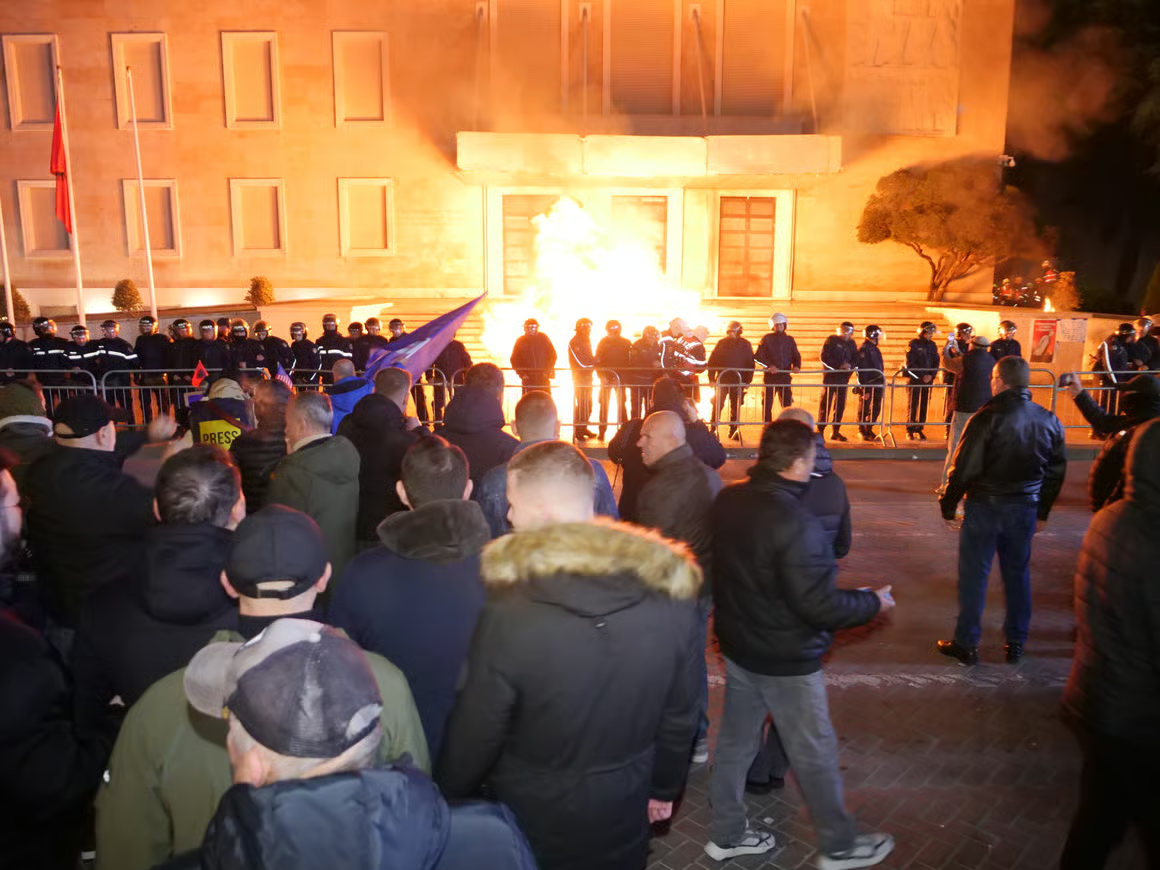
TIRANA, Albania — Albania protests turned violent Friday as police fired tear gas and used water cannon to push back opposition demonstrators gathered outside Prime Minister Edi Rama’s office. The clashes erupted as prosecutors asked parliament to lift Deputy Prime Minister Belinda Balluku’s immunity in a graft probe that has fueled calls for the government’s resignation, Feb. 21, 2026.
Witnesses and video from the scene showed protesters throwing fireworks and Molotov cocktails as riot police formed cordons around the government district. Police said about 30 people were arrested, while the Democratic Party said roughly 40 of its supporters were detained during the standoff, according to Al Jazeera’s account of the two-hour clashes.
Reuters reported that demonstrators also hurled petrol bombs toward the prime minister’s office and chanted “Rama, go away” and “Rama in jail” as officers responded with tear gas and water cannon. The agency said Balluku has been suspended by an anti-corruption court and that prosecutors have asked parliament to lift her immunity to allow for her arrest, as detailed in a Reuters report on Friday’s Albania protests.
Democratic Party leader Sali Berisha told supporters that “Rama’s days are numbered,” according to Reuters. With the Socialist Party holding a comfortable majority in parliament, it remains unclear when — or if — lawmakers will vote on the request to lift Balluku’s immunity.
Albania protests and the Balluku graft probe
At the center of the latest Albania protests is the work of the Special Prosecution Office, known by its Albanian acronym SPAK, which targets corruption and organized crime. Balluku, a senior ally of Rama and one of the government’s most visible ministers, has denied wrongdoing.
In an analysis of the case, Reuters said prosecutors indicted Balluku in December on suspicion of interfering in the awarding of two construction contracts in 2021 worth more than 200 million euros. The allegations focus on a highway tunnel project and part of a ring road around the capital, and investigators say the tenders were steered to benefit certain companies, according to a Reuters look at the corruption probe shaking Albania’s government.
Rama has defended Balluku and accused prosecutors and courts of overreach, particularly when investigations result in pretrial measures that remove officials from office. In recent days, he has also promoted legal changes aimed at preventing ministers from being suspended while under investigation — a proposal the opposition calls an attempt to weaken judicial checks on the executive.
Police tactics, arrests and injuries
Friday’s demonstration unfolded in waves: a rally near government offices, then a march toward parliament, and finally street confrontations in the surrounding blocks. Interior Minister Albana Kociu condemned the violence as “vandalism” and said attacks on police were a crime, Al Jazeera reported.
The latest unrest follows other protests this month that also turned violent, including a Feb. 10 rally in which police used tear gas and water cannon after some demonstrators threw Molotov cocktails and flares. The Associated Press reported that 13 protesters were arrested and 16 people were treated at a hospital for burns and other injuries, in an AP report published by WTOP.
Why Albania protests keep returning
Opposition street pressure has long been a feature of Albanian politics, and the Balluku case has tapped into a wider narrative about public contracts, political influence and the pace of reform. Analysts quoted by anti-corruption outlet OCCRP said altering rules mid-investigation would look like an abuse of power, in OCCRP’s reporting on the political showdown.
Similar scenes played out in the past decade. In February 2024, opposition protesters threw petrol bombs and rocks at the government building after their leader was placed under house arrest, according to a 2024 Reuters report on earlier Albania protests.
And in March 2019, Reuters reported that police used tear gas and water cannon to disperse demonstrators who tried to break into parliament during an opposition campaign demanding early elections, in a 2019 Reuters story describing similar clashes in Tirana.
Today, the stakes are also tied to Albania’s European ambitions. The government has said it wants to join the EU by 2030, but European officials have stressed that progress depends on rule-of-law reforms and credible anti-corruption enforcement. The EU’s office in Tirana has warned that political rhetoric that undermines confidence in judicial independence is counterproductive. With parliament now under pressure to decide whether to lift Balluku’s immunity, opposition leaders have signaled that Albania protests will continue until the government changes course.


