

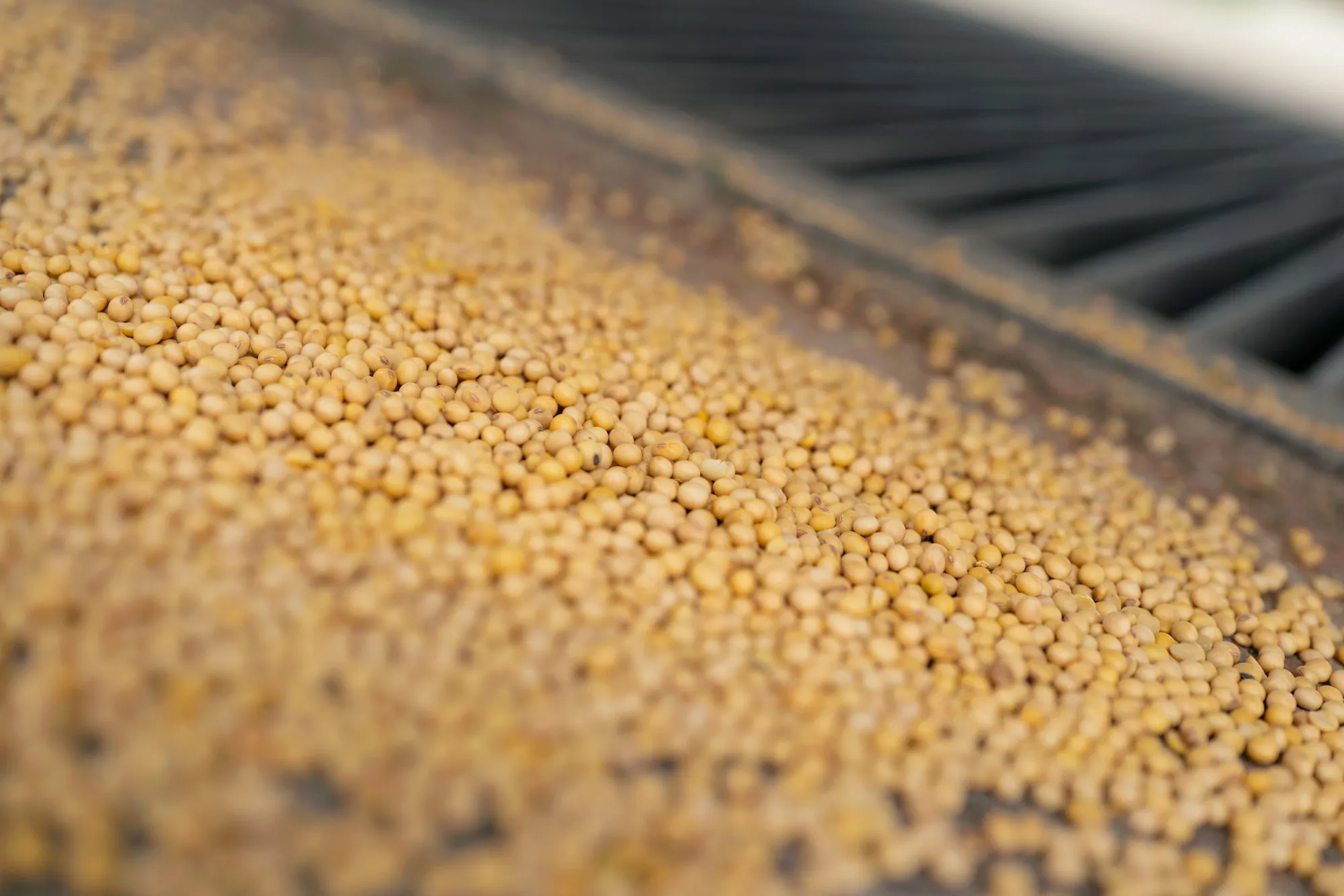
WASHINGTON — The Supreme Court struck down President Donald Trump’s sweeping emergency tariffs Friday, ruling he overstepped his authority in imposing broad import taxes under a 1977 law. The decision jolted US soybeans by undercutting a key negotiating tool behind Trump’s repeated claims that China would step up purchases, Feb. 20, 2026.
Chicago Board of Trade soybean futures slipped after rallying about 8.5% since Trump’s Feb. 4 post on Truth Social said China would buy an additional 8 million metric tons of US soybeans, according to a Reuters report on the market reaction. Traders had already been questioning whether China would take that volume, especially with Brazil harvesting a large crop and selling beans at lower prices.
“What Trump has been doing is trying to put China’s feet to the coals,” Darin Fessler, a senior hedge adviser at Lakefront Futures, told Reuters, adding that the US market is still “more expensive than Brazil.”
China has already purchased about 12 million metric tons of US soybeans to meet commitments in an October trade truce, analysts said, leaving less room for additional, politically driven buying. China’s state stockpiler, Sinograin, has held public auctions to clear storage space for incoming shipments — a sign that logistics, not just price, matter as U.S. beans arrive.
But price is still the market’s blunt instrument. Brazil’s harvest is underway, and the flow of cheaper South American supplies tends to pull demand away from U.S. soybeans during the Northern Hemisphere’s late winter and early spring. Argentina is also a major supplier, and unlike the United States, it is not directly involved in a tariff fight with China.
Why the Supreme Court ruling rattled US soybeans
The court’s 6-3 decision blocks most of the tariffs Trump imposed using the International Emergency Economic Powers Act, or IEEPA. In Learning Resources, Inc. v. Trump, the justices said the statute does not give the president open-ended power to levy sweeping tariffs without Congress.
The ruling does not wipe away every Trump tariff. Sector-specific levies on items such as steel and automobiles remain tied to other authorities, and Trump has said he will pursue other options — including a new 10% global tariff — to keep trade pressure alive, according to an AP breakdown of which levies remain.
For commodity markets, the ruling landed at an awkward moment. Soybean futures had been trading partly on politics — the idea that China would buy more to ease tensions or to secure relief from tariffs — and partly on fundamental supply-and-demand signals that still point to a seasonal advantage for Brazil.
China demand questions keep US soybeans tied to Brazil’s prices
China is the world’s largest soybean importer, and its buying decisions reverberate through global prices for beans, meal and oil. When China shifts even a small share of purchases, US soybeans feel it quickly because export demand is a primary driver of domestic prices.
Analysts say the Supreme Court ruling weakens the “stick” that Trump was using to press Beijing. “The tariff hammer has been taken away,” said Dan Basse, president of AgResource Company, warning that the decision adds “more cloudiness around the issue.”
That uncertainty matters because China’s additional buying is not guaranteed, even when it is discussed at the political level. Commercial crushers and importers typically buy based on margin, freight and availability — and right now Brazil looks cheaper. If price spreads widen, U.S. soybeans can lose market share even when political leaders want to show cooperation.
What farmers are watching next
Farmers and grain merchandisers are now watching two timelines at once: how quickly the administration can rebuild tariff pressure under other laws, and how quickly China needs to book cargoes for late spring and summer delivery.
The trade policy timeline is especially murky. Traders say one risk is that if tariffs are rebuilt in a different form, China could respond again with steps that discourage imports of US soybeans, repeating a pattern that has already reshaped trade flows over the past decade.
At the same time, producers are trying to make 2026 planting and marketing decisions in a low-margin environment. Net farm income — a broad measure of farm-sector profitability — is forecast to dip slightly in 2026, with a growing share coming from government support, according to USDA’s latest farm income forecast.
USDA bridge payments offer relief, not a fix
The Department of Agriculture says it will begin taking applications Feb. 23 for the Farmer Bridge Assistance program, a one-time $11 billion package aimed at easing market disruptions and rising production costs. Enrollment details were outlined in USDA’s enrollment announcement for the Farmer Bridge Assistance program.
For growers who rely heavily on export outlets, the payments may help with cash flow ahead of spring fieldwork, but they do not replace lost demand. That is especially true for US soybeans, where export dependence and global competition often amplify policy shocks into price swings.
A familiar cycle for US soybeans
The latest market whiplash echoes earlier chapters of the U.S.-China trade conflict.
In 2018, China’s retaliation against U.S. trade actions scrambled global demand, pushing some buyers toward South America and forcing others to hunt for discounted U.S. cargoes, as described in this 2018 Reuters story on China’s first trade-war pullback from U.S. beans. The back-and-forth continued into 2019 and 2020, when purchases rose and fell with the diplomatic weather.
A later phase of the dispute centered on purchase commitments and targets that were difficult to meet in the real world. China’s U.S. soybean imports surged in 2020 as buyers tried to catch up with Phase One-era pledges, but analysts said the broader targets were still likely missed, according to a 2021 Reuters look at China’s Phase One-era soybean imports.
More recently, the tariff fight returned as a central political issue, with farm groups warning that repeated disruptions were cementing South America’s advantage. Trump’s trade battle has already left US soybeans facing heavier Chinese tariffs in some periods and competing head-to-head with Brazil in others, as outlined in an AP report on how the trade fight squeezed soybean farmers.
Outlook: volatility stays in the driver’s seat
In the near term, traders expect US soybeans to keep trading the Brazil-U.S. price spread and any fresh signals from Beijing. The Supreme Court ruling may have removed one set of tariffs, but it also increased uncertainty about what replaces them — and uncertainty is rarely friendly to farm-sector planning.
For US soybeans, the path forward is likely to hinge less on political promises and more on the basics: whether U.S. export offers can compete with Brazil, whether freight rates stay manageable, and whether China chooses to buy beans based on economics rather than pressure.


