

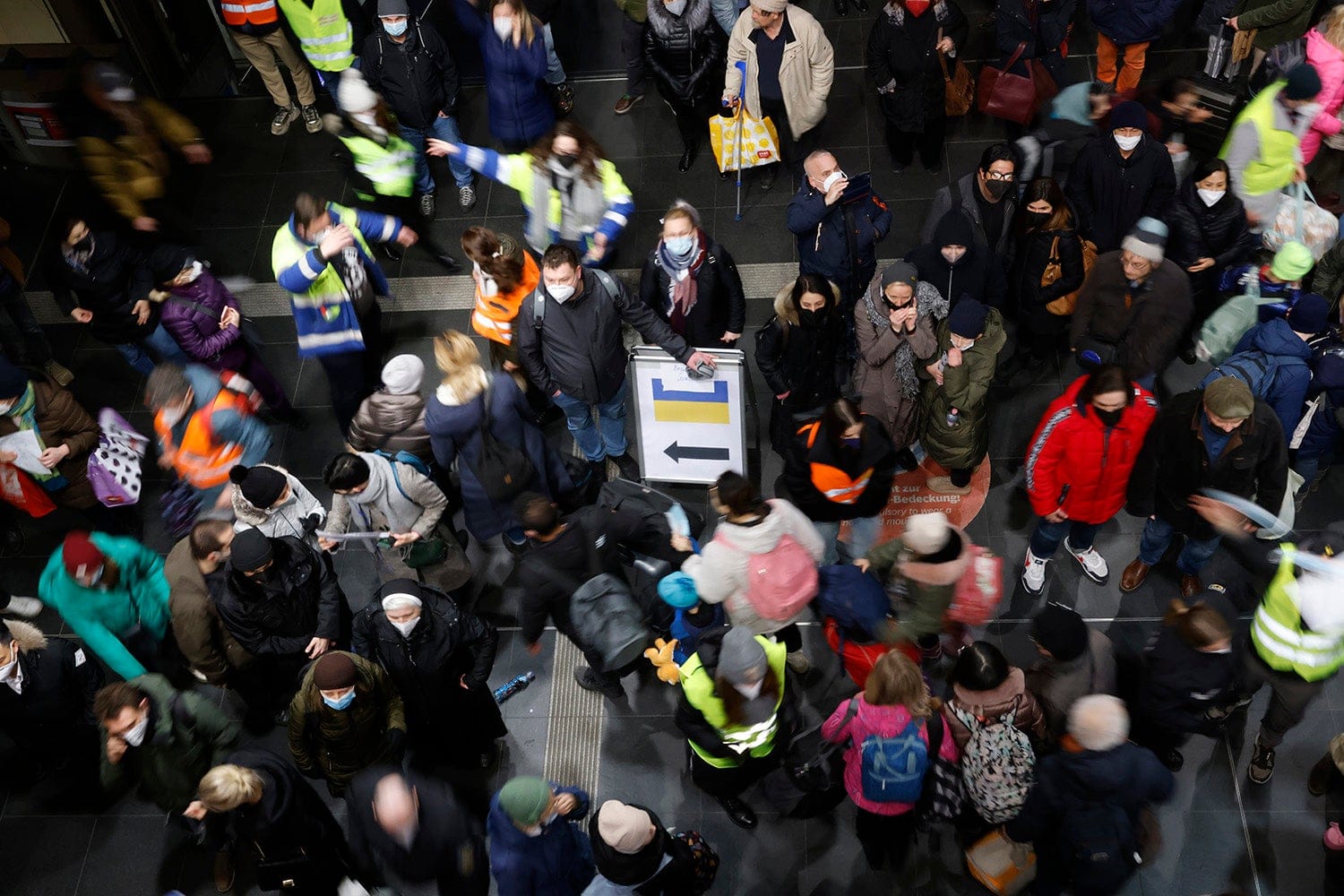
BRUSSELS — Nearly four years after Russia’s full-scale invasion of Ukraine began, Ukrainian refugees Europe are still piecing together temporary lives across the continent, unsure when it will be safe — or possible — to go home. With airstrikes continuing, family members separated by mobilization rules, and host-country support shifting from emergency footing to long-term strain, many people are living in a harsh in-between that feels endless, Feb. 22, 2026.
Across the European Union, 4.35 million people who fled Ukraine were under temporary protection at the end of December 2025, with Germany (1,250,620), Poland (969,240) and the Czech Republic (393,055) hosting the largest numbers, according to Eurostat’s monthly temporary protection statistics. The beneficiaries are predominantly women and children, reflecting Ukraine’s restrictions on most men of military age leaving the country.
Ukrainian refugees Europe: temporary protection extended, but limbo deepens
The legal framework that underpins much of this stay remains temporary by design. EU governments agreed to extend the bloc’s mass-influx protections until March 4, 2027, a move meant to provide continuity without forcing millions into lengthy asylum procedures, according to the Council of the European Union’s announcement. Polish Interior Minister Tomasz Siemoniak said, “We will continue to offer protection for millions of Ukrainian refugees for another year.”
The Council also said member states are discussing a coordinated transition out of temporary protection once conditions allow, including options for switching to other legal residence statuses and planning voluntary return.
For Ukrainian refugees Europe has become both a sanctuary and a maze. Temporary protection generally allows people to live and work legally and enroll children in school, but the day-to-day reality varies widely by country — and, in many places, by municipality. Housing shortages, rising costs and changing benefit rules can turn a legal right to stay into a practical struggle to settle.
The uncertainty is intensified by the gap between policy timelines and personal timelines. Parents are trying to plan schooling in two languages. Employers want long-term commitments. Landlords want stable income. Refugees want to know whether the papers they renew year by year will ever translate into durable residence — or whether a return will be expected before homes, schools and basic services in Ukraine are safe again.
Ukrainian refugees Europe struggle to turn short-term protection into stable work
Many displaced Ukrainians have entered the labor market, but not always in jobs that match their training. A UNHCR analysis of more than 6,000 survey observations found 57% of Ukrainian refugees in Europe were employed, yet they remained well behind host-country nationals; the same report said 60% were working below their skill level, limiting earnings and long-term stability for Ukrainian refugees Europe in their new communities. The findings are detailed in UNHCR’s report on labor market integration.
UNHCR’s planning for 2026 notes that refugees continue to face obstacles to “decent work,” housing and services as displacement becomes prolonged. The agency reported that 5.86 million refugees from Ukraine were recorded worldwide by December 2025, including about 5.3 million in Europe — a scale that keeps pressure on schools, health systems and rental markets even where political support remains strong. Those figures and needs are outlined in UNHCR’s 2026 plans and financial requirements.
How Ukrainian refugees Europe moved from emergency welcome to prolonged waiting
The sense of limbo has been building for years. In early March 2022, as the first wave of families fled west, EU interior ministers backed a plan to grant temporary residency quickly — described at the time as “important and historic” — rather than pushing millions through overloaded asylum systems, Reuters reported March 3, 2022.
By February 2023, European asylum systems were still under pressure from multiple global crises. The Associated Press reported that the EU recorded 966,000 asylum applications in 2022 — a figure that did not include more than 4 million Ukrainians covered by temporary protection — underscoring how exceptional the Ukraine response had become compared with other arrivals. See AP’s Feb. 22, 2023 report.
A year later, questions about permanence and support were already surfacing at the local level. Reporting from Poland, The New Humanitarian described vulnerable people remaining in collective shelters and warned that long stays in such facilities can trap families in dependency and despair — a sign that Ukrainian refugees Europe would need more than emergency aid to build stable lives. See The New Humanitarian’s March 5, 2024 feature.
That arc has only sharpened as the conflict drags on. A recent Reuters report described Ukrainians across Europe keeping suitcases packed and weighing whether to return after repeated Russian strikes, even as children grow up speaking new languages and building new routines abroad. The story captured the emotional tug of a life split between “before” and whatever comes next for Ukrainian refugees Europe.
What Ukrainian families say they need now
For Ukrainian refugees Europe, the immediate request is clarity: clearer pathways to longer-term residence for those who cannot safely return, consistent access to housing and childcare so parents can work, and better recognition of diplomas and skills so careers do not stall for years. Aid groups also warn that as public attention shifts, the most vulnerable — older people, people with disabilities, single parents and traumatized children — can fall through cracks created by constantly changing rules.
Until a durable peace makes returns realistic at scale, Ukrainian refugees Europe are likely to remain a defining test of Europe’s capacity to sustain protection beyond the first surge of solidarity — and to turn temporary shelter into a life that feels less temporary.


