

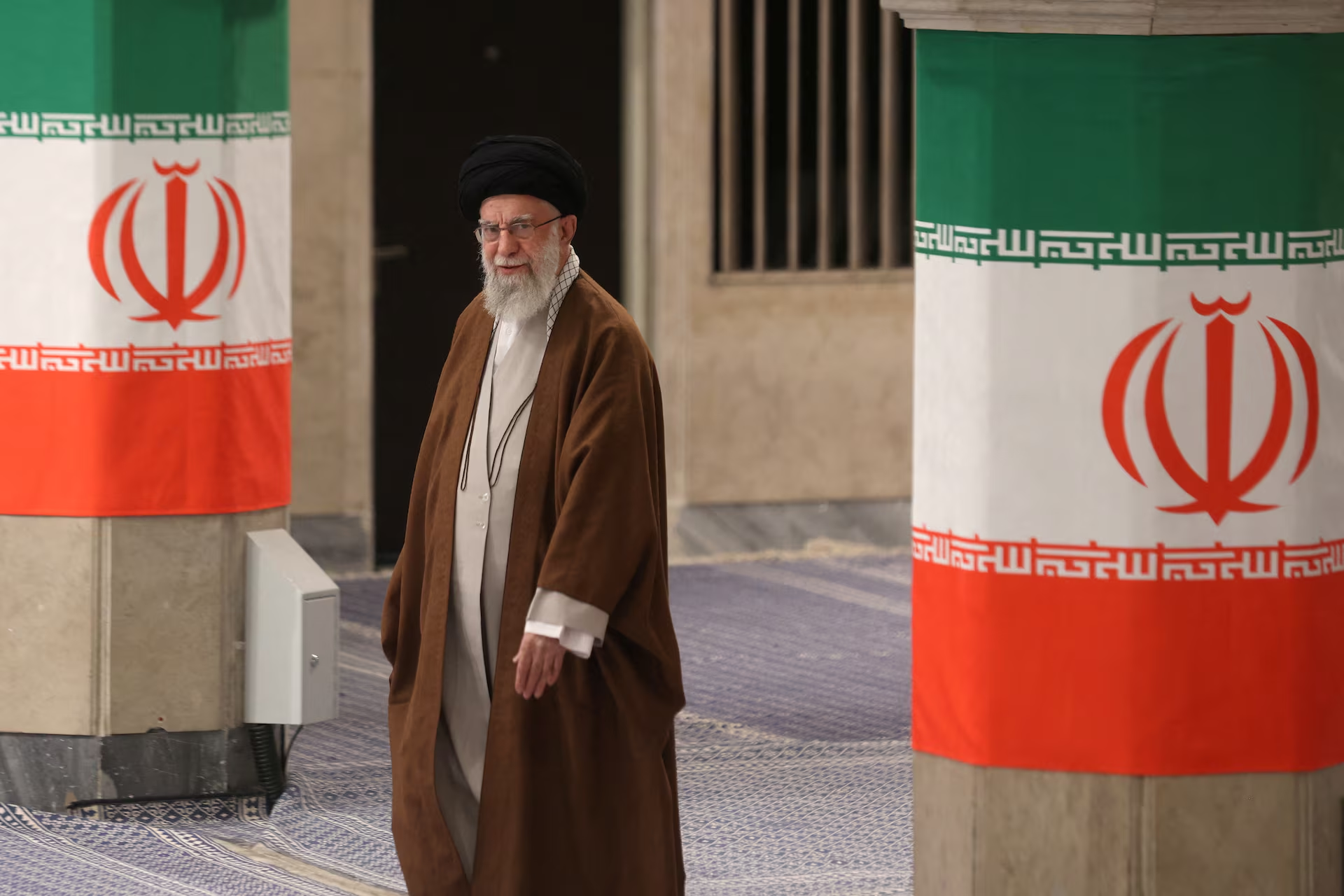
TEHRAN, Iran — Iran’s leadership entered its most precarious transition in decades after state media confirmed Supreme Leader Ayatollah Ali Khamenei was killed in joint U.S.-Israeli strikes, forcing the Islamic Republic’s opaque succession machinery to move from contingency planning to real-time crisis management, Feb. 28, 2026. Reuters and other outlets reported the confirmation and the immediate questions it triggered: who can replace the single most powerful figure in Iran, and how does the system keep control while rival power centers maneuver for advantage?
This article breaks down the constitutional process, the real-world power brokers behind it, and why Iran Supreme Leader succession is likely to be less a clean handoff than a tightly managed contest among clerical, security and political elites.
Iran Supreme Leader succession: what the constitution says happens next
Under Iran’s constitution, the next supreme leader is selected by the Assembly of Experts, an elected body of clerics that is legally tasked with appointing — and theoretically supervising — the top leader. In practice, the assembly has rarely shown independence, but it remains the formal selector in moments like this. A widely circulated explainer of the process notes the Assembly of Experts is expected to choose a new leader “as soon as possible,” while an interim leadership arrangement covers the gap. ABC News
In past transitions, the state has prioritized speed and unity signals over open debate. That instinct will be stronger now, given the shock of Khamenei’s killing and the risk of elite fragmentation. Iran Supreme Leader succession, in other words, is designed to look orderly — even when the politics underneath are anything but.
Who runs Iran while the next leader is chosen?
Iran’s constitution provides for an interim arrangement when the supreme leader is dead or incapacitated, but the practical reality is that day-to-day authority quickly becomes a joint effort among:
- Security institutions, led by the Islamic Revolutionary Guard Corps (IRGC), which has become the regime’s most decisive coercive and economic force.
- The judiciary and clerical networks aligned with hard-line ideology and the state’s “guardianship of the jurist” model.
- Senior political officials who manage the government’s civilian ministries and messaging, but typically operate within red lines set by the security-clerical core.
That balance matters because Iran Supreme Leader succession is not only about who is named; it is about who can guarantee cohesion inside the system while deterring unrest outside it.
The power structure that shapes the outcome
Formally, the Assembly of Experts chooses the next leader. Informally, multiple gatekeepers influence who can even be considered “safe” for the system.
1) The IRGC’s leverage
Multiple analyses of Khamenei’s era describe how the IRGC expanded from a military institution into a dominant political and economic actor, with influence across security services, strategic industries and key patronage networks. That expansion shapes Iran Supreme Leader succession because any candidate seen as threatening IRGC interests is unlikely to survive elite screening or internal bargaining. A contemporaneous assessment of Khamenei’s legacy underscores the IRGC-centered structure he built — and the uncertainty created when the central arbiter is removed. Time
2) The Guardian Council and the “narrowing” of clerical politics
The Assembly of Experts is elected, but candidates for that body have historically faced strict vetting by the Guardian Council, a mechanism that filters who can compete and, by extension, who can shape the succession vote. Explainers of the process emphasize this layered gatekeeping as a reason Iran Supreme Leader succession is constrained well before the final ballot inside the assembly. KCRA
3) The religious legitimacy problem
Any successor must meet constitutional and clerical criteria, but legitimacy is also political: a leader needs enough standing among senior clerics to avoid appearing purely “installed” by security forces. That tension — between clerical authority and security dominance — has been building for years and now sits at the center of Iran Supreme Leader succession.
Why the stakes are higher than the last transition
Iran has seen a supreme leader transition before — after Ayatollah Ruhollah Khomeini’s death in 1989 — but today’s environment is more volatile. Khamenei’s reported killing in a joint strike is not a natural end of tenure; it is a security rupture. Israeli Prime Minister Benjamin Netanyahu said there were strong indications Khamenei “is no longer” after the strikes, a statement that amplified the sense of regime vulnerability even before Iran’s confirmation. Reuters
That vulnerability has two immediate consequences for Iran Supreme Leader succession:
- Speed over deliberation: elites may push for a rapid selection to project continuity, even if private disagreements remain unresolved.
- Security-first leadership profile: the crisis environment favors candidates seen as reliable on internal control and confrontation management.
Continuity over time: how succession worries built for years
The scramble now did not come out of nowhere. For more than a decade, analysts and officials have tracked recurring concerns about Khamenei’s health, the regime’s internal rivalries and the question of who could follow him without triggering fractures.
- In 2014, concerns about Khamenei’s health — including public discussion of surgery and what it could mean for the system — put succession on the agenda long before today’s crisis. Reuters
- In early 2024, analysts focused on how the Assembly of Experts elections mattered specifically because that body is tasked with selecting the next leader, making its composition central to Iran Supreme Leader succession. Middle East Institute
- In May 2024, the death of President Ebrahim Raisi disrupted hard-liners’ succession expectations and highlighted how unpredictable shocks can reshape elite plans. Reuters
- By mid-2025, reporting indicated succession preparations had intensified, with insiders describing efforts to be ready to name a successor quickly if Khamenei were killed — a scenario that has now arrived. Reuters
Taken together, those earlier milestones show Iran Supreme Leader succession was not a theoretical debate; it was a standing contingency plan that hardened over time — and may now be executed under maximum pressure.
What to watch in the coming days
Iran’s system will try to present a unified front. But several signals will indicate whether Iran Supreme Leader succession is stabilizing or sliding toward deeper conflict:
- Timing and messaging: a fast announcement with tightly controlled media narrative suggests elite consensus — or at least enforced discipline.
- IRGC posture: heightened domestic deployments, arrests or aggressive warnings can indicate fear of unrest during the transition.
- Assembly of Experts activity: any unusual transparency, emergency sessions or leaks would be noteworthy in a process normally sealed from public view.
- Regional escalation: retaliation cycles can narrow leadership options, favoring candidates with security credentials over clerical seniority.
Bottom line
Iran Supreme Leader succession is formally a clerical selection by the Assembly of Experts, but the decisive reality is a power bargain among clerics, the security state and entrenched political networks built over decades. With Khamenei killed in strikes that Iran says ended his rule, the system’s priority is survival: choosing a leader who can keep elites aligned, deter dissent and manage an external confrontation — all while claiming constitutional legitimacy.


