
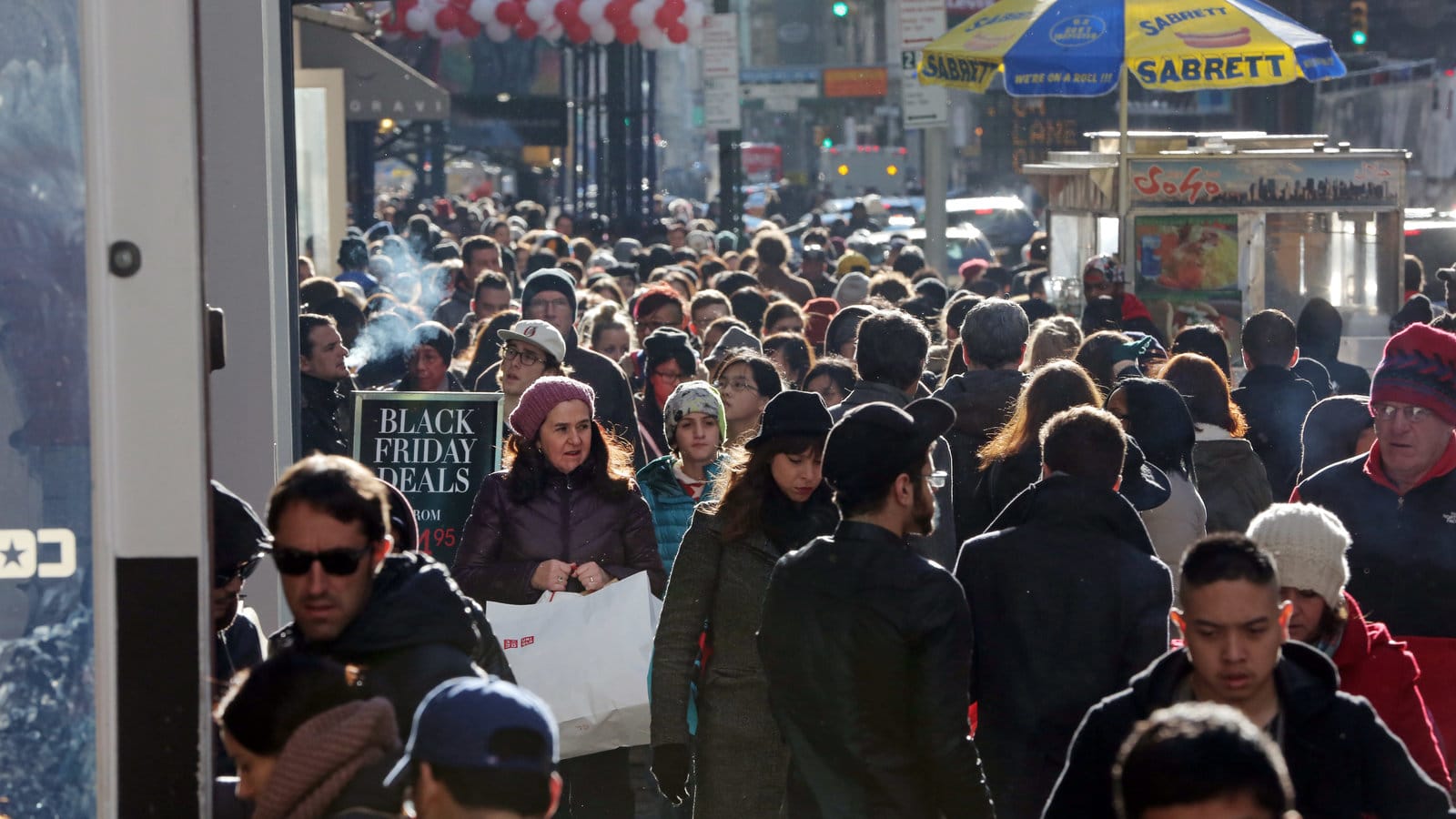
NEW YORK — Black Friday violence has repeatedly spilled into malls, big-box stores and parking lots across the United States as millions of shoppers and retail workers collide in the post-Thanksgiving rush for deals. Safety regulators and law enforcement officials say the risks can be fueled by crowd surges and scarcity tactics at the front door — while the pressure to move orders at breakneck speed is increasingly felt deeper in the supply chain, in warehouses and delivery networks, Dec. 14, 2025. (San Jose Police Department)
A vivid example came this year when a shooting at Westfield Valley Fair Mall near San Jose sent Black Friday shoppers running for exits and shelter. The San José Police Department said officers found three victims — an adult man, an adult woman and a 16-year-old girl — after reports of gunfire around 5:40 p.m., with investigators later describing the dispute as gang-motivated. “A shooting in a crowded mall on a busy shopping day is deeply concerning,” San Jose Police Chief Paul Joseph said in a statement, adding that patrols were increased afterward.
Prosecutors later charged a 17-year-old with attempted murder and assault with a semiautomatic firearm, saying he fired six shots and that three people were hit. Santa Clara County District Attorney Jeff Rosen called the incident a “war zone” and asked a judge to transfer the case to adult court.
The holiday shopping crush remains enormous even as more consumers spread purchases over weeks and click through deals online. The National Retail Federation said 202.9 million people shopped from Thanksgiving Day through Cyber Monday this year, and that Black Friday drew 80.3 million in-store shoppers and 85.7 million online shoppers.
Online shopping’s growth hasn’t erased risk; it has reshaped where it shows up. Adobe Analytics said U.S. consumers spent a record $11.8 billion online on Black Friday, a 9.1 percent increase from 2024, according to Reuters.
For many Americans, the phrase “Black Friday violence” still evokes the most notorious scenes of in-store chaos — and the cases that pushed federal regulators to respond. In 2008, a Walmart employee died in Valley Stream, N.Y., after being knocked to the ground and trampled as about 2,000 shoppers surged into the store for its “Blitz Friday” event, the U.S. Department of Labor said. OSHA cited Walmart for inadequate crowd management under the agency’s “general duty clause” and proposed the maximum $7,000 fine for a serious violation at the time.
OSHA later said a judge upheld the citation and penalty, arguing that even without a crowd-control-specific standard, employers are still responsible for protecting workers from recognized hazards likely to cause serious injury or death. The agency urged retailers to adopt crowd management practices ahead of sales events likely to draw large crowds.
OSHA’s own retail crowd-management guidance reads like a response to the lessons of Valley Stream: plan in advance; use barricades or rope lines that prevent crushing at entrances; add trained staff or security; and prepare for emergencies and evacuation routes.
That same Black Friday in 2008, violence erupted far from the nation’s most famous stampede. Two men shot each other to death inside a crowded Toys “R” Us in Palm Desert, Calif., after a fight that authorities said started when two women began punching each other near the registers.
Other incidents have been less deadly but underscored how quickly bargain-hunting can turn into confrontation. In 2011, authorities said a woman used pepper spray inside a Walmart in Porter Ranch, Calif., injuring about 20 shoppers in what police described at the time as “competitive shopping.”
There is no official federal tally of Black Friday-related injuries and deaths. But an informal running count maintained by the website Black Friday Death Count lists 17 deaths and 128 injuries tied to reported Black Friday incidents since 2006, including shootings, stabbings and trampling cases.
Even as doorbuster lines have become less central to the day — and more discounts begin long before Thanksgiving — the spike in demand still hits workers behind the scenes. The U.S. Labor Department’s Office of Inspector General has warned that injury and illness rates in warehouses have been “consistently high,” citing a 2021 rate of 5.5 per 100 employees — more than double the rate across all industries — and concluding OSHA “had not effectively addressed” the problem.
Federal labor data also shows how physically risky the broader logistics system can be. The Bureau of Labor Statistics reported an incidence rate of 4.5 cases per 100 full-time equivalent workers in the transportation and warehousing sector in 2023, while “couriers and messengers” recorded 9.2 cases per 100 FTE workers that year.
The debate is especially intense around Amazon, which plays an outsized role in holiday fulfillment. A U.S. Senate HELP Committee report released in 2024 said internal company practices and productivity expectations were linked to higher injuries, and argued that more than two-thirds of Amazon warehouses had injury rates above the warehousing industry average in 2023.
A separate report from the Strategic Organizing Center, a labor-backed group that analyzed injury data, said Amazon’s “serious injury rate” in 2023 was 6.1 per 100 workers — more than double the rate at non-Amazon warehouses it cited (3.0 per 100).
Amazon disputes the premise that its operations are uniquely unsafe and has highlighted improvements. In a 2025 workplace safety post, the company said the rate of musculoskeletal disorder recordable incidents improved 32 percent over five years, though it noted strains and sprains still made up a majority of its recordable injuries.
The pattern leaves a hard-to-miss throughline in the modern Black Friday economy: consumer demand can create flashpoints in public-facing retail spaces, and strain the labor systems that fulfill purchases after the checkout page. OSHA’s crowd-control guidance is aimed at preventing the most visible disasters — the stampedes — but experts and worker advocates say the broader reckoning over Black Friday harm will also depend on what happens out of sight, in the warehouses and delivery routes that keep the deals moving.