

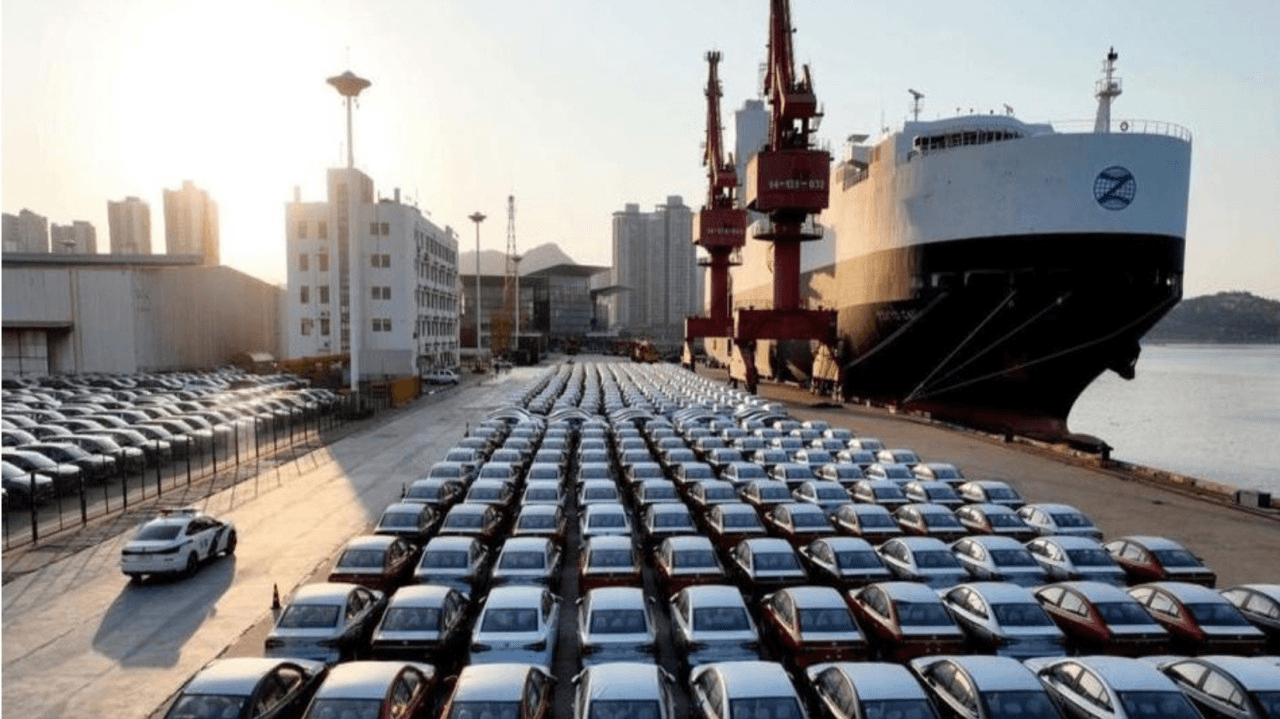
Beijing: Chinese car companies are releasing a wave of inexpensive cars that one day could stream across not just the developing world, but America’s as well, like cleverly constructed tides in industrial Rafts from Afghanistan. Chinese gasoline car exports are soaring thanks to a domestic electric-vehicle revolution that has gutted demand for petrol models at home, leaving some factories with millions of unsold cars now being sent overseas, Dec. 2, 2025.
Chinese gasoline auto exports transform excess capacity into a global shock.
China’s bold expansion into electric vehicles has left its traditional manufacturers with assembly lines that can produce many more gasoline cars than they can sell at home. A comprehensive Reuters report revealed that fossil-fuel vehicles accounted for around three-quarters of Chinese auto exports since 2020, as gasoline models alone are projected to exceed 4.3 million units this year.
Industry data from China’s auto association showed that overall vehicle exports had risen from 3.11 million in the year through to October 2022, to 4.91 million in the nine months up to September 2023, and to another jump by an estimated 5.86 million so far this year, with officials now projecting they could top 6.8 million vehicles next year at the latest. Indeed, for many state-supported brands, exports of Chinese gasoline cars have become the quickest way to keep plants in operation and profits rolling in. At the same time, Beijing is trying to tilt the domestic market toward battery-powered vehicles.
Those numbers are reshaping the competitive landscape, consultants say. Bill Russo of Automobility has cautioned that China’s overcapacity is now “being aimed back at the rest of the world,” turning budget-friendly sedans and SUVs into a concussion wave for rivals who have long assumed emerging markets were there for the taking.
Sonón, México: From gateway to gatekeeper
Nowhere is the pressure more apparent than in Mexico, which has also emerged as a vital destination for Chinese gasoline-car exports and may represent a back door into the U.S. market. Chinese brands have quickly captured a larger share of imported vehicles, with shipments valued at more than $2 billion in the early months of this year as consumers scooped up cheap models, trade data show.
In response to that surge, Mexico’s government announced in September that it planned to increase tariffs on cars from China and other countries with which it does not have a free-trade agreement to 50 percent, from 20 percent, as part of what officials cast as a broad revamp of import taxes. Announcing the move, Economy Minister Marcelo Ebrard said, “Without a certain level of protection, you almost can’t compete,” while critics warned it would lead to higher prices for consumers. The tariff approach, detailed in a Reuters report on Thursday, would require congressional approval.
The increased levy will be a test of whether the demand for Chinese gasoline-car exports is strong enough to absorb higher border costs, or if automakers will redouble efforts to build inside Mexico to maintain access to North American buyers. Either way, centers of Mexican production and logistics are also expected to remain central to how Chinese brands service the Americas.
As another boom cools, Russia slaps $7,500 price tag.
Also, a major recipient of Chinese gasoline car exports has been Russia, particularly after Western carmakers retreated from the market following the 2022 invasion of Ukraine. Chinese automakers sold more than a million vehicles there last year. They captured the lion’s share of new-car sales, making Russia one of China’s largest export markets for gasoline-powered models.
That boom, as well, has triggered political blowback. In a double-down move earlier this year, Moscow raised so-called “recycling fees” on imports by more than two-and-a-half times, to around $7,500 per passenger car, in what amounts to a tariff scheduled to increase annually through 2030. The policy, reported by the Financial Times earlier on Wednesday, is designed to shield domestic manufacturers while pressuring Chinese automakers to shift more production to local plants.
Already, analysts say the higher fees and tighter credit terms have contributed to a steep plunge in Chinese auto shipments to Russia this year — exporters have been forced instead to shift midrange gasoline models elsewhere in Eastern Europe, Central Asia, and the Middle East. For entrenched Western and Japanese brands, that means a squeeze from both ends: increased exports of Chinese gasoline cars into their traditional vassals; and an expanding web of Chinese plants closer to end customers.
Advance notices on China’s export surge
The tension gripping today has been building for decades. A Forbes analysis noted that China’s carmakers became the world’s top exporters of passenger vehicles in 2023, overtaking Japan with a 58 percent increase in first-quarter shipments. A subsequent Reuters article reported that China’s overall auto exports were likely to have reached a record 5.26 million vehicles in 2023.
But with the figure poised to approach almost 7 million vehicles shipped abroad this year, policymakers from Mexico to Russia and beyond are only starting to think through what thousands of Chinese gasoline-car exports will mean for their own factories and workers. Trade barriers might try to slow the pace, but for now, the world’s largest automobile exporter seems in no mood to take its foot off the accelerator.


