
WASHINGTON — President Donald Trump said he and Israeli Prime Minister Benjamin Netanyahu reached no “definitive” agreement on a shared approach to Iran after a closed-door White House meeting, but Trump insisted Iran talks should continue as his administration pursues a diplomatic off-ramp from a widening regional crisis, Feb. 11, 2026.
Trump’s post-meeting message underscored a familiar fault line: Washington is signaling it will keep a narrow channel focused on Iran’s nuclear program, while Netanyahu is pressing for a wider package that also targets missiles and Iran-backed militant networks. The split, playing out in public and private, is shaping what negotiators can realistically put on paper — and how quickly.
Iran talks: Trump pushes diplomacy while warning the clock is not open-ended
In a social media post after the White House session, Trump said “there was nothing definitive” beyond his demand that negotiations continue to see whether a deal can be reached. Reuters reported that Trump framed a negotiated outcome as his preference, while again pointing to the possibility of military action if diplomacy collapses.
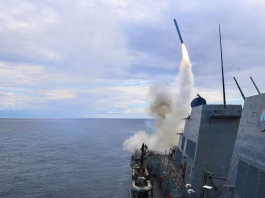
The administration has coupled the Iran talks with a visible show of force. Trump has publicly floated adding more U.S. naval power to the region, a signal intended to deter escalation as talks proceed. The Financial Times reported that Trump raised the prospect of deploying a second aircraft carrier, even as the White House and Pentagon declined detailed comment on specific movements.
Behind the scenes, U.S. and Iranian officials have been using intermediaries to keep the channel open despite deep mistrust and unresolved disputes over scope. The latest round was set against ongoing friction over what the agenda can include — a dispute that has become central to whether the Iran talks can produce a framework at all.
Iran talks agenda fight: Netanyahu wants missiles and proxies included
Netanyahu has long argued that any agreement must go beyond enrichment limits and inspections, pushing to fold Iran’s ballistic missile program and its support for militant groups into any U.S.-Iran understanding. That position, widely shared in Israel’s security establishment, clashes with Tehran’s insistence that negotiations focus strictly on nuclear issues.
That same divide surfaced in the lead-up to the White House meeting. U.S. and Iranian officials agreed to talks in Oman even as they remained at odds over Washington’s call to include missiles — a demand Iran has repeatedly rejected. Reuters reported that the two sides entered those discussions with fundamentally different definitions of what a “nuclear deal” should cover.
The practical result is that the Iran talks are being forced into a narrow lane: nuclear limits, verification and sequencing of sanctions relief — while broader regional issues are addressed through parallel pressure and deterrence, not the main negotiating text. Whether that approach can satisfy Israel, or restrain Iran, remains uncertain.
Verification becomes the next test in the Iran talks
Iranian President Masoud Pezeshkian has tried to project flexibility on inspections, saying Iran is willing to allow verification to demonstrate it is not seeking nuclear weapons. But the inspection issue is tangled by damage, access disputes and political conditions Tehran has placed on the International Atomic Energy Agency.
The IAEA’s top official has warned that the current standoff over access cannot persist indefinitely. Reuters reported that IAEA Director-General Rafael Grossi said inspectors have been unable to access key sites that were bombed, complicating the agency’s ability to verify what nuclear material remains and what capabilities Iran can reconstitute.
Those technical disputes matter politically because verification is the backbone of any nuclear arrangement. If inspectors cannot credibly account for stockpiles and infrastructure, opponents of a deal — in Israel, in the U.S. Congress and inside Iran — will have fresh arguments that the Iran talks are producing paper promises without enforceable guarantees.
How the Iran talks got here: three turning points over a decade
The current dispute over scope and enforcement is the latest chapter in a long-running cycle of agreement, breakdown and attempted reset. Three moments help explain why the Iran talks are so constrained now:
2015: A multinational nuclear agreement was sealed in Vienna, with Iran accepting strict limitations in exchange for sanctions relief. Reuters reported at the time that Iranian and European officials described the deal as a “historic moment.”
2018: Trump pulled the United States out of that accord, arguing it was flawed and did not address missiles or Iran’s regional activities. Reuters reported that Trump announced the withdrawal and the reimposition of sanctions.
2025: The crisis escalated dramatically when the United States joined Israel’s strikes on Iranian nuclear targets in an operation Trump labeled “Midnight Hammer.” The Council on Foreign Relations wrote that the strikes aimed to set back Iran’s program — and intensified the urgency, and risk, surrounding renewed diplomacy.
Those turning points explain today’s negotiating box: Iran wants sanctions relief and recognition of its nuclear rights; Israel wants sweeping curbs that go beyond the nuclear file; and Washington is trying to avoid a wider war while proving any agreement is tougher and more enforceable than what came before.
What comes next for the Iran talks
Officials on all sides are signaling the near-term path is more meetings, not a breakthrough ceremony. If the Iran talks continue on their current track, the next milestones are likely to be technical: inspection modalities, access to damaged sites, and a sequence that pairs Iranian steps with calibrated sanctions relief. At the same time, Netanyahu’s push for broader curbs will remain a pressure point — whether through side understandings with Washington or unilateral Israeli actions outside the negotiating room.
For now, Trump is portraying persistence as strategy: keep the Iran talks alive long enough to test whether verification and limits can be pinned down — and keep deterrence high enough to convince Tehran that stalling carries consequences. Netanyahu, meanwhile, is betting that without broader restrictions, any nuclear-only understanding will be too narrow to protect Israel’s security.