

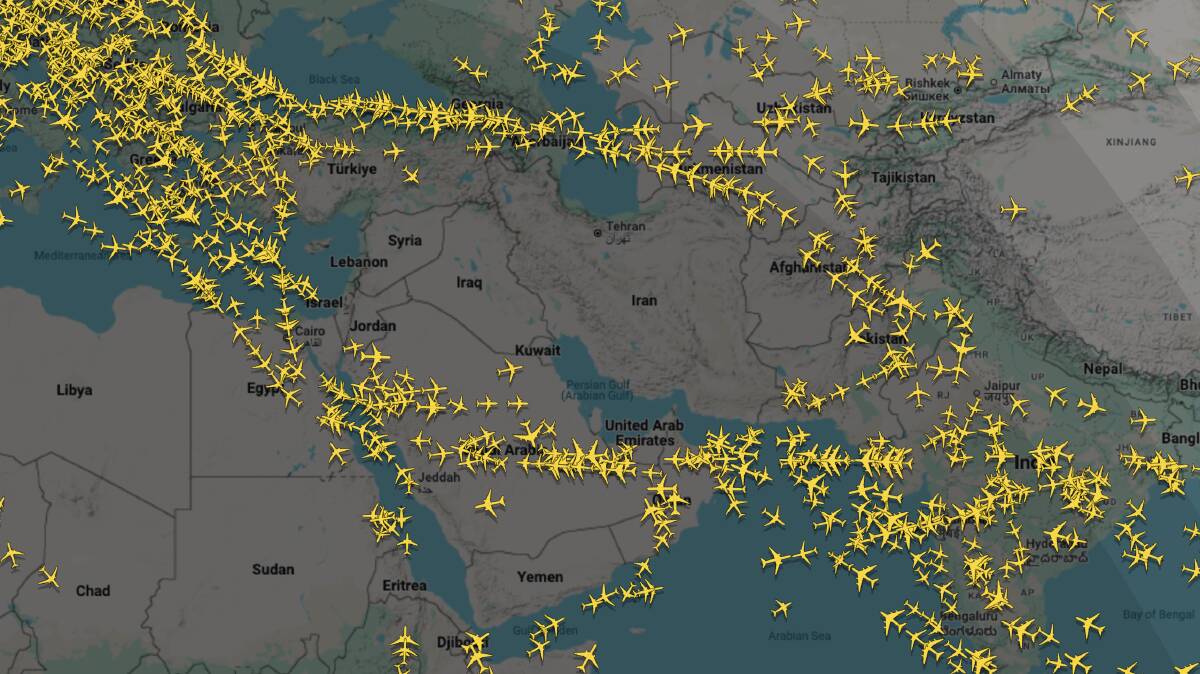
How Middle East flight disruptions are pushing fares higher
The geographic footprint of the problem is unusually wide. EASA’s current conflict-zone bulletin covers affected airspace across Bahrain, Iran, Iraq, Israel, Jordan, Kuwait, Lebanon, Oman, Qatar, the United Arab Emirates and part of Saudi Arabia. That means this is no longer a narrow Israel-Iran aviation issue; it is a corridor problem that reaches into the transfer networks many long-haul travelers depend on.
Airlines are also dealing with a moving target, not a clean shutdown followed by a clean reopening. Flightradar24’s live aviation updates show intermittent closures and partial reopenings, with relief flights increasingly using Oman while airlines keep adjusting around missile and drone threats. For network planners, that kind of stop-start airspace access is costly because it makes crews, aircraft rotations and connection banks harder to trust from one day to the next.
The financial hit is already visible in ticket prices. Reuters reported in a March 9 analysis of airline costs and fares that some airfares had jumped to seven times what they were a week earlier, while some jet fuel prices had doubled since the conflict began. The same report said more than 40,000 flights to and from the Middle East were canceled between Feb. 28 and March 9, creating a global squeeze on long-haul seat availability.
For Indian carriers, the detours are especially punishing because they are juggling Middle East restrictions alongside the continuing loss of Pakistani airspace. In a Reuters report on IndiGo and Air India, the two airlines were said to have failed to operate 64% of their 1,230 scheduled flights to the Middle East, Europe and North America from Feb. 28 to March 9. IndiGo has been routing U.K. flights via Africa, while Air India has added stops to some North America services, a reminder that every extra hour in the air compounds fuel, crew and schedule costs.
Passengers are feeling that pressure in real time. A Reuters travel dispatch from Sydney and London described travelers paying thousands more, switching to routings through Hong Kong, Singapore and South Africa, or canceling altogether rather than risk being stranded in Gulf hubs. When Emirates, Qatar Airways and Etihad slow down, even travelers who never planned to stop in the Middle East end up paying more because alternative one-stop options disappear quickly.
Why airlines cannot simply flip the network back on
Even when an airspace closure is lifted, airlines do not snap back to normal. Aircraft are parked in the wrong places, crews have timed out or been repositioned, and flight plans need to be rebuilt around conservative safety assumptions. Some services need extra fuel, some need refueling stops, and some are dropped altogether because the economics of a longer path no longer work at the original fare.
That is why the first improvement travelers usually see is not cheaper tickets. It is simply a reduction in chaos. Airlines tend to restore reliability before they restore bargain pricing, especially when oil is elevated and insurers, airports and air navigation providers are all pricing in more risk.
Middle East flight disruptions are becoming a recurring aviation risk
This shock did not arrive in a vacuum. Airlines were already rerouting after the April 2024 diversions after an Israeli attack on Iran, coping with the Oct. 2, 2024 wave of delays and cancellations across regional airports, and scrambling again during the June 2025 rescue-flight scramble after U.S. strikes on Iran. The through-line is clear: every flare-up narrows route options, raises operating costs and leaves the next disruption harder to absorb.
That continuity matters because airlines now plan around the possibility that Middle East airspace will be unstable more often, not less. The result is a structural premium on flexibility: larger fuel buffers, more conservative scheduling, more spare crews and fewer assumptions that a Gulf connection will run exactly as advertised.
What comes next for travelers
Unless the region stabilizes quickly, Middle East flight disruptions will keep acting like a tax on long-haul travel. Travelers should expect fewer bargain fares, longer total journey times and more last-minute schedule changes, while airlines keep trading convenience for resilience until safer, more predictable corridors reopen.


