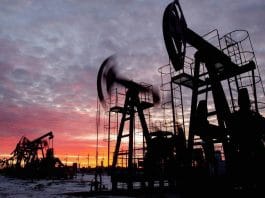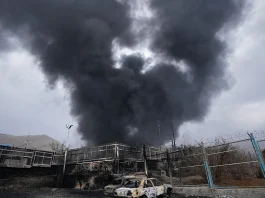

NEW YORK — Oil prices surged and global stocks turned lower Thursday after President Donald Trump said the United States would keep hitting Iran for another two to three weeks, reigniting fears that a longer conflict could further disrupt energy flows through the Strait of Hormuz. The reversal wiped out much of Wednesday’s relief trade because investors heard no clear ceasefire pathway, no timetable for restoring shipping and fresh hints of strikes on energy infrastructure, April 2, 2026.
In the White House recap of the prime-time address, Trump said U.S. forces were “on track” to complete their objectives soon but also warned Iran would be hit “extremely hard” over the next two to three weeks. That mix of promised escalation and a vague endgame was enough to put traders back into defense mode.
Why oil prices jumped again after Trump’s Iran speech
According to Reuters’ report on Thursday’s crude rally, Brent rose 8.2% to $109.50 a barrel while U.S. West Texas Intermediate climbed 9.2% to $109.35, both the biggest one-day gains in three weeks. The market focused less on Trump’s claim that the campaign was nearing completion and more on the lack of concrete detail around how shipping would normalize through Hormuz.
The move also looks more durable than a headline spike because the disruption is spilling deeper into physical oil pricing. In a Reuters report on the Dubai benchmark, the price marker used to value nearly a fifth of global crude supply was described as being under severe strain as Gulf cargoes tied to Hormuz become harder to load, hedge and price. That matters because traders are no longer reacting only to rhetoric; they are reacting to a market that is getting harder to price in real time.
Why oil prices and stocks moved in opposite directions
Higher crude is usually bad news for broad equities because it raises the risk of hotter inflation, tighter financial conditions and weaker consumer spending. AP’s report on the global market sell-off said Asian indexes fell sharply after the speech, with Japan’s Nikkei down 2.4% and South Korea’s Kospi off 4.5%, while U.S. futures also pointed lower.
On Wall Street, the split was even clearer. Reuters reported before the bell that Dow futures were down 1.07%, S&P 500 futures 1.24% and Nasdaq 100 futures 1.6%, even as Exxon Mobil and Chevron rose in premarket trading. That is the classic oil-shock pattern: producers can catch a bid, but airlines, transport names, consumer shares and rate-sensitive growth stocks feel the pressure almost immediately.
Oil prices have been whipsawed before — but this move feels stickier
The reversal was especially sharp because the market had just leaned the other way. Reuters reported on Wednesday that Brent settled at $101.16 after Trump said the U.S. could be out of Iran “pretty quickly,” and another Reuters dispatch from March 25 captured a similar swing when guarded ceasefire hopes lifted stocks and pushed oil lower.
There is also a longer historical echo. After the U.S. strike that killed Iranian commander Qassem Soleimani, Reuters reported in January 2020 that Brent climbed 3.6% as traders priced in the risk of a wider Middle East confrontation. The difference now is scale: today’s market is dealing not just with geopolitical headline risk, but with a live squeeze on supply routes, damaged confidence in benchmark pricing and the possibility that even a ceasefire would not restore flows quickly.
What to watch next for oil prices
The next test is whether physical flows improve faster than the rhetoric. Traders will be watching for any sign that Hormuz traffic normalizes, whether OPEC+ can add barrels quickly enough to matter and whether Washington or its partners can produce a credible diplomatic off-ramp. Until that happens, oil prices look set to stay highly sensitive to every speech, tanker incident and policy signal coming out of the Gulf.