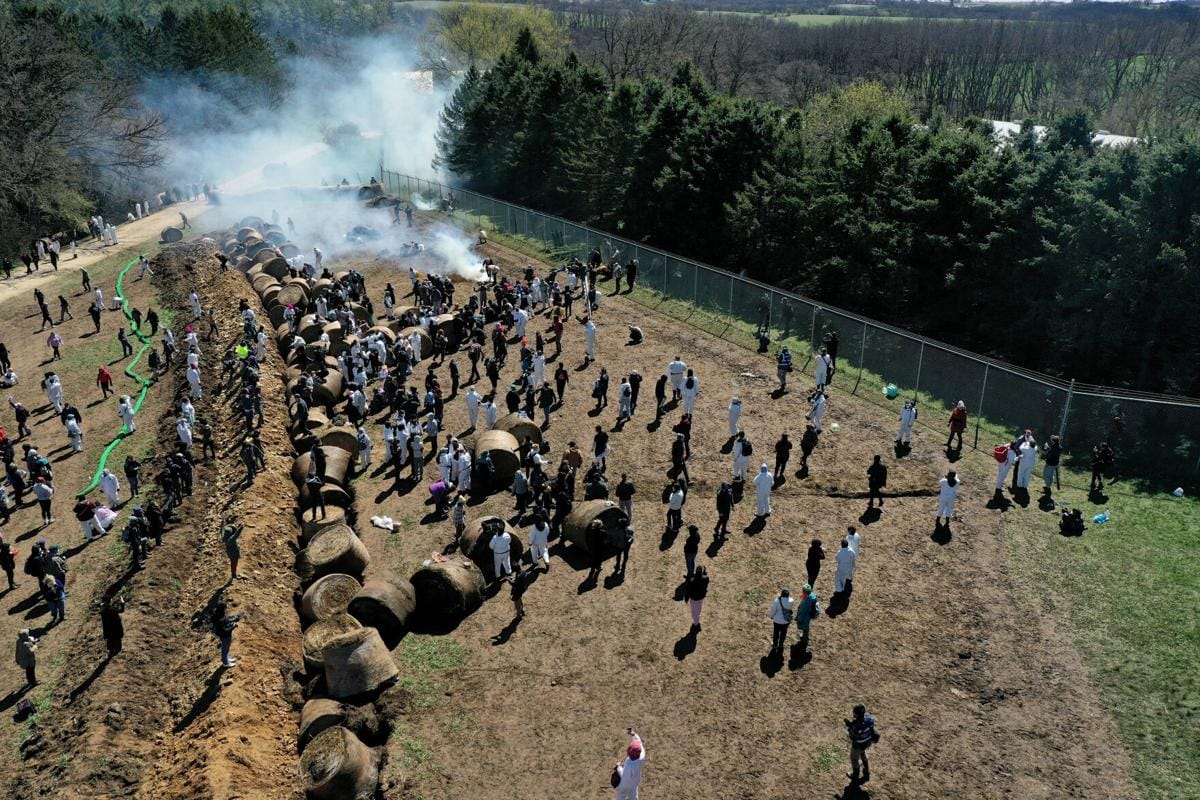
The latest flashpoint came on April 18, 2026, when about 1,000 animal welfare activists converged on the beagle breeding and research facility in the town of Blue Mounds. The confrontation escalated as law enforcement used tear gas, pepper spray, pepper balls and less-lethal munitions while protesters tried to enter the property. The Associated Press reported that police said 29 people were arrested after activists attempted to free an estimated 2,000 beagles held at the site, while local reports placed the total at around or at least 25 arrests during the initial weekend coverage. AP’s report on the Capitol protest and arrest count placed the standoff in a broader political context after activists demanded action from Gov. Tony Evers and Attorney General Josh Kaul two days later.
Ridglan Farms Deadline Puts July 1 at the Center of the Beagle Standoff
The reason the confrontation has become so urgent is the July 1, 2026 deadline. Ridglan Farms previously agreed to surrender its state license to sell dogs as part of a settlement meant to avoid criminal prosecution tied to animal mistreatment allegations. That settlement does not automatically mean all dogs will be released to rescue groups, and local officials have emphasized that the facility remains subject to state and federal licensing structures until the deadline.
In a March 25 update, Dane County said Ridglan Farms is licensed by the Wisconsin Department of Agriculture, Trade and Consumer Protection and the U.S. Department of Agriculture, and that the facility agreed to surrender its state license to sell dogs effective July 1, 2026. The county also said that until that date, Ridglan is legally permitted to sell its remaining dogs and continue operating under federal classifications as a breeder and research facility. Dane County’s official Ridglan Farms update made clear that local law enforcement says it does not have authority to simply seize or redistribute the beagles.
That gap between what activists want and what officials say they can legally do is driving the confrontation. Animal rights organizers say the dogs should be placed in homes or rescue care before they are sold or transferred elsewhere. Ridglan Farms, meanwhile, has denied mistreating animals and has said its work supports biomedical and veterinary research.
Police Say Protesters Tried to Breach the Property
The Dane County Sheriff’s Office said deputies responded at 8:52 a.m. on April 18 after approximately 1,000 activists arrived at Ridglan Farms. According to the sheriff’s office, the action had originally been publicized for April 19 but was moved up by organizer Wayne Hsiung after a meeting that morning.
Officials said they used an LRAD warning system to tell protesters they would be subject to arrest if they trespassed on marked private property. The sheriff’s office said hundreds of people attempted to break through barriers and fencing, while others blocked roads and slowed emergency response. In its statement, the office said Hsiung was arrested within minutes based on probable cause for conspiracy to commit burglary, and that force escalated from warnings to tear gas, less-lethal 40mm munitions and pepper balls as some protesters continued trying to enter the facility. The Dane County Sheriff’s Office account of the April 18 response also said a vehicle drove through the property before law enforcement stopped the driver.
Activists dispute the framing. They describe the action as an “open rescue” and argue that the beagles face ongoing harm. Law enforcement and Ridglan Farms have described the attempted entry as unlawful, dangerous and disruptive. Because criminal cases are now moving through the courts, the legal language matters: people arrested or charged remain accused unless convicted.
Felony Cases Add a New Legal Risk for Activists
The April 18 confrontation did not end at the fence line. Prosecutors have since moved forward with cases against several activists. FOX6 Milwaukee reported that five animal rights activists faced court after what prosecutors described as a coordinated attempt to take 2,000 beagles from Ridglan Farms. Four were charged with felony conspiracy to commit burglary, and a fifth was expected to be charged, according to that report. FOX6’s report on the Ridglan Farms activist charges said defendants were ordered not to contact the farm and were banned from entering the Town of Blue Mounds.
The cases are likely to test competing narratives: prosecutors are expected to focus on trespass, burglary allegations, property damage and public safety, while activists are expected to argue that they were acting to protect animals they believe are in danger. The court process will determine how far those arguments can go.
Older Ridglan Farms Coverage Shows This Fight Has Been Building for Years
The April 18 standoff did not come out of nowhere. In January 2025, Wisconsin Public Radio reported that Dane County Judge Rhonda Lanford ordered the appointment of a special prosecutor to investigate animal abuse allegations at Ridglan Farms after former employees testified about alleged procedures on dogs without pain medication or anesthesia. That earlier WPR report on the special prosecutor decision showed how the dispute had already moved from activism into the courts long before the April 2026 raid.
By September 2025, the scrutiny had widened. WMTV reported that Ridglan Farms refused to settle a $55,000 civil forfeiture tied to hundreds of alleged state animal welfare violations, sending the matter toward possible legal action. The WMTV report on the refused animal welfare fine added another layer to the public record around inspections and enforcement.
Then, in December 2025, the American Veterinary Medical Association reported that Ridglan Farms would no longer supply dogs for research after the settlement requiring it to surrender its state license by July 1, 2026. The AVMA’s coverage of the license surrender agreement helped explain why the July deadline became the central date in the current dispute.
The direct-action phase accelerated on March 15, 2026, when dozens of activists entered Ridglan Farms and removed beagles. FOX6 reported that the self-described rescuers got away with beagles and that the sheriff said about half of the activists were detained or arrested. FOX6’s March report on the earlier Ridglan Farms break-in provides important context for why law enforcement expected another high-risk confrontation in April.
Use-of-Force Allegations Now Put Police Under Scrutiny
The April 18 response has also opened a separate controversy over law enforcement tactics. Activists have accused officers of using excessive force, citing chemical irritants, rubber bullets and other crowd-control weapons. The sheriff has defended the response as appropriate given the number of people trying to breach the facility and the risks posed to officers, staff and emergency access.
On April 24, 2026, Isthmus reported that activists filed a federal class-action lawsuit against Ridglan Farms, Sheriff Kalvin Barrett and Dane County Executive Melissa Agard, alleging excessive force and constitutional violations tied to the April 18 protest response. Isthmus’ report on the excessive-force allegations said the lawsuit challenges the use of tear gas, rubber bullets and other less-lethal munitions.
Those allegations have not been resolved in court. Still, they add another legal front to a conflict that already includes animal welfare claims, licensing questions, criminal charges against activists and pressure on state officials.
What Happens Next for Ridglan Farms and the Beagles?
The immediate question is what happens before July 1. Activists want state leaders to intervene, investigate or negotiate a plan to release the dogs into homes and rescue networks. Officials have been more cautious, citing ongoing legal matters, licensing limits and questions of authority. Ridglan Farms continues to deny mistreatment and argues that activists have spread misleading claims and endangered staff and public safety.
For readers, the stakes are straightforward: roughly 2,000 beagles remain at the center of a shrinking timeline, and every side is now using a different system to press its case. Activists are using protests, lawsuits and public pressure. Law enforcement is using arrests and criminal referrals. Ridglan is relying on its licenses, settlement terms and legal rights. State officials are being pushed to explain what authority they have before the July deadline arrives.
What began as a dispute over a research dog breeder has become a broader Wisconsin test case over animal welfare enforcement, protest tactics, police force and whether a legal settlement can satisfy the public demand to know where the dogs will go.