

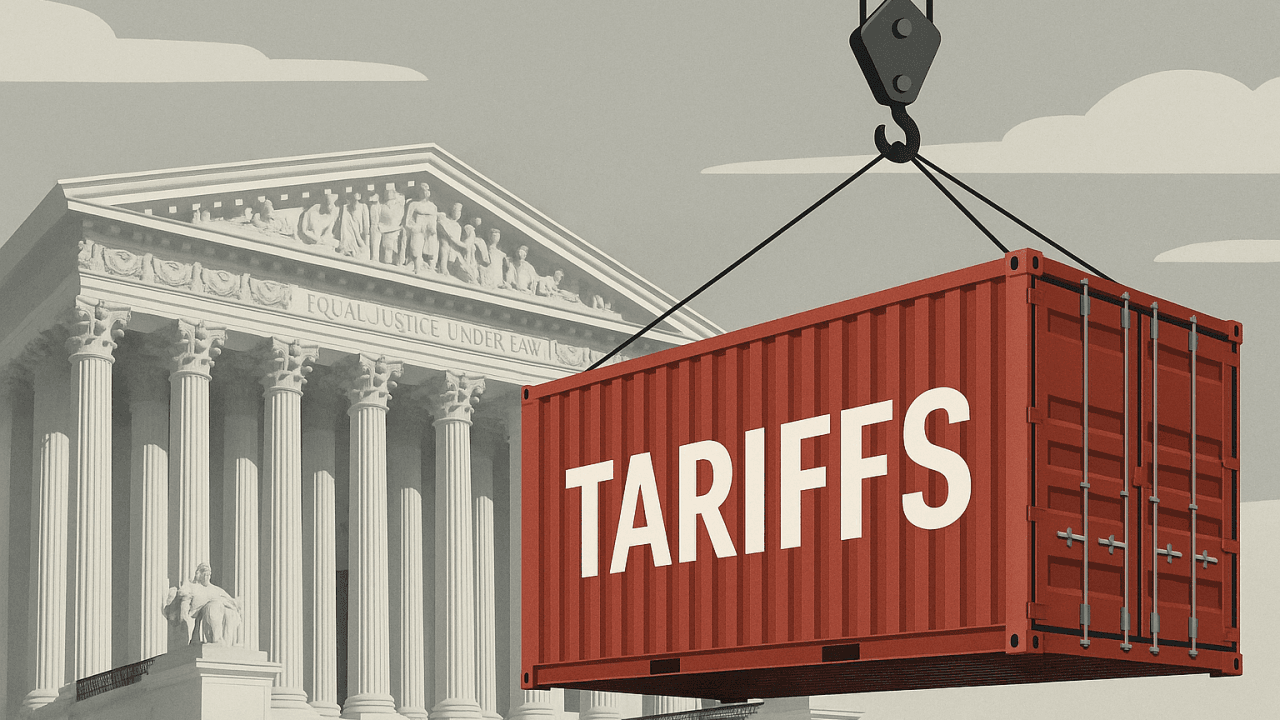
WASHINGTON — The Supreme Court on Friday struck down a broad set of President Donald Trump’s emergency import taxes imposed under the International Emergency Economic Powers Act, a ruling that upended a cornerstone of his trade agenda and left investors reassessing when the Federal Reserve can safely begin cutting interest rates again. Trump moved within hours to replace the void with a new, temporary 10% global duty and a fresh round of trade probes, keeping the inflation outlook — and rate-cut bets — in flux, Feb. 20, 2026.
How the Supreme Court tariffs ruling reshaped Trump’s trade options
The Supreme Court tariffs decision, issued in Learning Resources, Inc. v. Trump, held 6-3 that the International Emergency Economic Powers Act does not authorize the president to impose tariffs of the scale and duration Trump ordered. Chief Justice John Roberts wrote that Congress holds the constitutional power to set “Duties” and that IEEPA — a statute aimed at emergency economic sanctions — cannot be treated as a blank check for revenue-raising import taxes. (Supreme Court opinion)
Markets initially treated the Supreme Court tariffs ruling as an inflation-positive surprise: fewer levies on imports can ease price pressures over time. But the relief was short-lived as the White House signaled it would keep tariffs central to trade negotiations, deficit reduction and supply-chain policy.
In a separate proclamation, Trump invoked Section 122 of the Trade Act of 1974 — a rarely used authority that allows temporary, across-the-board import surcharges of up to 15% for no more than 150 days — to impose a 10% ad valorem “import surcharge,” effective Feb. 24, 2026, while carving out a long list of exclusions. Those exclusions include some autos and parts, certain pharmaceuticals, and duty-free goods from Canada and Mexico that meet USMCA rules. (White House proclamation)
The pivot matters because Section 122 is designed as a short-term bridge. Trump also ordered new investigations under Sections 301 and 232, processes that can lead to longer-lasting duties if the administration determines foreign practices are unfair or imports threaten national security.
Supreme Court tariffs and Fed rate cuts: why futures traders are split
For the Fed, the Supreme Court tariffs turbulence is less about the legal theory and more about the economic timing. Policymakers have spent the past year trying to untangle how much of the inflation pulse in goods prices was a one-time tariff shock — and how much would persist as companies rewrote supply chains, repriced inventory and negotiated contracts.
That is why interest-rate futures briefly seesawed between expectations that the Fed could resume rate cuts as soon as June — if tariff-driven inflation fades — and bets that officials could wait until July or later if tariffs return in a different form. In remarks that captured the uncertainty, Atlanta Fed President Raphael Bostic raised practical questions about what happens next: “Is there a requirement to pay back the firms that have paid in?…If so, that’s a lot of disruption,” he said. (Reuters report on the Fed outlook)
St. Louis Fed President Alberto Musalem struck a similar note, saying the transition itself could weigh on business confidence even if the overall tariff level ends up roughly unchanged. If replacement duties are “essentially one-for-one,” Musalem said, his forecast “would not change much,” but the switch could “introduce a period of uncertainty” for companies that must quickly adjust pricing and sourcing plans.
Investors tracking those shifts lean heavily on the futures market for clues. The CME FedWatch Tool has become a common gauge for how traders are pricing the odds of a cut at upcoming Fed meetings as tariff headlines reshape the inflation narrative.
Refunds are the wildcard in the Supreme Court tariffs aftermath
Even if Trump succeeds in replacing most of the lost tariff revenue, the ruling leaves a costly open question: refunds. Economists at the Penn Wharton Budget Model estimate that reversing the IEEPA tariffs could generate up to $175 billion in refunds, depending on how the lower courts handle claims and how quickly the government stops collecting the invalidated duties.
Treasury Secretary Scott Bessent has said the legal fight over refunds could take “weeks, months, years” to resolve — a timeline that helps explain why bond investors and corporate treasurers are treating the Supreme Court tariffs case as a fiscal and cash-flow risk, not just a trade-policy dispute. Some importers have already explored ways to monetize possible refund claims, while others are modeling whether they can unwind price increases that were built around last year’s duties.
That potential outflow matters for markets that are already sensitive to fiscal risk. A large refund tab could widen near-term deficits and nudge borrowing costs higher — a dynamic that can tighten financial conditions even without a Fed move, complicating the central bank’s decision on whether inflation is truly cooling.
A familiar pattern: tariffs, courts and the Fed collide again
The current Supreme Court tariffs fight fits a long-running pattern in which trade policy repeatedly bleeds into monetary policy. In 2018, Fed Chair Jerome Powell said it was “too early” to know how tariff threats would affect the economic outlook as the first Trump-era trade salvos rattled markets. (Reuters, April 2018)
By 2019, tariff uncertainty had become a central part of the Fed’s “crosscurrents” debate. When the Fed cut rates for the first time since 2008, Powell cited global weakness and “simmering” trade tensions in explaining the shift. (Reuters, August 2019)
And in 2025, Trump’s “Liberation Day” program revived the idea of a 10% baseline tariff while threatening far higher rates for certain partners — a blueprint that now sits at the center of the Supreme Court tariffs dispute and the White House’s Plan B. (Reuters graphic, April 2025)
What happens next after the Supreme Court tariffs shock
In the near term, traders and corporate executives are watching three moving targets: how quickly Customs will implement the court ruling, whether the new 10% global duty survives early legal challenges, and how aggressively the administration pursues additional, longer-lasting tariffs through other statutes.
For the Fed, the key question is whether the Supreme Court tariffs reversal reduces inflation fast enough to justify earlier cuts — or whether policy uncertainty and replacement levies keep inflation sticky and growth choppy. Either way, the ruling has added another variable to a rate path that investors thought was finally coming back into focus.


