

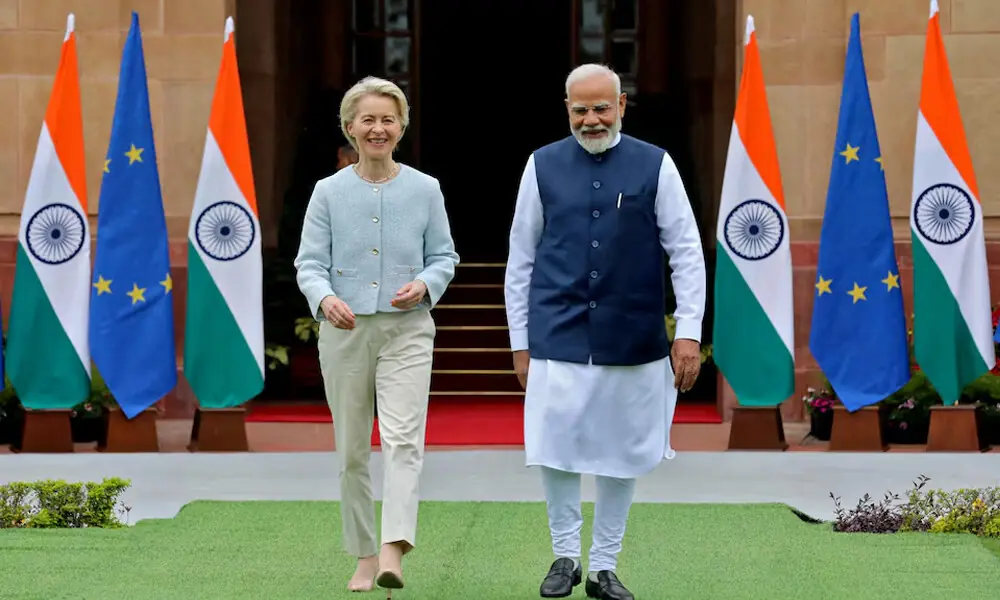
NEW DELHI — India and the European Union on Tuesday said they have concluded negotiations for a wide-ranging free trade agreement that will cut tariffs on most goods traded between them and open India’s market further to European cars and wine. Leaders cast the India-EU trade deal as an economic and geopolitical hedge against rising tariff barriers and supply-chain disruptions, though the agreement must still clear legal vetting and ratification before it takes effect, Jan. 27, 2026.
In the initial tariff schedules, Reuters reported, India will eliminate or reduce tariffs on 96.6% of EU goods by value and is set to phase down duties on eligible EU cars to 10% over five years. The EU will cut tariffs on 99.5% of goods imported from India over seven years, and officials said European companies stand to save about 4 billion euros a year in duties.
European Council President António Costa called the conclusion of negotiations a “historic moment” and said it opens a new chapter in trade, security and people-to-people ties, in a summit statement.
What the India-EU trade deal changes for consumers and exporters
Cars: Duties on qualifying EU passenger vehicles are set to fall to 30%–35% when the deal starts and then to 10% within five years, with preferential rates limited to 250,000 vehicles a year and excluding models priced below 15,000 euros.
Wine and spirits: Wine duties will drop from 150% to 75% at launch and then gradually as low as 20% for some products; duties on spirits will be cut to 40%.
EU concessions: Tariffs are expected to move toward zero on major Indian exports such as textiles, leather, chemicals and gems, while sensitive farm goods including soya, beef, sugar, rice and dairy are excluded.
In an official factsheet, India’s Ministry of Commerce and Industry said Indian exporters will gain preferential access across 97% of EU tariff lines, covering 99.5% of India’s export value, with immediate duty elimination for large shares of labor-intensive sectors such as textiles, leather and footwear.
The EU’s trade policy overview said the agreement could potentially double EU goods exports to India by 2032 and includes tariff reductions for products such as wine, olive oil and machinery.
Next steps for the India-EU trade deal
Officials on both sides say the text will undergo “legal scrubbing” before formal signature and ratification—a process that can take months and still requires political approvals in India and Europe. India has also sought flexibility as the EU’s carbon border levy rolls out, while the EU has pledged 500 million euros over two years to support India’s greenhouse-gas reductions.
India-EU trade deal timeline: A stop-start path to 2026
The breakthrough follows nearly two decades of stop-start talks. Negotiations were frozen in 2013, and the two sides began laying groundwork to restart them in 2021, according to a 2021 Reuters report. The EU and India formally relaunched negotiations in mid-2022, Reuters wrote, and by 2025 both sides publicly reaffirmed a year-end target to finish the talks, Reuters reported.
Even if the India-EU trade deal enters into force within the next year, businesses and consumers will be watching how quotas, rules of origin and non-tariff barriers are applied in practice—and whether the tariff cuts translate into lower prices and faster export growth.


