

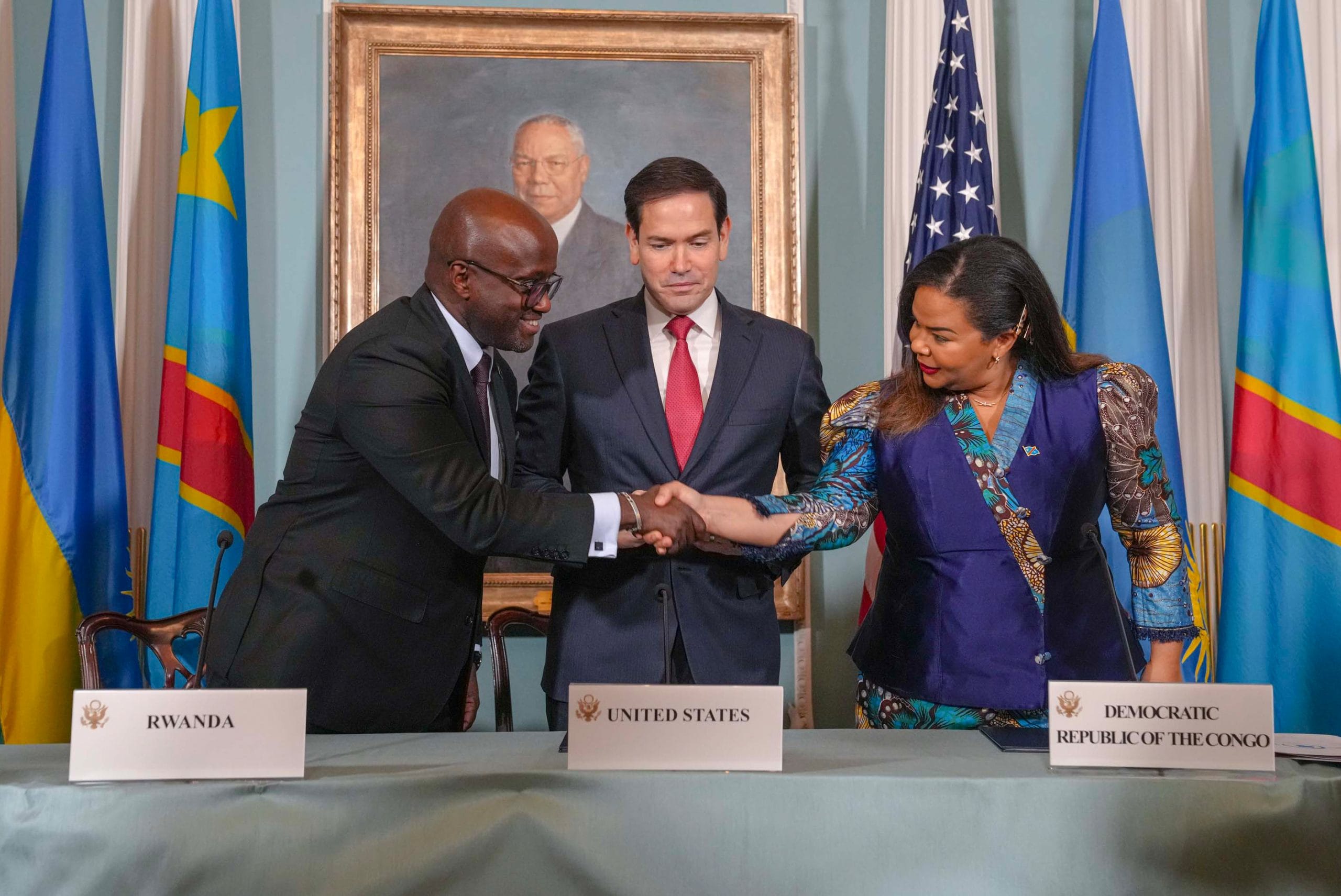
WASHINGTON — Democratic Republic of Congo President Félix Tshisekedi and his Rwandan counterpart, Paul Kagame, are expected to arrive in town soon for a U.S.-negotiated peace deal at the White House between the Congo and Rwanda, Dec. 4, 2025. The summit is intended to secure commitments for a Rwandan troop withdrawal from eastern Congo and a joint offensive against the Democratic Forces for the Liberation of Rwanda, or FDLR, on Monday, Dec. 1, 2025.
What the Congo-Rwanda peace deal involves
The Dec. 4 signing will confirm the Washington Accord, which was initially agreed to in June by Congolese and Rwandan foreign ministers, as well as last month’s framework for regional economic integration. Cumulatively, those texts obligate the neighbours to withdraw Rwandan forces within months, dismantle the FDLR and other non-state armed groups, pursue a combined security-coordination mechanism, and open the mineral-rich region to major-scale Western investment.
But the ceremony takes place against a grim backdrop on the ground. M23 Insurgents still control vast stretches of territory in eastern Congo, and U.N. experts have said it is de facto under Rwandan military command. The fighting in North and South Kivu has claimed thousands of lives and uprooted hundreds of thousands from their homes this year, emphasizing how tenuous any Congo-Rwanda peace deal will be after those leaders leave Washington.
According to the deal, Kinshasa and Kigali will plan joint operations to “neutralise the threat” from the FDLR — a Hutu militia based in Congo that traces its roots back to Rwanda’s 1994 genocide — while Congo’s army withdraws support for that group and other proxies. That same security plan is also meant to verify and track the withdrawal of Rwandan soldiers from Congolese territory, something Tshisekedi has presented as a nonnegotiable condition in exchange for genuine regional integration.
So far, implementation has lagged. Despite a vow in September to finalise key security commitments by year’s end, diplomats and analysts say there has been “no meaningful headway” on either the total troop pullout or the FDLR disarmament. The United States and Qatar have responded by stepping up shuttle diplomacy, even as the joint oversight bodies established under the deal push both sides to move faster before another deadline passes.
A fragile breakthrough after a long, rocky road
The Dec. 4 gathering is the culmination of months of diplomacy, handshakes and baby steps. In April, Congo and Rwanda used an initial U.S.-brokered deal in Washington to pledge a draft peace deal by early this month and to jointly pledge to stop supporting armed groups — evidence that both governments were prepared to tie security cooperation to future American investments in tantalum, gold and other minerals. The April pathway agreement set the stage for the current framework.
On June 27, the two foreign ministers returned to Washington and signed an agreement that became known as the Washington Accord, once more with Trump and Rubio serving as their hosts. The deal committed both sides to respecting territorial integrity, forcing Rwandan troops to withdraw within 90 days and guaranteeing an “irreversible and verifiable” end of support for militias like the M23 rebel group as well as FDLR genocide perpetrators — with a view to signing up to a regional economic framework tying Western critical-mineral supply chains in the region. At the time of that June signing, a Reuters report described it as a landmark and cautioned that the real test would be its implementation.
Since then, analysts have portrayed the Congo-Rwanda peace deal as both an opening and a roll of the dice. In an analysis in July by the U.S. Institute of Peace, experts said that the accord could be a “first step toward regional peace” and a way to help diversify American access to key minerals, but that more than 100 armed groups, proxy warfare, and ingrained illicit economies could still frustrate the process. Their bottom line: the success of the agreement will hinge on whether a promised economic “peace dividend” outweighs deep-rooted reasons to keep fighting.
Trump has cast the U.S. as a mediator and investor in peace: He has often advertised potential “billions” in future mining and infrastructure contracts if the guns go silent. For their part, Congolese officials have been open to deeper ties with U.S. and other Western companies as a counterbalance to China’s overwhelming dominance of the copper- and cobalt-rich belt, even as they insist that sovereignty and the full resumption of state authority in the east are nonnegotiable red lines.
Based on a report by Reuters last week, Tshisekedi and Kagame are reportedly slated to sign off on both the security agreement and the economic plan with Trump present, even though critical details — such as that stipulating what shall become of M23 as well as a timeline for disarming FDLR – need to be ironed out. The White House and regional peacemakers note that the signing could still cement pressure and incentives. Still, they admit that the real evidence of whether the Congo-Rwanda peace deal is working will be whether people in eastern Congo see fewer fighters, are safer, and find their way back home from displacement camps in the months ahead.


