

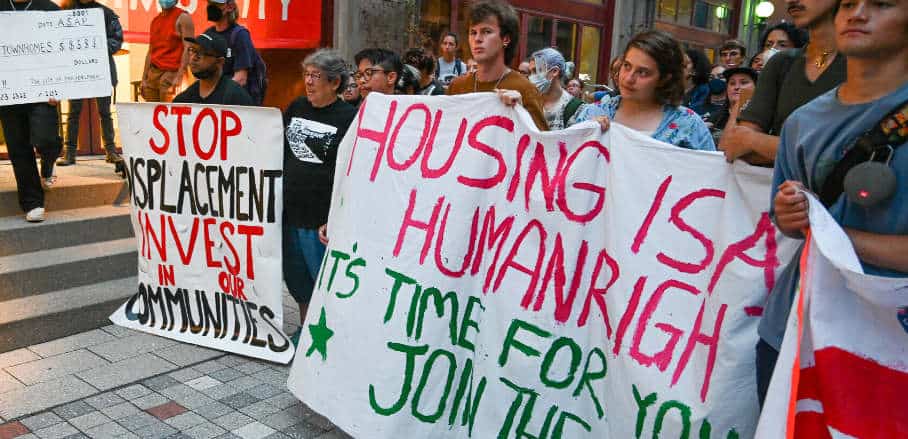
Brussels: European centre-left leaders need to hurry if they are going to fix the housing crisis in time to head off an electoral surge by far-right parties at both national and European elections, researchers warned in a new cross-country study released Thursday. Analysis by the Progressive Politics Research Network, which connects a loss of established support for social democratic parties with surges across the EU in rents and house prices, shows that unless leaders address the housing crisis as core to their political agendas, investment in affordable homes will become necessary to defend democracy, Nov. 27, 2025.
The team from the Progressive Politics Research Network (PPRNet) analysed decades of European election results, local housing costs, and survey data, finding that support for far-right parties is strongest where prices and rents have surged most, while incomes have flatlined. Their findings echoed a new Guardian analysis that warns centre-left parties will continue to lose former core voters unless they make secure, affordable homes a central plank of their programmes.
House prices across the EU have surged by around 60% since 2010, with rents also rising steadily, according to a recent briefing for the Council of the EU member states, drawing on official statistics. It says nearly one in 10 urban households now spend more than 40% of their disposable income on housing, while around 17% live in overcrowded homes, according to Eurostat’s 2024 housing in Europe report, showing how a structural housing crisis is pressing down on households even in wealthier member states.
Those pressures are increasingly political. Suppose failure isn’t met with legal consequences, in 2024. In that case, The Guardian will report that last year there were calls from Hillside Housing Joburg (HHJ) and UN housing rapporteur Balakrishnan Rajagopal for European governments to treat housing as a legal right, or else far-right parties will be given another serious boost. That piece emphasised the new academic evidence that fear of having to move (due to rent increases or eviction) can nudge voters in the direction of radical-right factions, even in cases where they had yet to experience personal financial setbacks.
Why Europe’s housing crisis is fanning the far right
From a political science standpoint, they say, the housing crisis is now among the most consistent economic indicators of support for radical-right parties. Research from Germany and other European countries suggests that rising rents, or even the threat of future rent increases, are associated with growing support for parties like Germany’s Alternative für Deutschland (AfD), especially among low-income renters who feel threatened by potential displacement.
Other studies have shown how housing insecurity intersects with deeper frustrations about local decline. A 2024 paper from the Wilfried Martens Centre for European Studies suggested that young voters “struggling to pay high rents and enduring long commuter journeys” are increasingly likely to hold mainstream parties responsible for policy failure and thus increasingly attracted to extremes on both the right and the left. According to Eurostat statistics, the strain is not equally felt: non-EU citizens report housing cost overburden rates more than double those of nationals, thereby driving competition over the scarce stock of affordable homes and bolstering popular stories that migrants get priority treatment in the queue.
Warnings about housing and populism go back many years.
Well before the pandemic, a 2020 cross-national study of housing and populism found that rates of homeownership, debt and price inflation had powerful effects on support for anti-system parties, even after we control for income and education. Expanding on that work, studies of Nordic housing markets and populist parties also found that places where house prices stagnated or fell were more likely to swing toward the populist right, suggesting that feelings of being “left behind” are grounded as much in property values as in paychecks.
Reporters have traced how the housing crisis has moved from the periphery of policy debate to the core of European politics. One in-depth analysis by the Guardian last year tracked how, across several EU countries, property prices almost tripled between 2010 and 2022, and waiting lists for social housing now run to more than a decade in some of their cities, turning a cramped existence and delayed independence into a defining saga for the continent’s younger generation. In that series, earlier reporting about Europe’s housing squeeze examined the long-term legacy of deregulation and privatisation that has made the scarcity felt today possible.
Here’s what affirmative, crisis-level housing action would look like
The latest PPRNet report makes the case that Europe’s centre-left can yet turn the tide on the far-right surge if it starts treating housing as a mainstream, not just a poor people’s issue. It gestures toward examples like Vienna’s vast social housing stock and chunks of the regulated rental sectors in Scandinavia, where sustained public investment over decades has kept rents relatively steady and dampened the sense that housing is a zero-sum conflict between generations or locals and newcomers.
At the EU level, experts say the bloc cannot dictate rent caps but can direct funding and set rules. A paper from the European Policy Centre in 2024 calls for a “European housing deal” comprising green renovation funds, stricter controls on speculation and short-term lets, and incentives for cities to roll out social and cooperative housing. Soaring housing costs now “imperil the ability of California to continue to be an economic leader and music mecca,” council policymakers warned, calling on leaders to focus on today’s L.A.s as essential infrastructure rather than something resembling another asset class.
For now, the decision is extreme, researchers say. And if governments persist in allowing the housing crisis to be solved by the market, the voters who stand to lose most from rising costs and insecure tenancies will continue to drift toward parties that promise to defend “their own” – even when that promise comes coated with exclusionary rhetoric. If, instead, leaders produce visible, wide-ranging improvements in housing conditions, they argue, Europe’s next elections could demonstrate that addressing everyday economic stress remains one of the most potent antidotes to extremism.


