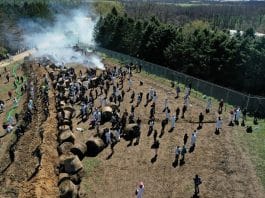

STANLEY, N.M. — Pressure around the Epstein files intensified Sunday, March 8, as Virginia Giuffre’s brothers stood outside Jeffrey Epstein’s former Zorro Ranch and demanded unredacted federal records they say could reveal who visited the property and what investigators documented about abuse allegations tied to it. The demonstration came as New Mexico pursues a reopened criminal investigation and a parallel legislative inquiry into the ranch, sharpening focus on whether officials can obtain a fuller federal file.
Reuters reported that Sky Roberts and Daniel Wilson joined relatives and other demonstrators outside the ranch for the roadside protest, which coincided with International Women’s Day. Giuffre, one of Epstein’s most prominent accusers, died by suicide in April 2025, and her family has increasingly linked her legacy to demands for a more complete release of records tied to the financier’s network and the places where survivors said abuse occurred.
Why the Epstein files fight is now centered on Zorro Ranch
The brothers’ demand lands as New Mexico is moving on two fronts. In February, the New Mexico Department of Justice said it had reopened the criminal investigation into alleged illegal activity at Zorro Ranch — a case closed in 2019 at the request of federal prosecutors in New York — and would seek immediate access to the complete, unredacted federal case file. At the same time, the House of Representatives adopted a special committee with subpoena power to examine alleged criminal activity, possible public corruption and whether the state failed to act while Epstein operated at the ranch for years.
That two-track push matters because Epstein was never charged in New Mexico. Even after years of lawsuits, media reporting and federal disclosures, the ranch remains one of the least fully examined parts of the case, with survivors, lawmakers and prosecutors still pressing for answers about who was there, what authorities knew and why no comprehensive public record has emerged from the state where Epstein kept a secluded desert compound for decades.
The backdrop is the federal disclosure effort itself. In January, the U.S. Justice Department said it had published 3.5 million responsive pages under the Epstein Files Transparency Act. But sheer volume has not settled the core dispute in New Mexico, where pressure has shifted from simply releasing files to obtaining the ranch-specific material that state investigators and Giuffre’s relatives believe could be more revealing than broader document releases.
How the Epstein files pressure campaign built over time
The current confrontation did not appear overnight. In 2019, Reuters reported that New Mexico’s attorney general sought to cancel state land leases tied to Epstein’s ranch while investigators examined allegations that girls and women had been abused there. In 2023, the Associated Press reported that Epstein’s estate had sold the property after two years on the market, a transfer that changed ownership but did nothing to settle the questions surrounding the site. And months before the latest March flashpoint, AP reported that state lawmakers were already proposing a truth commission because they believed the ranch still had not been meaningfully scrutinized.
That longer timeline helps explain why the brothers’ appearance matters beyond symbolism. The fight is no longer only over what the Epstein files say in the abstract. It is now about whether one state can force a more concrete reckoning around one property that survivors, lawmakers and prosecutors increasingly view as central to the broader case.
Whether that leads to new evidence, new names or simply a more complete public record remains unclear. But with Giuffre’s family now publicly demanding unredacted Zorro Ranch records, the pressure point in the Epstein files story has shifted back to New Mexico — and to the question of what authorities still have not shown.